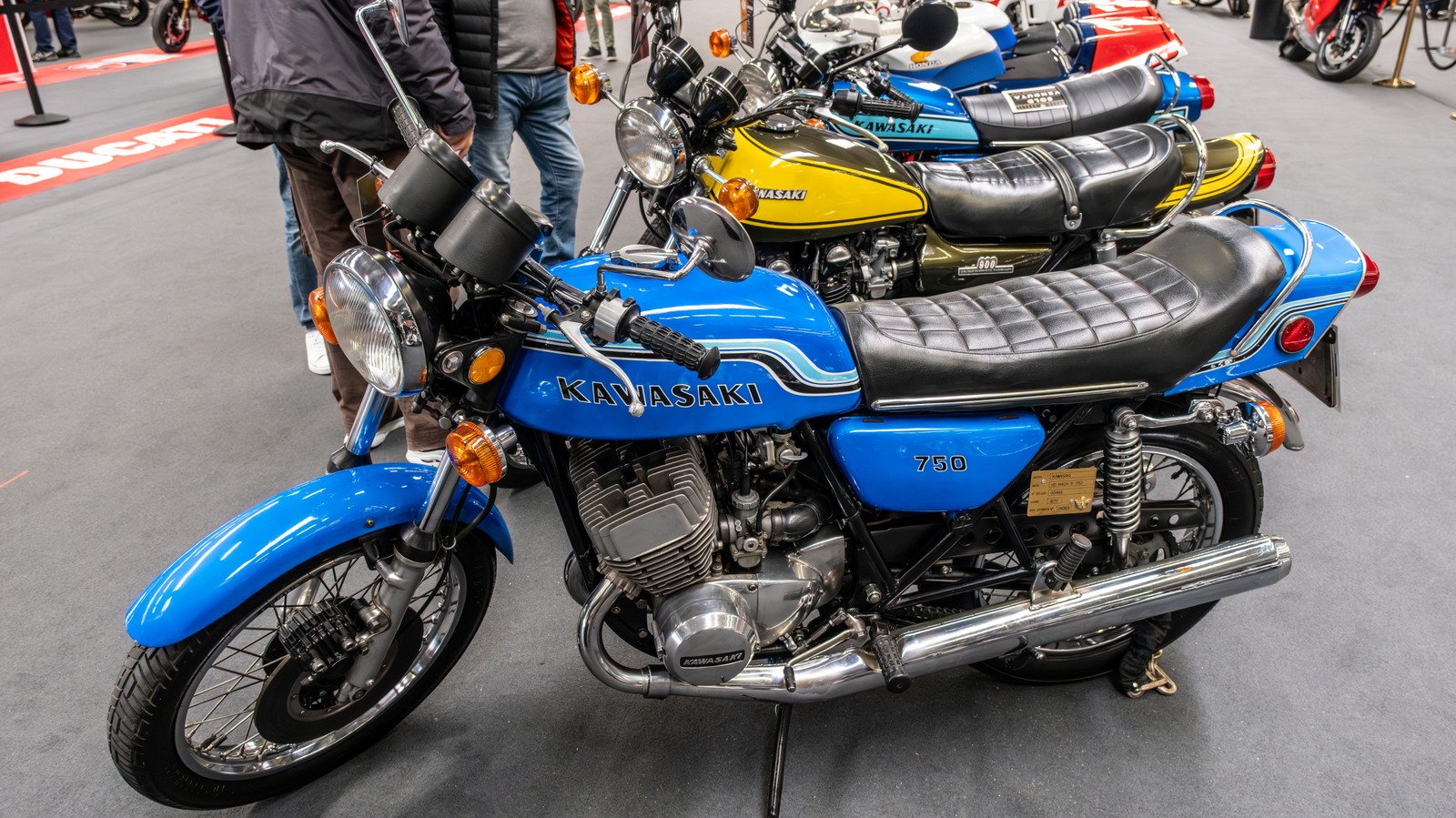
The 1970s were an era when motorcycle manufacturers, intoxicated by the explosion of the superbike market, realized the best way to stay on top was simply to offer an unnatural amount of horsepower, while completely ignoring whether the motorcycle’s chassis or rider could even handle it. Honda provided the world with the smooth, reliable and downright civilized CB750, but Kawasaki looked at that motorcycle and chose violence.
In 1972, the brand released the Mach IV H2 750. It had a 748-cubic-centimeter air-cooled, two-stroke triple engine providing 74 horsepower. Although the numbers may not seem like much, the H2 outpaced the fastest motorcycles of the ’70s when the quarter-mile distance was crossed in less than 12 seconds. Because of its performance, it soon became known as “The Widowmaker”. It’s an ominous name, but still not as good as the Suzuki “Whispering Death” RG500 – the deadliest motorcycle ever sold.
To understand why the early H2 wanted to kill you, you have to understand how a big two-stroke engine delivers power. Unlike a linear four-stroke engine, an aggressive two-stroke engine relies heavily on exhaust tuning. Below 4,000 rpm, the H2 was relatively docile. But as the rev needle moved past that, it offered a sharp surge of acceleration as the torque practically doubled in an instant. If you were mid-corner when the bike reached the powerband, the sudden surge of torque would cause the rear wheel to lose traction or send the frame into a terrifying high-speed wobble. Adding to this effect was the chassis geometry – a light front end, a short wheelbase, and a chassis that bent into corners that routinely spit out riders, reinforcing the H2’s lethal folklore.
How Kawasaki tamed the Mach IV H2 750
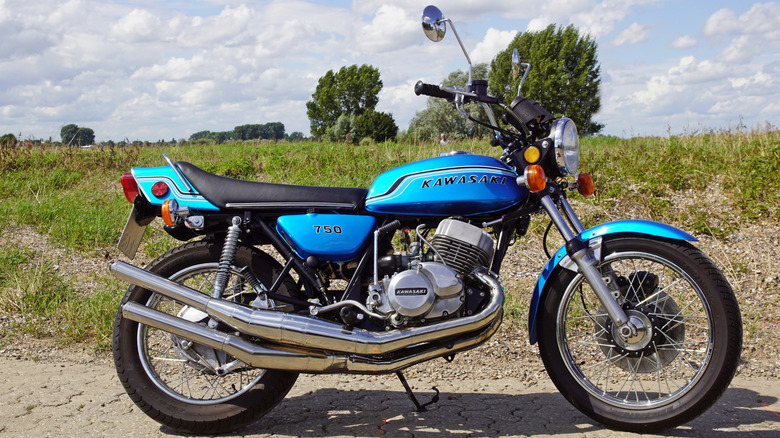
Kawasaki knew that behind the good success of the H2 in the market lay a potential PR disaster. So, for the 1974 model year, the brand’s engineers set to work tweaking the motorcycle. He didn’t fundamentally redesign the engine, but he worked on how the rest of the motorcycle would behave. First, he attacked the suspension geometry. Kawasaki lengthened the swingarm while stretching the wheelbase, which helped keep the front tire firmly planted on the asphalt. They modified the steering rake from a conservative 28 degrees to 26.5 degrees, pairing it with 4.09 inches of trail to give the motorcycle high-speed stability.
Then it was the turn of the engine. By subtly altering the port timing and reworking the exhaust system, Kawasaki engineers smoothed out that terrible, almost exponential torque curve. Kawasaki reduced some peak horsepower from the top end – causing output to drop to 71 hp in 1974, and eventually to 70 hp for the 1975 model year. However, this drop in straight line acceleration bragging rights helped make the H2 a more compliant, rideable motorcycle. The engine’s low-end manners were improved, making changes in the powerband more predictable. The resulting 1974 and 1975 models were considered safer and better-balanced. However, taming the H2 took away some of its scary legendary status. And despite Kawasaki sorting out the handling, the end was near for the Mark IV H2.
As the blue smoke of H2 subsided, the legend grew stronger.
While Kawasaki engineered the “Widowmaker” flaws out of the H2 chassis, they couldn’t engineer their way around the changing market. The 1970s brought the shock of the oil crisis, tightening safety standards, and the US Clean Air Act. The big two-strokes were dirty, fast, and thirsty. In fact, early H2s left a trail of dense blue smoke because their variable delivery oil pumps were unnecessarily left on maximum settings by dealers, and the two-stroke engines were not environmentally friendly by nature. As a result, by 1975, two-stroke engines were virtually extinct on the road. Kawasaki halted two-stroke development, instead shifting its engineering resources toward four-stroke engines.
The H2 was replaced by the legendary Kawasaki Z1 900 – a sophisticated world-beating, four-cylinder superbike that proved that performance doesn’t have to feel like a near-death experience. However, those original, unhinged 1972 H2 models are still highly sought after by motorcycle collectors today, with pristine first-year models regularly fetching $30,000 to $50,000 or more at auction. In an age of neat, electronic safety nets that hamper motorcycle performance, motorcycles like the H2 show you what unfiltered, scary performance feels like.