While many core exercises resist force, such as planks, the cable push-pull rotation trains your body to generate force off the ground. Your feet hit the floor, your hips initiate the movement, your core transfers the force, and your upper body completes it. That transfer of force is what powers many athletic performances and real-world movements.
Whether you’re swinging a golf club, throwing a punch, or throwing a baseball, the job of your core isn’t just to stop the motion – it’s to generate, control, and transfer rotational force.
Cable push-pull rotation develops both sides of the rotational equation. It teaches you how to generate rotational force, control it, and slow it down. This is a skill that many people overlook until their body or performance reminds them otherwise.
Here, I’ll go into detail about everything you need to know about the cable push-pull rotation so you can perform this movement with confidence.

What is the cable push-pull rotation exercise?
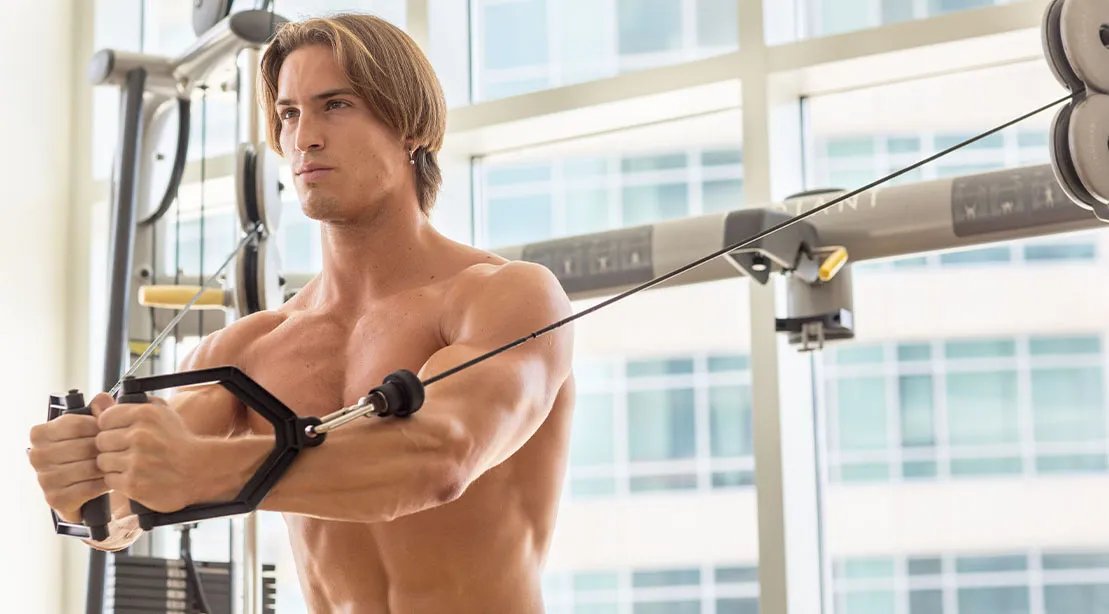
The cable push-pull rotation is a standing rotation exercise in which one arm pushes while the other pulls, with your hips and torso rotating as one unit. It combines strength, coordination and power into one movement.
It looks like an upper body exercise, but the real action happens below. The movement starts from the ground, moves through the hips and core and ends with the upper body. Instead of resisting motion like a plank, you are creating and controlling rotation.
Think of the cable push-pull rotation as the bridge between strength training and athletic performance. It trains your core to generate, transfer, and control force the way it does in the real world.
How to do cable push-pull rotation correctly
Here’s how to perform this exercise with strength and confidence.
- Attach two D handles to a cable station, setting both between chest and shoulder height. Stand sideways and grab both handles.
- Turn toward a cable stack, placing one arm straight in front of you and the other behind you in a press position.
- Keep your ribs over your hips and keep your shoulders down and chest up.
- Drive with the foot farthest from the direction you’re turning, allowing your hips to initiate the movement.
- As your torso rotates, one hand pushes while the other pulls, while avoiding leaning back or over-rotating.
- Return with controls to starting position, reset and repeat.
Coaching Tips to Know If You’re Doing Cable Push-Pull Rotations Correctly
Not everyone has the benefit of a coach who stares at you and points out every mistake. Here’s how you’ll know and feel that you’re doing the cable push-pull rotation exercise correctly.
You are doing it right if…
- The movement starts with your legs and hips, not your arms.
- Your hips and shoulders rotate together.
- You feel your obliques and glutes working.
- The push and pull happen simultaneously and feel balanced.
how it must feel
- As you rotate and slow down the pace, your obliques fire up.
- Your glutes help drive and control turns.
- Smooth transfer of force from your lower body through your torso and into your arms.
- Tension throughout your core without feeling any unnecessary tension in your lower back.
visual check point
- Your chest and hips twist together.
- Your feet remain in contact with the floor.
- Your posture remains tall throughout the entire movement.
- The cable path remains smooth and controlled.
Which muscles does the cable push-pull rotation work?
Here’s what’s happening under the hood.
Slant: Creating, controlling and slowing down rotation.
As you rotate, the obliques help transfer force from your hips to your upper body while controlling your speed and range of motion. During the withdrawal phase, they work brilliantly to slow you down.
Glutes: Generating rotational force and controlling stabilization.
The rotation starts above the ground, and your glutes help do this. They rotate the hips while helping to stabilize the pelvis so force can travel efficiently to the upper body.
Transverse abdominal: spinal stability
The transverse abdominis acts like a weight belt. This stiffens the torso and helps maintain neutral spine so the rotation is where it needs to be.
Rectus Abdominis: Opposition to expansion.
The RA keeps the rib cage attached to the pelvis and prevents the ribs from expanding.
Lattes: Drag
The lats allow the power generated by the lower body and hips to travel efficiently through the upper body.
Chest, shoulders and upper back: push-pull prime movers
The muscles of the shoulders, rhomboids, chest, and upper back work together to push and pull. Their role is to transmit force – not to dominate the movement.
Common Cable Push-Pull Rotation Mistakes and Fixes
Here’s what you should keep in mind so that you can perform this exercise as well as possible.
using too much weight
Too much weight is the fastest way to turn any rotational exercise into a mess. When you go too heavy, the arms take over, speed slows down and the quality of the rotation disappears.
solve: Do I even need to mention this? The goal isn’t to impress others – it’s to create efficient force transfer through the hips and core.
using weapons only
If you stand in place and simply press and pull, but the hips and torso don’t contribute, you are missing the purpose of this exercise.
solve: Think “hips first, arms second.” The handle should move as your body rotates.
hanging out in all the wrong places
The lumbar spine is meant for stability rather than large amounts of movement. Forced twisting of the lower back often causes discomfort and reduces the effectiveness of the movement.
solve: Rotate through your legs, hips and thoracic spine. Imagine that your navel and sternum are rotating together while your lower back remains stationary.
hurry back
Most people focus on creating force and neglect controlling it. The result is a less-than-smooth return where the cable does all the work.
solve: Lord of the prodigious stage. Slowly return the handle to the starting position and feel your obliques and glutes working to slow the movement.
Cable push-pull rotation benefits for strength and performance
Cable push-pull rotation teaches your body to generate, transfer, and control force. That’s why it has such a strong inclusion of sports, weight lifting and daily activity.
creates rotational force
Many athletic activities involve rotation. The cable push-pull rotation trains this pattern by directly training your body to generate power from all the right places.
Improves athletic performance
This exercise trains the hips, core and upper body to work together as a unit, similar to many athletic activities. The result is better force transfer, better motion efficiency and better performance.
Develops rotational control
With power comes responsibility. You create the rotation, but you need the ability to slow down, stop, and redirect the force. During the return phase, your obliques, glutes and core work hard to slow the motion and maintain control.
Best Sets and Reps for Cable Push-Pull Rotation
The cable push-pull rotation works best when you treat it as a strength and speed-quality exercise rather than a maximum-impact exercise. The following are the best places to incorporate this, along with set-and-rep suggestions.
Dynamic Warm-up: A great way to warm up the hips, core and upper body before strength training.
strength training: Place it after explosive exercises, such as medicine ball throws, jumps, or kettlebell swings, to strengthen rotational strength.
Main Accessories: Use it after your main lifts to train force transfer and rotational strength.
Sets and Reps: 2 – 4 sets of 8-12 repetitions per side, 1 minute rest between sides and sets.
Progress
- Increase the resistance gradually.
- Increase rotational speed while maintaining control.
- Add a short pause at the end position.
- Split-stance variation for greater involvement of the lower body.
Why is the cable push-pull rotation a valuable exercise?
A more complete core can generate, transfer, and control force in every direction.
This is what makes cable push-pull rotation so valuable. Your body works as a unit in a powerful movement pattern. Whether you’re pursuing athletic performance, stronger lifts, or better speed, this exercise benefits more than just your abs.
Don’t just prepare your core to resist the movement, but train it to move forward with intention.