It’s a popular hot-weather trick, and it works for cooling. A new study tested whether it also helps your body burn more of the fuel you drink.
Published: Nov 20, 2026 9:55 am
A cold bottle can lower body temperature during a hot run. Does it also help you use more of the carbohydrate in that bottle?
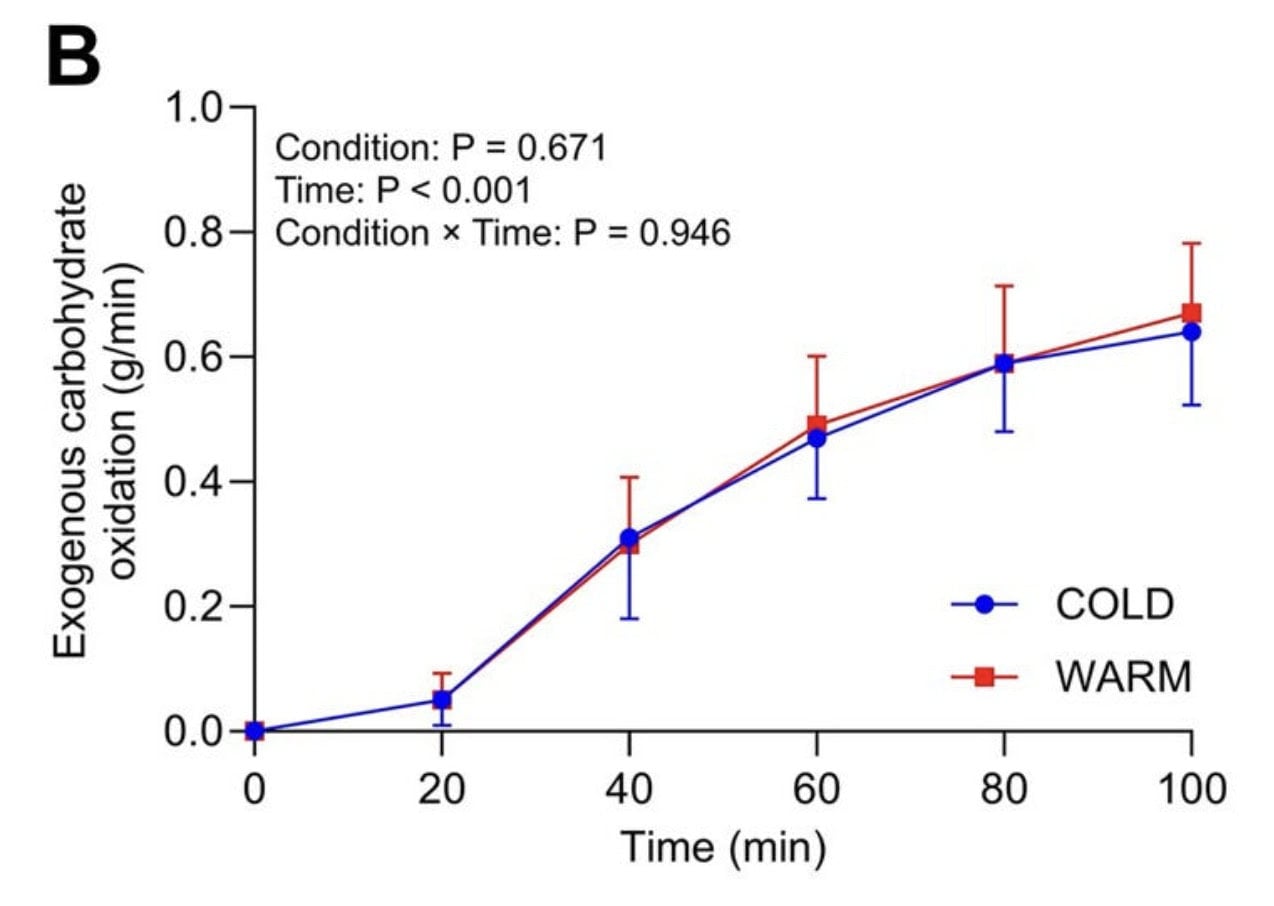
In a randomized crossover trial of 11 trained cyclists, participants rode for 100 minutes at about 96.8℉/36°C and 55% relative humidity, then completed a time trial. They consumed the same 15% carbohydrate drink at 60 g/hour in each trial; only drink temperature changed, from about 39℉/4°C to 96.8℉/36°C. A labeled tracer let the researchers estimate oxidation of the ingested carbohydrate.1Authors : Loïs Mougin https://orcid.org/0009-0002-9401-6080 [email protected] , Ben Will , Coen C.W.G. Bongers https://orcid.org/0000-0003-0055-5308 , Lewis J. James https://orcid.org/0000-0001-6514-5823 , and Stephen A, & Affiliations, A. I. (2020). Cold fluid ingestion does not enhance exogenous carbohydrate oxidation during prolonged endurance exercise in the heat | Journal of Applied Physiology | American Physiological Society. Journal of Applied Physiology. https://doi.org/10.1152/japplphysiol.00617.2026
- Cold fluid lowered rectal temperature at the end of the steady ride and heart rate by about four beats per minute.
- It did not increase oxidation of the drink’s carbohydrate: the average rate from minutes 40 to 100 was 0.50 g/min with the cold drink and 0.51 g/min with the warm one.
- Time-trial performance, the participants’ sensation of heat, and gastrointestinal comfort also did not differ.
What this means for runners
Do not count on drink temperature alone to improve fuel oxidation or performance. Choose a cold drink if you prefer it or if it helps you follow your fueling plan. Cooler body temperature and a lower heart rate were measurable benefits, but participants did not feel cooler or use more ingested carbohydrate.
References
- 1Authors : Loïs Mougin https://orcid.org/0009-0002-9401-6080 [email protected] , Ben Will , Coen C.W.G. Bongers https://orcid.org/0000-0003-0055-5308 , Lewis J. James https://orcid.org/0000-0001-6514-5823 , and Stephen A, & Affiliations, A. I. (2020). Cold fluid ingestion does not enhance exogenous carbohydrate oxidation during prolonged endurance exercise in the heat | Journal of Applied Physiology | American Physiological Society. Journal of Applied Physiology. https://doi.org/10.1152/japplphysiol.00617.2026↩︎
Join 300,000+ runners in RunClub
Free training plans for every distance, a daily running game, exclusive coaching content, and a real community of runners. Create your free account in 20 seconds — no card.
‘;
pfOverlay.addEventListener(‘click’, function(e){ if (e.target === pfOverlay || e.target.closest(‘.rc-news__pf-close’)) pfOverlay.style.display=’none’; });
document.body.appendChild(pfOverlay);
}
pfOverlay.querySelector(‘.rc-news__pf-body’).innerHTML = r.data.html;
pfOverlay.style.display = ‘flex’;
}).catch(function(){});
}
root.addEventListener(‘click’, function(e){
var a = e.target.closest(‘.rc-news__author’); if (!a) return;
e.preventDefault(); openProfile(a.getAttribute(‘data-user’));
});
// Reply targeting (composer lives outside the re-rendered box).
var pill = document.getElementById(‘rc-artc-reply-pill’);
var pillName = document.getElementById(‘rc-artc-reply-to’);
var input = document.getElementById(‘rc-artc-input’);
var formEl = document.getElementById(‘rc-artc-composer’);
function setReply(pid, name){ replyParent = parseInt(pid,10)||0; if (replyParent && pill){ if (pillName) pillName.textContent = name||’comment’; pill.style.display=”; } if (input) input.focus(); }
function clearReply(){ replyParent = 0; if (pill) pill.style.display=’none’; }
var rcx = document.getElementById(‘rc-artc-reply-cancel’); if (rcx) rcx.addEventListener(‘click’, clearReply);
box.addEventListener(‘click’, function(e){
var b = e.target.closest(‘.rc-news__reply-btn’); if (!b) return;
setReply(b.getAttribute(‘data-parent’), b.getAttribute(‘data-name’));
if (formEl) formEl.scrollIntoView({block:’nearest’});
});
// Show-all (load the full thread).
box.addEventListener(‘click’, function(e){
var s = e.target.closest(‘.rc-artc__showall’); if (!s) return;
s.disabled = true;
post(‘mh_artc_thread’, {post_id:postId, sort:currentSort, all:1}).then(function(r){ if (r.success && r.data.html) box.innerHTML = r.data.html; }).catch(function(){ s.disabled=false; });
});
// Sort tabs.
Array.prototype.forEach.call(document.querySelectorAll(‘#rc-artc .rc-news__sort’), function(tab){
tab.addEventListener(‘click’, function(){
var ss = tab.getAttribute(‘data-sort’); if (ss === currentSort) return;
currentSort = ss;
Array.prototype.forEach.call(document.querySelectorAll(‘#rc-artc .rc-news__sort’), function(t){ t.classList.toggle(‘is-active’, t===tab); });
post(‘mh_artc_thread’, {post_id:postId, sort:currentSort, all:1}).then(function(r){ if (r.success && r.data.html) box.innerHTML = r.data.html; }).catch(function(){});
});
});
// Composer: emoji (all) + member image upload + submit.
var msg = document.getElementById(‘rc-artc-composer-msg’);
var mediaIds = [];
if (formEl){
var emojiBtn = document.getElementById(‘rc-artc-emoji-btn’);
var emojiPop = document.getElementById(‘rc-artc-emoji-pop’);
var emojiLoaded = false;
if (emojiBtn) emojiBtn.addEventListener(‘click’, function(){
if (!emojiLoaded){ emojiLoaded = true;
var sc = document.createElement(‘script’); sc.type=’module’; sc.src=’https://cdn.jsdelivr.net/npm/emoji-picker-element@1/index.js’; document.head.appendChild(sc);
var picker = document.createElement(’emoji-picker’);
picker.addEventListener(’emoji-click’, function(ev){
var u = ev.detail && ev.detail.unicode; if (!u) return;
var s0 = input.selectionStart||0, s1 = input.selectionEnd||0;
input.value = input.value.slice(0,s0) + u + input.value.slice(s1);
input.focus(); input.selectionStart = input.selectionEnd = s0 + u.length;
});
emojiPop.appendChild(picker);
}
emojiPop.hidden = !emojiPop.hidden;
});
var preview = document.getElementById(‘rc-artc-media-preview’);
var attachBtn = document.getElementById(‘rc-artc-attach-btn’);
var fileInput = document.getElementById(‘rc-artc-file’);
function renderPreview(){ if (!preview) return; preview.innerHTML=”; mediaIds.forEach(function(m){ var d=document.createElement(‘div’); d.className=’rc-news__pv’; d.innerHTML=’
‘; preview.appendChild(d); }); }
if (attachBtn && fileInput){
attachBtn.addEventListener(‘click’, function(){ fileInput.click(); });
if (preview) preview.addEventListener(‘click’, function(e){ var x=e.target.closest(‘.rc-news__pv-x’); if (!x) return; mediaIds=mediaIds.filter(function(m){ return String(m.id)!==String(x.getAttribute(‘data-id’)); }); renderPreview(); });
fileInput.addEventListener(‘change’, function(){
var files = Array.prototype.slice.call(fileInput.files||[]); fileInput.value=”;
files.forEach(function(file){
if (mediaIds.length >= 4) return;
var ph = document.createElement(‘div’); ph.className=’rc-news__pv is-loading’; ph.textContent=’…’; preview.appendChild(ph);
var fd = new FormData(); fd.append(‘action’,’mh_newsroom_upload’); fd.append(‘nonce’,upnonce); fd.append(‘file’,file);
fetch(ajax,{method:’POST’,body:fd,credentials:’same-origin’}).then(function(r){return r.json();}).then(function(r){
ph.remove();
if (r.success){ mediaIds.push({id:r.data.id, url:r.data.url}); renderPreview(); }
else { msg.className=’rc-news__composer-msg is-err’; msg.textContent=(r.data||’Upload failed.’); }
}).catch(function(){ ph.remove(); });
});
});
}
var btn = formEl.querySelector(‘.rc-news__send’);
var authorEl = document.getElementById(‘rc-artc-author’);
var emailEl = document.getElementById(‘rc-artc-email’);
formEl.addEventListener(‘submit’, function(e){
e.preventDefault();
var content = (input.value||”).trim();
if (!content){ msg.className=’rc-news__composer-msg is-err’; msg.textContent=’Write something first.’; return; }
var payload = {post_id:postId, content:content, parent:replyParent, sort:currentSort, all:1};
if (authorEl) payload.author = authorEl.value;
if (emailEl) payload.email = emailEl.value;
if (mediaIds.length) payload.media = mediaIds.map(function(m){ return m.id; });
btn.disabled = true; msg.className=’rc-news__composer-msg’; msg.textContent=’Posting…’;
post(‘mh_artc_comment’, payload).then(function(r){
btn.disabled = false;
if (r.success){
input.value=”; clearReply(); mediaIds=[]; if (preview) preview.innerHTML=”;
box.innerHTML = r.data.html;
msg.className=’rc-news__composer-msg is-ok’; msg.textContent = r.data.approved ? ‘Posted.’ : ‘Posted — awaiting moderation.’;
setTimeout(function(){ msg.textContent=”; }, 5000);
} else {
msg.className=’rc-news__composer-msg is-err’; msg.textContent = (r.data || ‘Could not post.’);
}
}).catch(function(err){ btn.disabled=false; msg.className=’rc-news__composer-msg is-err’; msg.textContent=’Error: ‘+err.message; });
});
}
})();