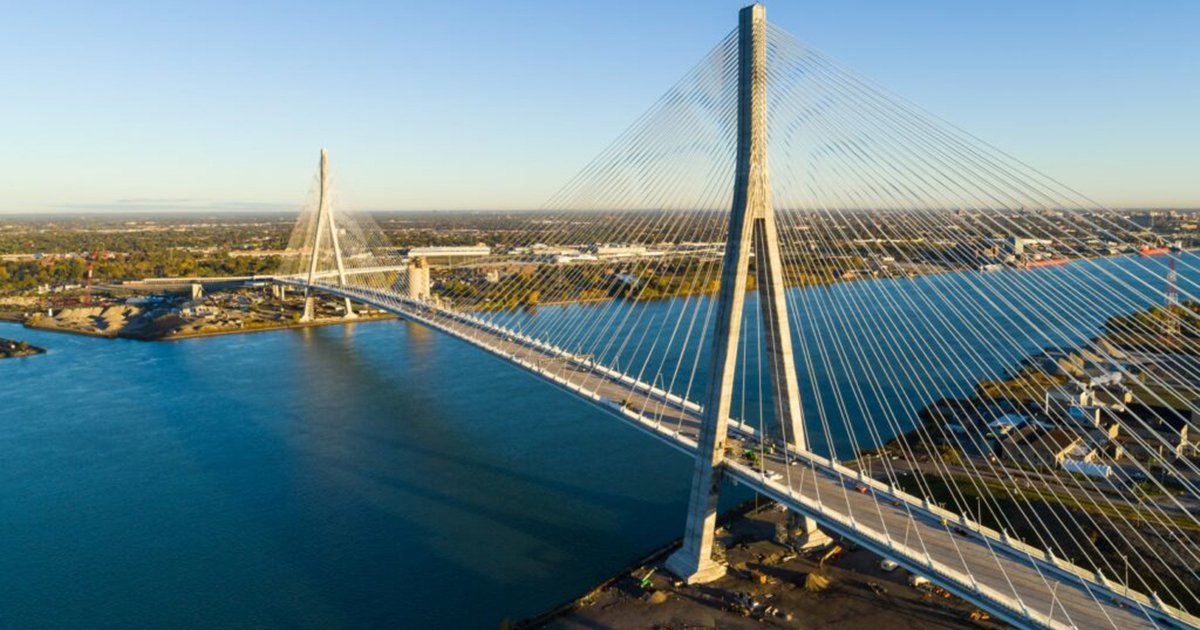
The bridge will open for traffic on June 15. (Gordie Howe International Bridge)
key takeaways:
- The US and Canada offered conflicting accounts of a profit-sharing deal involving the Gordie Howe International Bridge ahead of its planned opening on July 27.
- Prime Minister Mark Carney said debt-service costs reduce profits before sharing, while a US official said interest and depreciation are excluded.
- Both governments said the legal details were under negotiation, but neither indicated that the dispute would delay the bridge’s opening.
The US and Canada are hammering out different details of a profit-sharing deal President Donald Trump has agreed to that will allow a new bridge linking Michigan and Ontario to open later this month.
The White House and Prime Minister Mark Carney’s government announced an agreement to open the Gordie Howe International Bridge on July 10, after delays by the US. Canada would finance a regional development agency by sharing a portion of the net toll profits from bridge traffic, which Commerce Secretary Howard Lutnick was demanding.
However, since then, both governments have offered only limited details, which have painted different pictures of conditions.
Carney told a Canadian television network that the loan costs would be included in the bridge’s profit calculations. This is significant because Canada paid the entire C$6.4 billion ($4.6 billion) construction cost. The annual interest on that amount would amount to millions of Canadian dollars. The interest cut will reduce profits and hence, reduce the US share.
“We’re sharing after Canada pays. So we get the revenue, then service the cost of the bridge and pay off the debt on the bridge. And then what’s left is shared over 15 years,” the prime minister told CTV News on July 12.
However, a US official refuted Carney’s account and said that neither loan interest nor depreciation would be included in the calculations. This approach suggests lower expenses to offset revenues and, thus, a larger share for the US. The official spoke on condition that he not be identified discussing private matters.
At this point, there is no indication that the anomaly will jeopardize the bridge’s planned opening on July 27.
On July 14, when Audrey Champoux, Carney’s spokeswoman, was asked to clarify whether debt service costs are deducted before calculating the U.S. share of toll benefits, she did not provide a specific answer.
“Canada and the United States agreed to contribute half of the net profits to an economic development fund for a 15-year period, which will give both countries an incentive to make the bridge profitable,” he said. “As the Prime Minister said, we expect these net benefits to be a small portion of the total bridge revenue,” he said.
Benno Kass, a spokesman for the US Commerce Department, said the US “is pleased to reach an agreement with Canada on the Gordie Howe International Bridge that ensures that the United States will participate in setting tolls and receive an equal share of net bridge revenues.”
Neither country has published the text of the agreement. Champoux said that “officials from both countries are working to finalize the specific legal and administrative details of this arrangement.”
The bridge, which links Detroit to the industrial heartland of Ontario province, became another flashpoint between the two countries after Lutnick intervened to stop a planned opening last month. Its development took years. Yet to make it a reality, Canada agreed to finance it in advance.
That original agreement – which was between Canada and the state of Michigan, not the US government – stipulated that Canada would be allowed to recoup all of its costs, which was expected to take several decades. After that, the revenue would be split with Michigan, which shares ownership of the bridge with Canada.
But Trump said in February he was unhappy with those terms, and Lutnick moved to block plans to hold an inauguration ceremony in June. Talks led to a side deal last week.
Carney told CTV that with the current traffic projections, “there’s not going to be a lot of net splitting” and said “it’s a good deal for Canada.”
Trump himself claimed victory and confirmed the opening of the bridge.
“The new deal is great and fair. Thank you and congratulations to the Canadian government. May we both have many years of success with this wonderful new development,” he said in a social media post on July 11.
One reason for the Canadian government to renegotiate the terms is that the Gordie Howe Bridge, named after the Canadian-born hockey star who played for the Detroit Red Wings, is expected to streamline trade between the two countries.
Currently, the major commercial bridge connecting Detroit to Southern Ontario is the privately owned Ambassador Bridge. This area is particularly important for the automotive industry, where large quantities of parts and vehicles move around.

Alex Fraser from Cox Fleet discusses how fleets should respond when a roadside breakdown occurs, testing their safety, compliance and customer service systems simultaneously. Tune in by going above or RoadSigns.ttnews.com.
Although Trump’s tariffs have disrupted trade flows between the US and Canada, they have hardly collapsed. According to the US Bureau of Economic Analysis, the two countries exchanged about $880 billion of goods and services last year, down about 5% from 2024.
In the short term, traffic on the new bridge may be lighter than originally envisioned, partly because many Canadians are boycotting U.S. travel in protest of the tariffs and Trump’s anti-Canadian rhetoric. On July 14, the President reposted a fake image showing himself in the Oval Office surrounded by other world leaders. In the image, to his left is a map of North America with the American star and stripes over Canada and Greenland.
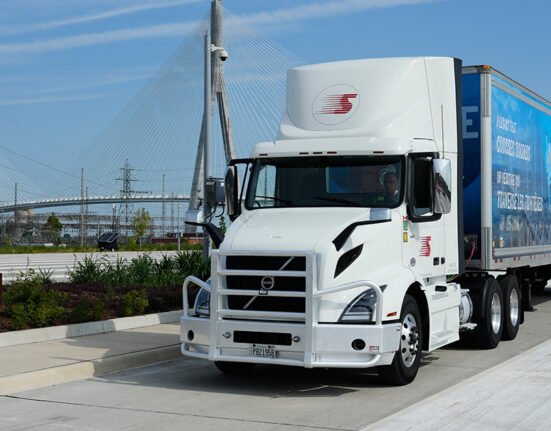
A local investment agency in the Windsor, Ontario area has estimated that 400 commercial vehicles will use the bridge each hour. A four-axle commercial truck must pay a minimum of $27.60 to cross it.