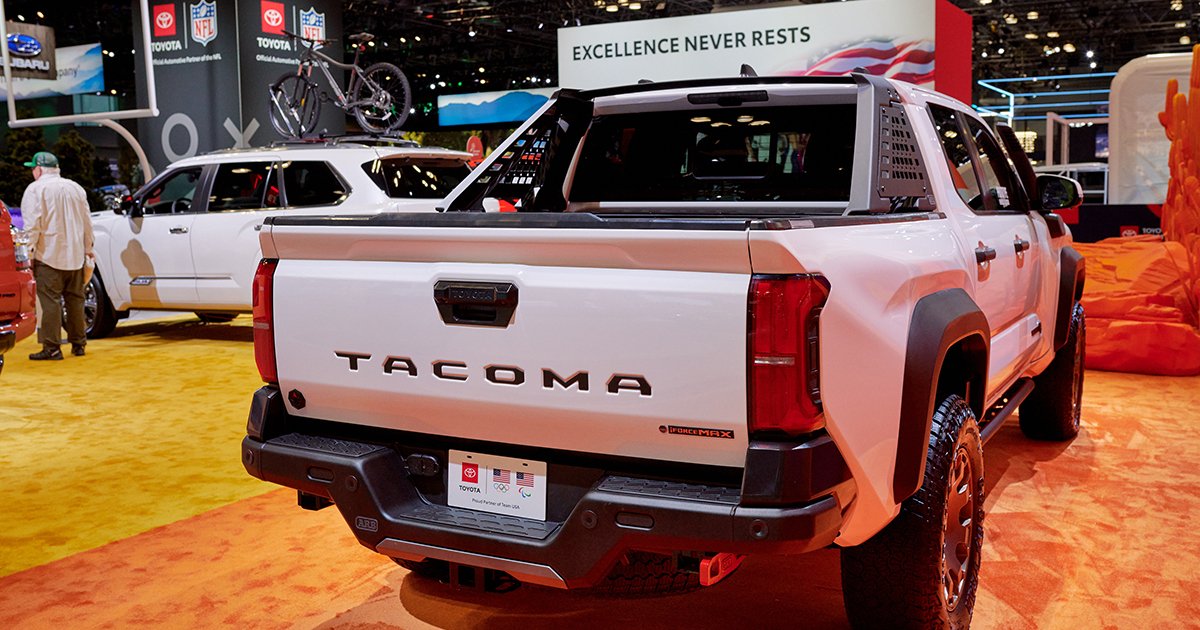
Toyota Tacoma concept pickup truck at the 2024 New York International Auto Show. (Gabby Jones/Bloomberg)
key takeaways:
- Toyota said it will shift some Tacoma truck production from Mexico to Texas as uncertainty increases over U.S.-Mexico trade policy.
- Analysts and industry sources said the shift reflects tariff risks and the USMCA changes, with autos accounting for 4.5% of Mexico’s GDP and exports already weakening.
- Officials said automakers are reviewing contingency plans and may shift more production to the U.S. or adjust supply chains as annual trade negotiations and tariffs continue.
Mexico’s auto industry is bracing for a shock that could extend beyond Toyota Motor Corp. after the Japanese automaker said it would move production of its popular Tacoma truck out of the country to Texas.
Growing uncertainty over future US-Mexico trade relations is fueling concerns that more Mexican auto production could lose out to US factories, as Donald Trump last week opted against a long-term renewal of the USMCA trade agreement and instead pushed for annual negotiations.
The skepticism is prompting more automakers operating in Mexico to review backup production plans, cut production and reevaluate long-term deals tied to plant expansions, two people who spoke on condition of anonymity to discuss private deliberations said.
Both said they fear more announcements like Toyota’s in the coming months, as hopes of reducing U.S. tariffs on Mexican-made vehicles soon fade.
“It is no coincidence that this announcement comes so soon after the US has been selected for the annual review,” said Gabriela Siller, director of economic analysis at Banco Base. “If this happens to Toyota, others may decide to leave Mexico in a domino effect to avoid losing competitiveness.”
Toyota’s decision to move a portion of its production to the US could signal a regional realignment, as tariffs and changes in rules of origin for a myriad of vehicle parts likely further erode the predictability that has underpinned the region for years.
Mexico’s already battered economy has a lot to lose. Carmaking is the crown jewel of its export-oriented manufacturing base, accounting for 4.5% of the country’s GDP.
Siller said Toyota’s announcement sends a particularly negative signal because its models already have the highest average share of U.S.-made parts. Mexican exports from BMW AG, Volkswagen AG’s premium brand Audi and Nissan Motor Co have declined the most this year, he said, with other companies also seeing shipments decline.
Over the past year, several automakers have studied whether to move some Mexican output across the border or remodel their supplier base to include more U.S.-made components, one of the people said. These talks have intensified after Trump refused to authorize a 16-year USMCA extension.
The auto industry is renowned for long-term planning that takes multiple objectives into account, Toyota’s North American headquarters said in a statement to Bloomberg.
https://www.youtube.com/watch?v=egor8gTOJ6s
(Bloomberg Television via YouTube)
“While we are influenced by evolving trade policies, our investments are multi-decade decisions based on broader strategic goals, our commitment to build where we sell, and to exceed customer expectations,” the company said.
Since his first term, Trump has tried to lure more factories to the US while downplaying the advantages of a regionally integrated auto industry. On July 7, he claimed that his tariffs were behind Toyota’s Tacoma decision.
Trump’s victory reinforced expectations that more Mexican auto plants will either shift some production to the US or brace for higher costs from its tariffs.
Toyota’s latest decision is far from the only Mexico-to-US change.
General Motors Co. already announced new U.S. capacity for its Chevrolet Blazer and Equinox SUV models, which are currently made in Mexico, while Hyundai Motor Co. has similarly made some changes to its Tucson SUV production, as well as created a tariff task force to boost U.S. sourcing.
Nissan halted exports of its Versa compact sedan from Mexico to the US late last year. It also discontinued two other Mexican-made models – the Infiniti QX50 and QX55 – which were largely destined for the US market.

Alex Fraser from Cox Fleet discusses how fleets should respond when a roadside breakdown occurs, testing their safety, compliance and customer service systems simultaneously. Tune in by going above or RoadSigns.ttnews.com.
Vehicles manufactured in Mexico and imported to the US could circumvent some of Trump’s 25% auto tariffs if they are USMCA-compliant, depending on how much US-made content they contain. But most import taxes are still in place. The average tariff is about 19%, according to a document seen by Bloomberg, which is higher than the 15% duty imposed on some vehicles imported from South Korea or Japan.
Some analysts say Mexico’s total vehicle exports continue to grow.
“I don’t think auto makers are considering leaving the country,” said Julio Ruiz, chief economist at Citi Mexico. “Instead they are simply adjusting some production lines, some cars that can be manufactured elsewhere, to try to reduce the tariffs they face.”