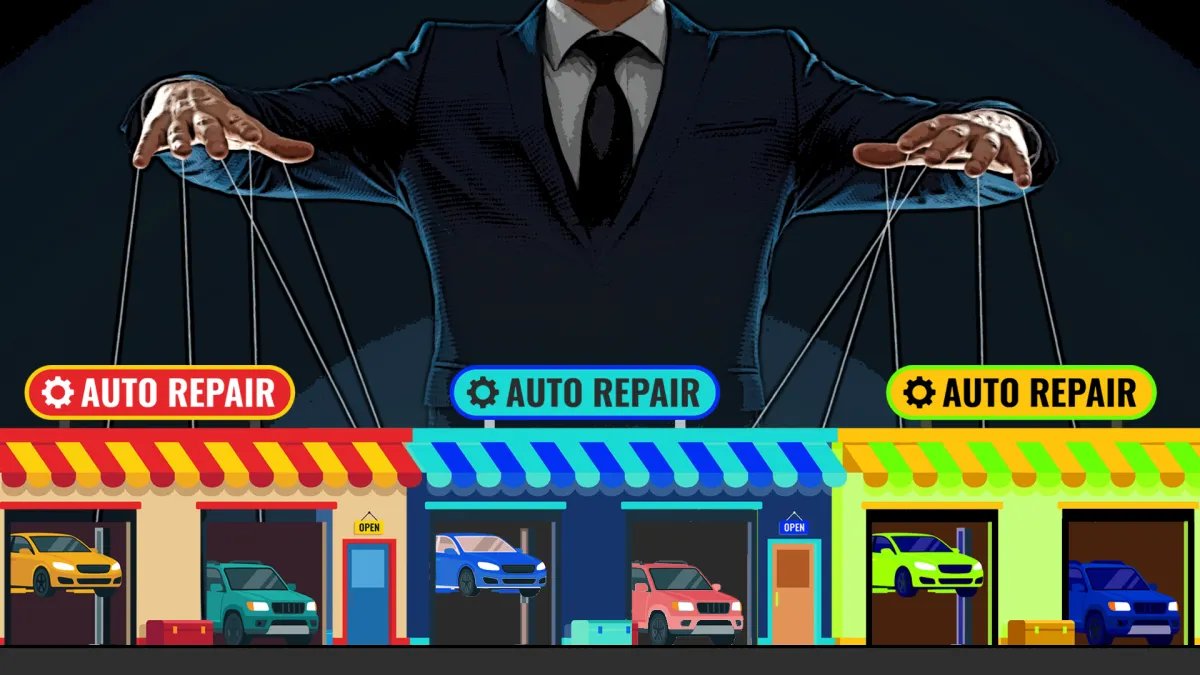
- Auto services are dominated by six giants. Private equity firms control most of the major chains while maintaining local branding for customer confidence.
- Mavis expanded with the acquisition of Pep Boys. The move highlights a trend of consolidation in the industry.
- The strategic game of private equity. Companies like Roark and Monomoy take advantage of regional brand equity without rebranding.
- Impact on consumers. Consolidation provides benefits such as pricing and availability but reduces competition and choice.
Ground level: A few powerful companies driven by private equity quietly control most of the auto service chains, influencing consumer choice and market dynamics.
AI assisted, editor reviewed
Mavis Tire recently purchased Pep Boys from Carl Icahn’s holding company for $700 million – making one of the nation’s largest tire retailers even bigger. But what’s more interesting isn’t that Mavis expanded. This is what Mavis really is, and what it tells you about the shop on your corner.
Earlier this month, we saw that O’Reilly Auto Parts was looking to buy NAPA’s auto parts stores, which brought us to the downside in US aftermarket auto parts businesses. (TL;DR: There are only four major auto parts retailers left in the US, and two may be merging.)
This week, “Mavis to acquire Pep Boys“The release came across my desk. Mavis has several thousand locations across the country and Pep Boys has about 800 – so that’s a bit of interesting industry news in itself. But it made me wonder – regardless of how many auto service chains we have in America, how many holding companies actually have control over them? The answer is six – there are six monolithic companies running almost every chain car repair location in the country.
And I bet you can guess where the real power behind those parent companies comes from: Yes, private equity. Mavis (Bepine/Goldman/TSG), Driven (Roark), Jiffy Lube (now Monomoy), Tech 5 (Roark), Strickland Brothers (Roark through 2024) – The automotive service industry, like the aftermarket, is being started by PE firms that hold on to familiar regional signage precisely because local brand equity is an asset.
The trick is to keep the symbol the same
The playbook is simple. A private equity firm buys a regional chain – let’s say, a beloved tire store that’s been in your area for 40 years – and then this happens. No Repainting the building. The local name remains above. The brand equity the store spent decades building is exactly the same asset the buyer paid for, so painting over it would be like burning money on fire.
The result is that you can drive across the country and visit a dozen different locally well-known tire-and-service shops, and half of them answer to the same parent company. The fragmentation you see on the road is a feature, not an accident. This is what allows these companies to scale without looking like the Walmart of oil changes or breaking new ground with brand-building.
Now, of course, there are still thousands of single-location, operator-owned indie auto shops. And there are franchises in the mix, too – some of the brands on this list below have local owners for some locations, even if the name on the door is that of a larger company. But when it comes to local brand-name type enterprises, here’s how six auto service empires were shaken up.
Mavis Tire Express Services
Who owns it: private equity-a group Which includes Baypine, Goldman Sachs’s West Street and TSG Consumer Partners.
This is what is buying Pep Boys, and it is the poster child of the strategy. If you’re in the Northeast you might know Mavis by name, but if not, you’ll definitely know it Know one of its other faces: : NTB, Tire Kingdom, Tuffy, Town Fair Tyre, Express Oil Change and Tire Engineers, And break plusAlso the scattering of regional banners action gator, jack williamsAnd Dekalb Tire. last year, Mavis absorbed magicalA huge brand in itself. Mavis runs its flagships under two names – Mavis Discount Tire and Mavis Tires & Brakes – largely to avoid trademark confusion over the word “discount”. Add Pep Boys and its nearly 800 locations, and Mavis becomes one of the largest service networks on the continent.
inspired brand
Who owns it: Publicly traded, but controlled Roark CapitalPrivate equity firm behind a large portion of American franchising.
If Mavis is a tire-and-service empire, Driven is its mirror image in oil changes, repairs and collision work. portfolioAccording to company filings, included Get 5 Oil Change, Meineke, Mako, Carstar, ABRA, Auto Glass now, And 1-800-Radiator & A/C. That’s a quick-lube replacement, a muffler replacement, a paint-and-body replacement, and a windshield replacement – all under one Charlotte roof. It is arguably the closest analog to the one being built by Mavis.
monroe
Who owns it: publicly tradedThe headquarters is in Rochester, New York.
Monero describes its holdings as A family of 16 regional brandsAnd that word—regional—is the whole game. you have got Monroe Auto Service, Mister Tire, Tire Choice, And a long tail of local names like Free Service Tire and McGee. Each is read as a hometown operation. Everyone goes to the same corporate parent in upstate New York. Monero has the largest footprint in the entire East, so if you’re anywhere in the Northeast, you’ve probably handed your keys over to Monero without even realizing it.
bridgestone retail operations
Who owns it: bridgestone-The tire manufacturer himself.
this is vertically integrated modelAnd it’s a different animal from PE rollups. The company that makes tires also has bays that install them. Bridgestone continues retail operations Firestone Complete Auto Care, Tires Plus, Hibdon Tires Plus, And wheel workand calls itself the world’s largest company-owned auto-care chain. When you get Bridgestone or Firestone tires installed at a Firestone shop, there is the same corporation on both ends of the transaction.
Fun Fact: Actually Bridgestone Tried to buy Pep Boys in 2015But lost the bidding war to Icahn (who is now selling Mavis). It’s all just big-money musical chairs.
valvoline
Who owns it: publicly traded (NYSE:VVV).
Here’s a fun wrinkle that says a lot about how broken this industry is. Oil-change series Valvoline and oil Valvoline are no longer the same company. Retail service business-valvoline instant oil change, The Great Canadian Oil Change and Express Care platform—now a pure-play services company. The oil-manufacturing side was sold to saudi aramco In 2023. So the brand on the sign and the jug of oil that goes into your engine can trace back to two completely different owners.
jiffy lube
Who owns it: Earlier this year, private equity-Monomoy Capital Partners.
And this is the most recent piece of the puzzle. Jiffy Lube—probably the most recognizable oil-change name in the country—just changed its name. In March 2026, Shell agreed to sell The deal with Monomoy Capital Partners for a nearly 2,000-location franchise network was reported to be worth about $1.3 billion. The deal was done in July. Shell owned it for two decades; Now it is moving towards PE consolidator. This means that the same year Pep Boys left Icahn for Mavis, Jiffy Lube left Shell for Monomoy. The two most familiar names in American car care both traded a strategic corporate parent for a financial one within months of each other.
what it really means to you
None of this is inherently scary. Jiffy Lube customers are there because they want to get in and out quickly, not because they want to have a special relationship with their mechanic or do complex work on somehow unique cars. The advantage for most daily driver customers is that scale can mean better pricing, more consistent warranties, and parts availability that a true mom-and-pop can’t match.
When a local shop can get a part in 24 hours because it is connected to a national distribution network, the machine is working in your favor. Again, fewer competitors means fewer consumer choices, which usually ultimately leads to a worse experience or higher prices.
But it is worth being honest about what is happening. The Pep Boys deal isn’t a one-off. It’s another brick in the wall that some companies—most of them driven by private equity—have been building for years. The signs out front still say dozens of different things. The number of real decision makers behind them is decreasing.
So the next time you go to your favorite quick-lube lane, you now know who really runs it. More often than not, the answer is: one of the six companies in this post.
Have information about an auto service or aftermarket business? Drop me a line at andrew.collins@thedrive.com.