The drive chain is one of the most important components of any motorcycle equipped with this system. It transfers engine power to the rear wheel, tolerates high loads, variations in stress and frequent exposure to dust, water and other impurities.
When looking for a new chain, it is common to find two designations: O‑ring and X‑ring. Although at first glance they may seem very similar, there are significant differences in construction, efficiency, longevity and maintenance.
But is the X-ring chain always the best choice? And is it worth the extra investment compared to O-rings? Here are the main differences.
Why are sealing rings used in chains?
In early roller chains used on motorcycles, the lubricant applied during manufacturing was easily drained from the area around the pins and bushings – exactly where the most wear occurs.
As a result, these chains require very frequent lubrication and have a relatively short service life.
To solve this problem, manufacturers began incorporating small rubber rings between the inner and outer plates of the chainring. These rings have two essential functions:
To retain factory-applied lubricants inside;
To prevent water, sand, mud and other abrasive particles from entering.
Thanks to this system, vital lubrication is preserved for thousands of kilometers.
What is O-ring chain?
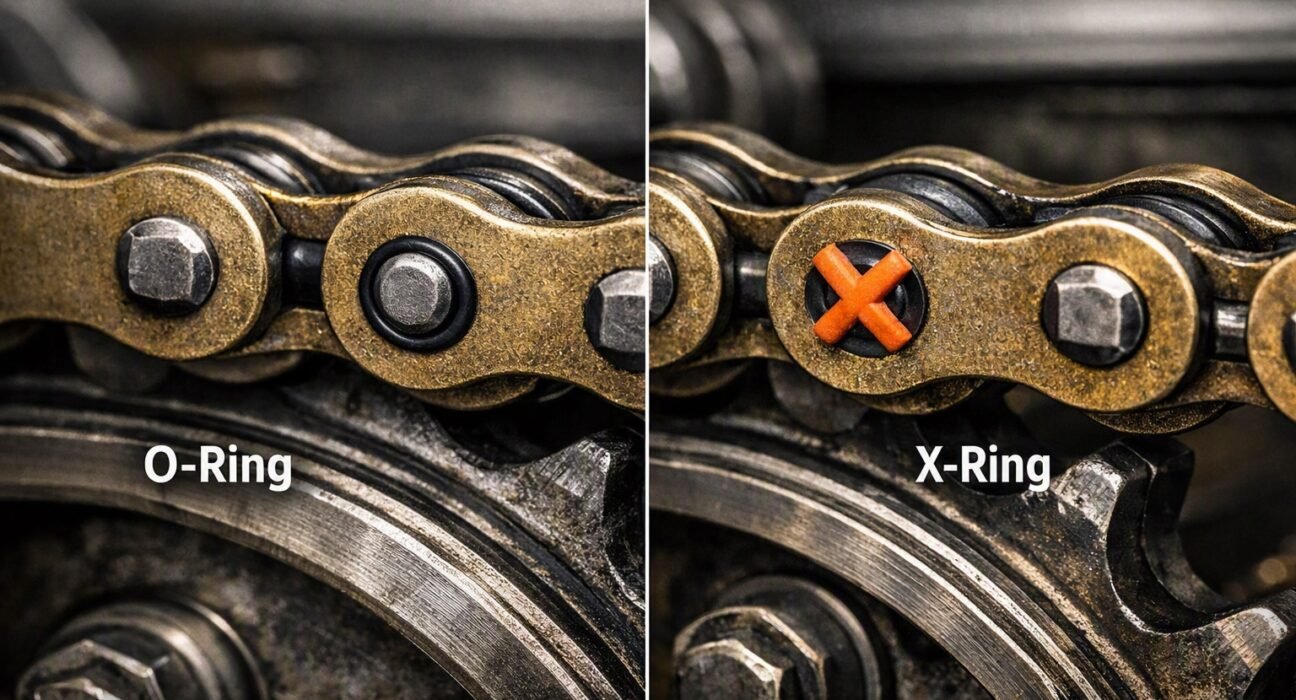
An O-ring chain uses a circular-section ring – hence the “O” designation – placed on both sides of each link. When the chain is assembled, these rings are compressed between the metal plates, forming a tight seal that protects the internal lubricant.
For many years, it was the reference solution for almost all medium and high capacity motorcycles.
Benefit
Excellent protection of internal lubrication;
Much longer lifespan than non-sealed chains;
low purchase costs;
wide market availability;
Relatively simple maintenance.
Loss
High internal friction due to the contact area of the ring;
little heavy;
Some minor loss in mechanical efficiency;
Excessive wear of rings over time.
Although the performance difference is almost invisible in daily use, in gaming applications it becomes more relevant.
What is X-ring chain?
The X-Ring series is a technological evolution of the O-Ring. Instead of a circular profile, it uses a ring with an “X” shaped cross-section, creating four sealing surfaces instead of the two found in O-rings.
At first glance this may seem like a simple geometric change, but the effect is significant.
By reducing the contact surface between the ring and chain plates, internal friction is reduced while maintaining effective sealing of the lubricant.
This is why almost all premium series manufacturers now use this technology for high-powered motorcycles.
Benefit
low internal friction;
high mechanical efficiency;
low heat output;
Better retention of lubricant;
greater resistance to wear;
Generally long lifespan;
Smooth operation.
Loss
higher price;
Replacement is generally more expensive;
Some budget versions may not provide any real benefits compared to a good O-ring chain.
Does ring design really matter?
Yes: In the O-ring series, the ring is compressed evenly between the metal plates, creating a relatively large contact area.
In the X-ring, the “X” profile reduces this surface significantly, reducing friction whenever the chain is articulated.
Additionally, the geometry creates multiple sealing points, preventing lubricant from leaking out.
In practice, this results in:
Low resistance to movement;
less ring wear;
Long period of basic lubrication;
Less frequent need for chain replacement.
Is the difference noticeable while riding?
For most riders, hardly. In the daily commute, touring or even dynamic riding, it is unlikely that you will feel any noticeable difference between a well-made O-ring and X-ring chain.
However, in competition or intensive use – where every small power loss counts – reduced friction can represent a measurable advantage. More important than the performance gains is usually the increase in durability.
Which one lasts longer?
Although it depends on manufacturing quality, maintenance and conditions of use, an X-ring chain generally offers a long service life.
Better retention of internal lubricant reduces wear on the pin and bushing, which are the components responsible for chain stretching over time.
Naturally, a premium O-ring chain can last longer than a lower-quality X-ring. Brand, material and heat treatment remain the deciding factors.
Maintenance: Is there a difference?
Despite structural differences, both require exactly the same care.
A common misconception is that sealed chains do not require lubrication. This is wrong.
The lubricant inside is protected by sealing rings, but the outer rollers can still be worn out from contact with the sprocket teeth.
Additionally, surface oxidation can significantly reduce the lifetime of the transmission.
how to clean properly
It is important to remove old residue before applying new lubricant.
The recommended procedure is:
Place the motorcycle on stands whenever possible;
Use a specific chain-cleaning product;
Use a soft bristle chain brush;
Slowly rotate the rear wheel while clearing the entire chain;
Dry completely before applying lubricant.
Gasoline, aggressive thinners or strong solvents should never be used, as they can damage the sealing ring. Metal brushes are also not recommended.
how to lubricate
Lubrication should preferably be done after riding, when the chain is still warm. At that time, the lubricant penetrates between the rollers more easily.
The spray should be applied to the inside of the chain, slowly turning the rear wheel until the entire length is covered.
After application, wait a few minutes before riding to reduce product splashing.
how often?
There is no universal interval.
As a general reference:
Normal usage: every 500 to 800 km;
After heavy rain;
After riding on very dusty roads;
After washing the motorcycle.
Riders who regularly ride in harsh environments should shorten these intervals.
How to know when to change the chain?
A chain should not be replaced just because it shows surface rust.
The main symptoms of wear include:
Extend beyond manufacturer specifications;
Stiff or seized links;
excessive noise;
constant need for adjustment;
Irregular wear on sprocket teeth;
Damaged or missing sealing ring.
Whenever possible, replacement should include the entire transmission kit – chain, front sprocket and rear sprocket – to avoid premature wear of the new components.
Is the price worth it?
In many cases, yes. Although an X-ring series may cost more than an equivalent O-ring, the difference is often offset by longer durability and extended replacement intervals.
For riders who cover several kilometers per year or travel frequently, the cost per kilometer is often reduced.
For occasionally used motorcycles with small engines or short urban routes, a good quality O-ring chain remains an excellent choice.
Which one should you choose?
The decision depends mainly on the type of use. The O-Ring series continues to provide excellent reliability for daily riding, regular maintenance and low costs.
An
Regardless of the technology chosen, one factor always makes the biggest difference: a clean, properly lubricated and correctly adjusted chain will always last longer than a top-tier chain subject to poor maintenance.
Don’t miss a second with the new app where you can watch live timing of MotoGP, Formula 1, NASCAR, IndyCar and much more: just press – Here (Free for all users)