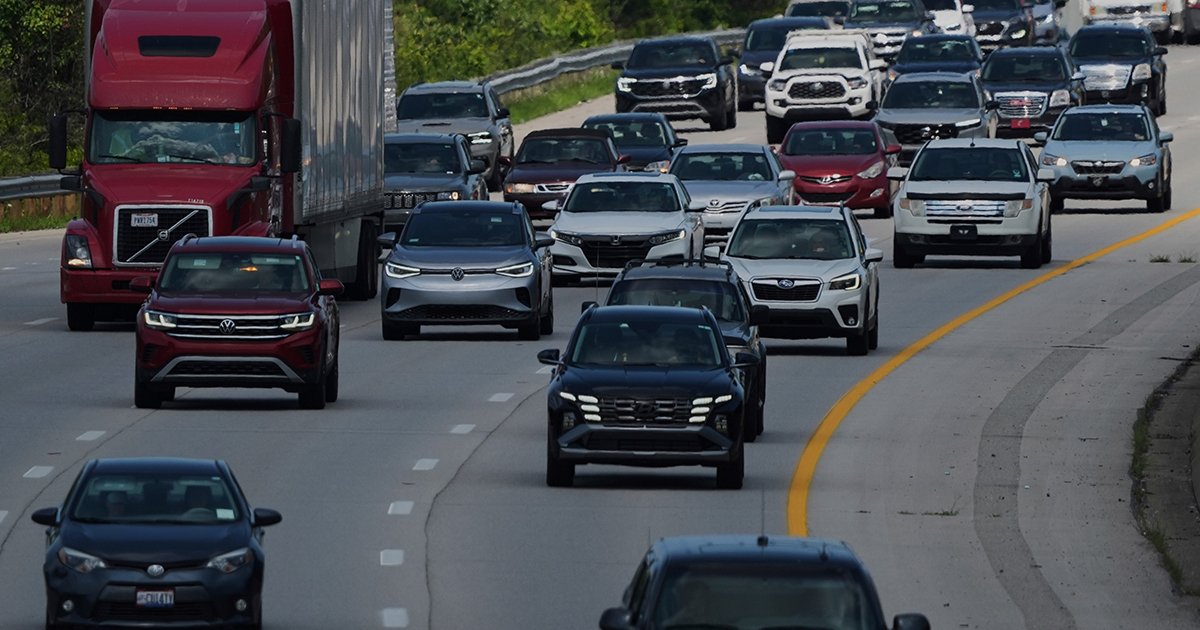
Vehicles move on the highway in Cincinnati. (Joshua A. Bickel/AP/File)
key takeaways:
- A University of Minnesota study found that obeying speed limits could save American drivers millions of dollars, 6.7 million gallons of fuel and 57,000 metric tons of CO2 per day.
- Researchers analyzed 120 million trips and found that driving faster on more than 43% of them added only 54 seconds per day.
- The findings come as fuel prices remain high, with researchers estimating that drivers could save about $26 million and 7.2 million gallons per day by slowing down now.
Driving fast to get to work, pick up your kids from school, or run from one errand to another not only wastes money on gas and releases harmful emissions into the air, but it also doesn’t save you time, new research says.
This is something to think about as gas prices remain high throughout the summer months and the hassles of day-to-day driving and seasonal road tripping increase.
Instead, obeying posted speed limits could save American drivers millions of dollars at the gas pump and eliminate millions of gallons of fuel consumed every day. The study was published on July 16 Nature Journal Communications in Sustainability. It is a fuel which, when burnt, emits planet-warming gases into the atmosphere. What’s more, changing driving habits won’t add a whole minute to a driver’s commute.
Researchers at the University of Minnesota analyzed 120 million vehicle trips across the United States from four Wednesdays in 2021 using driving data on the national road network, speed limits and U.S. Geological Survey elevation data. The analysis included roads with speed limits of 45 mph and above.
More than 43% of the trips studied involved at least one instance of speeding, and drivers spent almost 12% of their driving time going faster than the speed limit.
They found that if drivers of light-duty, conventional internal combustion engine vehicles actually drove at the posted speed limits, an average of $22 million could be saved over that time, based on fuel costs, 6.7 million gallons of fuel, and 57,000 metric tons of carbon dioxide each day. This is equivalent to removing approximately 5.5 million passenger vehicles from the road, researchers said.
Speeding has environmental and economic costs
And while drivers say that driving faster saves them valuable time, researchers found that’s actually not the case. With an average daily driving distance of 28.6 miles, driving at or below the limit takes only 54 seconds more per day.
“If your goal is to shave a minute off your time, you have to drive faster. If your goal is to reach your destination safely and save fuel, you can drive slower than the speed limit,” said William Northrop, a mechanical engineering professor at the University of Minnesota and co-author of the study.
The research only considered battery-electric vehicle efficiency in California, given the level of EV adoption in the US at that time. Based on California modeling, “we found that driving slowly is also beneficial for EVs,” he said.
Interestingly, the study found differences between states. Nevada saw a high prevalence of high speed winds as well. Higher speeds were prevalent in Florida, Georgia, and North Carolina, although those states did not necessarily exhibit higher speed excesses. Montana, Wyoming, Idaho, and South Dakota showed both lower speed prevalence and higher speed prevalence.
price of fast driving today
Driving fast increases a vehicle’s energy consumption and emissions from its engine, as well as reduces efficiency. Vehicle engines have become increasingly more efficient over the past several decades, while vehicles have become larger and more powerful. But speed limits have also increased since the enactment of the Emergency Highway Energy Conservation Act, which mandated a national speed limit of 55 mph amid the energy crisis of the 1970s.
People fill up with gas at a gas station in Portland, Oregon on May 6. (Jenny Kane/AP/File)
Taking into account the average cost of gas today and more vehicle miles traveled, this adds up to approximately $26 million and 7.2 million gallons of fuel that Americans could collectively save every day this year by not putting the pedal to the metal.
One limitation of the research is that driving slowly may affect traffic patterns, which may play a role in efficiency.
However, it is especially timely as American drivers remain price-sensitive to volatile gas prices as the cost of a gallon of fuel has soared to more than $4 this year due to the war in Iran. Experts say there are many ways to improve one’s gas mileage, including something as simple as slowing down. The need to purchase less fuel due to improved efficiency may impact oil market demand, which in turn may affect pricing.
Rob Middleton, associate research scientist in mechanical engineering at the University of Michigan, who was not involved in the research, said the study was good. But he also said the fuel saved by driving more slowly still represents only a fraction of daily gasoline consumption in the US, which is about 375 million gallons per day.

Alex Fraser from Cox Fleet discusses how fleets should respond when a roadside breakdown occurs, testing their safety, compliance and customer service systems simultaneously. Tune in by going above or RoadSigns.ttnews.com.
“It’s a big number, but it’s a small fraction,” Middleton said. “It’s a ‘freebie’ because it doesn’t really cost anyone anything to do.”
“The market penetration of selling EVs is still small, so we still need fuel, we still need ICE (internal combustion engine) vehicles, we’ll still have them for a very long time,” he said. “Things that we can do to either improve the new guys or improve our fuel supply, we need to do.”
Alexa St. John is an Associated Press climate reporter. The Associated Press’ climate and environmental coverage receives financial support from several private foundations. AP is solely responsible for all content.