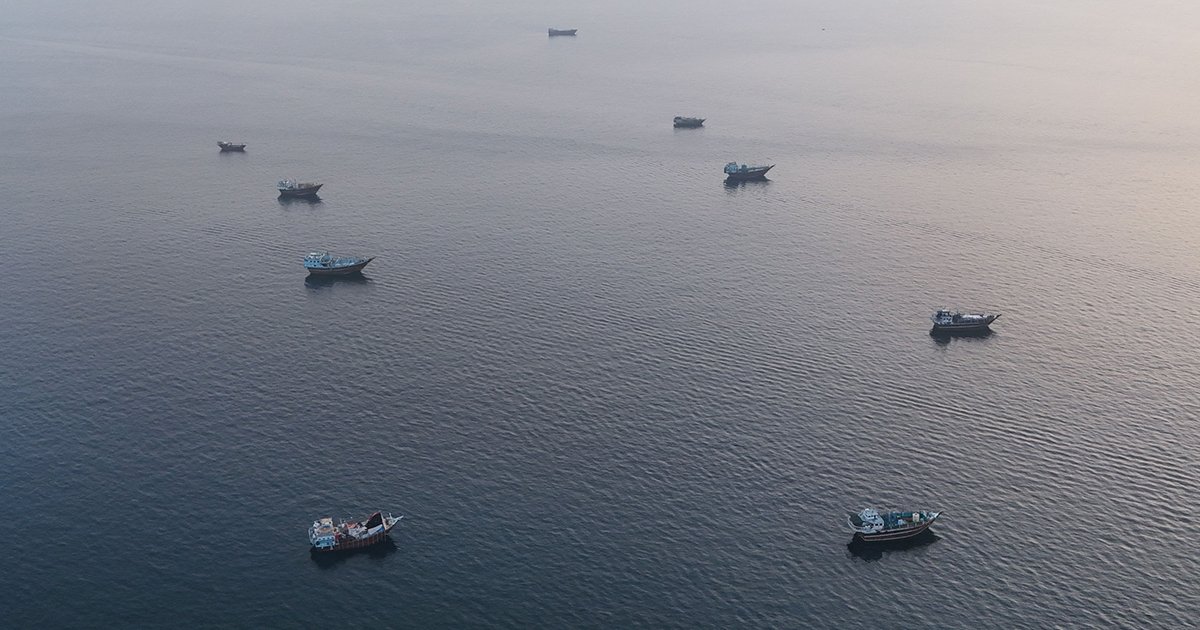
The ships anchored in Oman near the Strait of Hormuz in June. (AFP/Getty Images via Bloomberg)
key takeaways:
- Oil prices rose as Iran threatened to block Middle East energy exports.
- President Donald Trump announced on July 13 that the US blockade of Iranian ports had been resumed as an interim agreement to end the war.
- The big US banks posted strong reports on July 14, all of which they attributed to their trading desks to some extent.
Stock indexes were mostly rising in premarket trading on Wall Street on July 15 and oil prices rose modestly after Iran threatened to block Middle East energy exports in retaliation for the US resuming a blockade of Iranian ports.
Stock price gains were overall moderate given concerns about the United States and Iran returning to full-scale war. Renewed attacks in the Middle East have raised the risk of further disruption to oil and gas transportation through the Strait of Hormuz, sending oil prices higher.
Iran’s paramilitary Revolutionary Guard threatened to halt all energy exports from the Middle East on July 15 due to the US blockade. President Donald Trump announced on July 13 that the blockade had been resumed as an interim agreement to end the war.
“Oil and gas exports from the region will either be for all or for none,” the Iranian side’s statement said.
International benchmark Brent crude rose 63 cents to $85.36 a barrel, while benchmark U.S. crude rose 46 cents to $79.80 a barrel.
“The US-Iran memorandum of understanding signed last month has proven nothing. The two sides are once again exchanging military strikes, and they have completely different views on the state of affairs in the Strait of Hormuz,” said Tim Waterer, chief market analyst at KCM Trade.
“With navigation around the bay fraught with danger, traffic flows are once again decreasing,” he said.
S&P 500 futures rose 0.1% before the opening bell, while Dow Jones Industrial Average futures were unchanged. Nasdaq futures rose 0.5%.
Morgan Stanley shares rose 2% in premarket trading after the bank reported second-quarter revenue of $21.3 billion and profit of $5.6 billion, both records. This follows several strong reports from big US banks on July 14, all of which were attributed to their trading desks to some degree.
It marks the second consecutive quarter of strong results for banks, which have benefited from market volatility since the Iran war began in late February.

Alex Fraser from Cox Fleet discusses how fleets should respond when a roadside breakdown occurs, testing their safety, compliance and customer service systems simultaneously. Tune in by going above or RoadSigns.ttnews.com.
The government’s report on wholesale inflation in June is due on July 15.
In early European trading, France’s CAC 40 fell 0.2%, while the German DAX fell 0.8% and Britain’s FTSE 100 fell 0.2%.
South Korea’s Kospi led gains in Asia, rising 6.2% to 7,284.41, as a recent selloff in semiconductor shares lifted prices. Shares of computer chip maker SK Hynix rose 8.8%, while Samsung Electronics shares rose 6.3%.
Japan’s benchmark Nikkei 225 rose 1.5% to 68,751.51.
Australia’s S&P/ASX 200 rose 0.4% to 8,841.10.
Hong Kong’s Hang Seng rose 1.4% to 24,681.10, while the Shanghai Composite fell 0.3% to 3,955.58, after the Chinese government reported the economy grew at an annual pace of 4.3% in April-June, slowing sharply from 5% in the first quarter of the year.