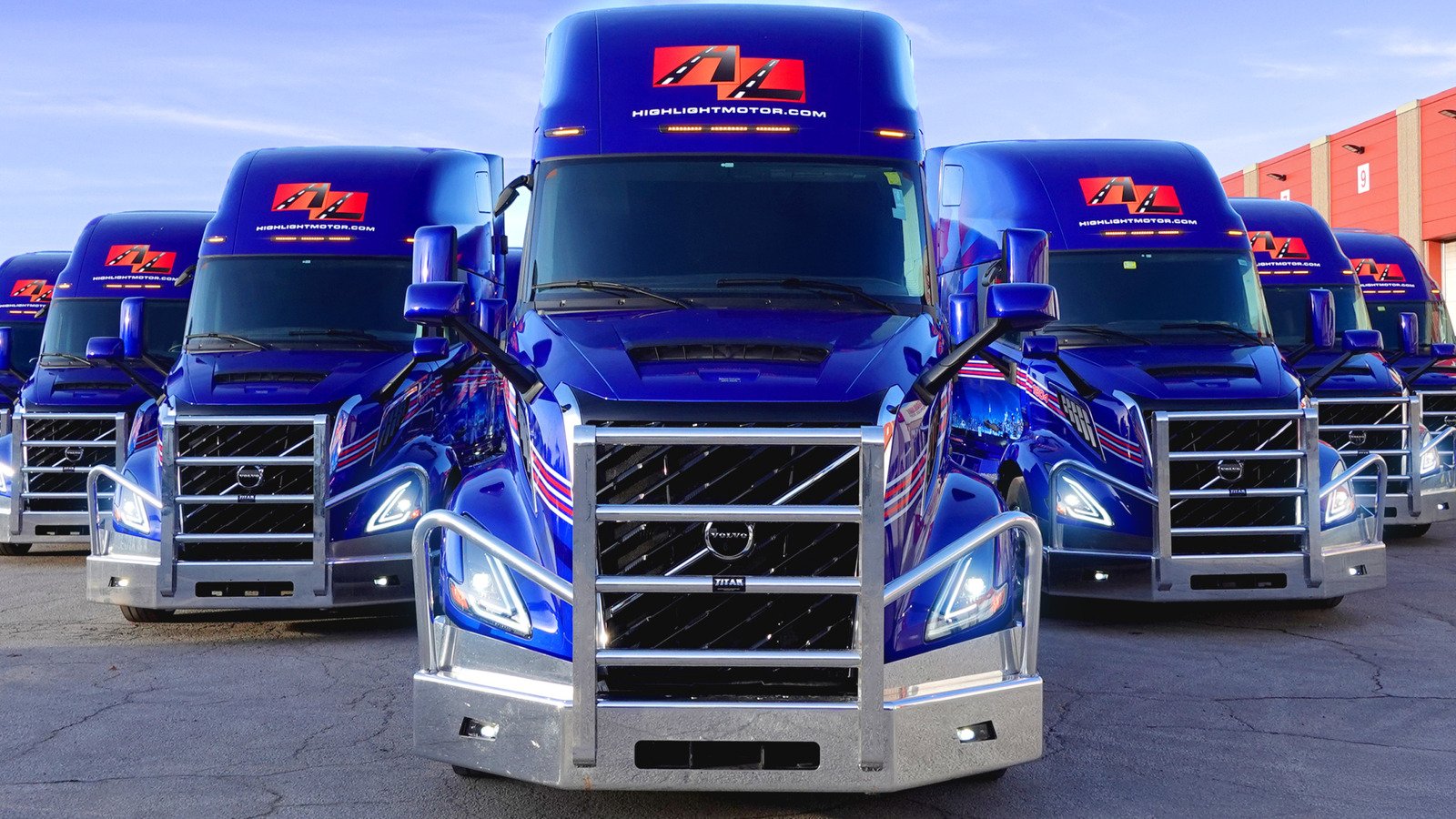
Semi-truck drivers, operators and truck manufacturers are constantly looking for ways to improve mileage. Newer trucks have evolved with more rounded and aerodynamic designs to save every ounce of fuel. For example, NASA-inspired Airtabs ducting can improve airflow to help save diesel and improve sustainability. However, Volvo Trucks has another solution for saving fuel, and it goes beyond streamlining the body design or being the world’s fastest Semi.
Volvo is using advanced connectivity and software-integrated hardware in its semi-trucks to maximize fuel economy. It starts with the brand’s I-Shift automated manual transmission, which uses state-of-the-art electronics to select or hold gears by tirelessly monitoring engine load shifting, terrain grade, road speed and truck weight. In 2013, Volvo released an upgraded version of the 2012 i-C, a predictive and intelligent cruise control system that works exclusively with the i-Shift gearbox to help realize better fuel economy. The 2013 i-C update targeted fuel savings on hilly terrain by using road topography data preloaded from a central server (updated periodically) before the truck reaches steep gradients. Volvo claimed that the system saved fuel consumption by up to 5%.
The Swedish automaker’s 2019 development of the i-C PVT-MTM, PVT-BAS and map-based PVT-MAP versions uses GPS coordinates and topography maps along with information on speed limits, roundabouts and road curvature, enabling the system to choose the right gear for a range of driving scenarios and maintain the appropriate speed and supplemental braking for maximum efficiency – especially in hilly terrain. Using that information, the system saved up to 7% fuel when combined with Volvo’s D13TC engine.
I-C Connectivity and Stage Spotlight
New Volvo trucks have a Telematics Gateway (TGW) system that receives updated topography information from a cloud-based server to support I-C. As a truck drives down a mountain road for the first time, the i-C sends information about the local topography to the server. When another truck passes through the same terrain, the system will automatically download the information and use software to optimize the truck’s acceleration, braking and gear changes.
Volvo’s i-C works in six stages. First, the system receives topographic data from the server and allows the truck to build speed by selecting and maintaining the highest gear when climbing terrain. The I-C then resists downshifting as it crests the hill. Third, as the truck approaches a slope, the system will stop accelerating. Fourth, it will temporarily shut down the driveline just before the descent to coast. The fifth stage is when i-C controls downhill braking, applying brakes only as needed to conserve speed.
The sixth and final stage allows the truck to coast and increase speed as it approaches the next climb. The process remains consistent whether the driver has road knowledge or not. Fuel economy is at the center of every step, but the system also helps reduce diesel emissions while squeezing more range for battery-powered electric trucks.