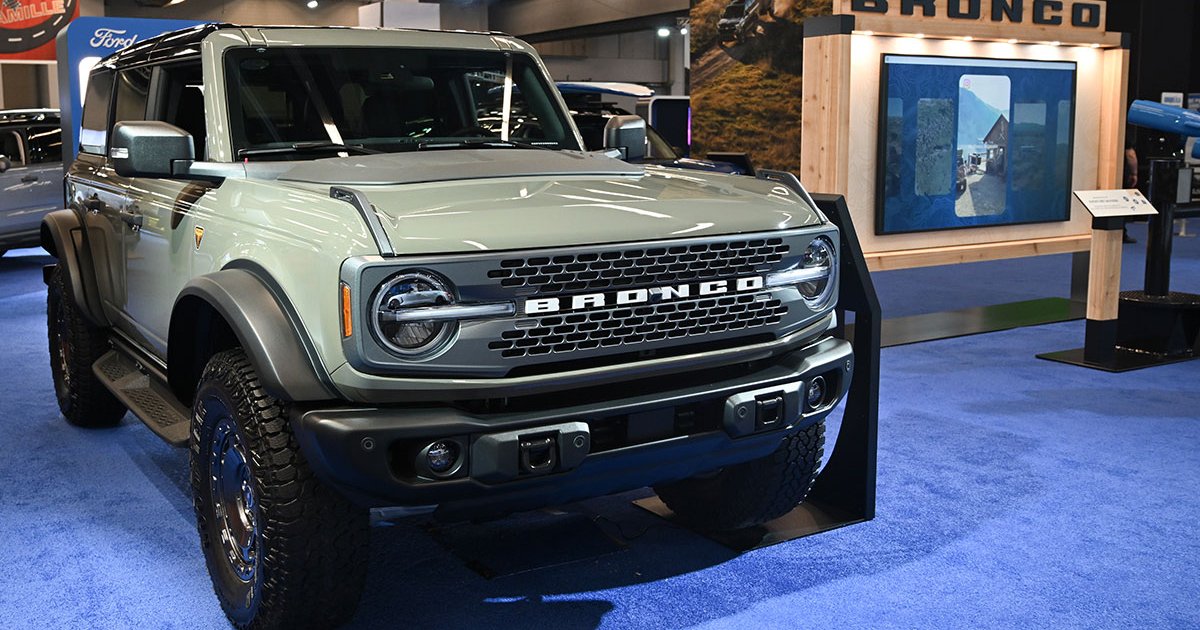
A 2025 Ford Bronco Badlands SUV. (Graham Hughes/Bloomberg)
key takeaways:
- Ford reported adjusted earnings of 42 cents per share, beating estimates and raising its 2026 EBIT outlook to $10.5 billion-$11 billion.
- Sales of higher-margin Bronco and Explorer SUVs helped offset weak F-Series availability, while Ford cited more than $1 billion in tariff costs.
- Ford expects improvements from additional F-Series production and says energy storage benefits won’t show up in results until 2028.
Ford Motor Co. reported earnings ahead of Wall Street estimates and raised its outlook for the second time this year on higher prices and strong sales of higher-margin sport-utility vehicles.
Adjusted earnings were 42 cents a share, which was above the 36-cent average of analyst estimates compiled by Bloomberg. Ford now expects to earn up to $11 billion before interest and taxes this year, up from its earlier forecast of $8.5 billion to $10.5 billion, the company said in a July 28 statement. Analysts on average expected $9.5 billion.
The improved outlook shows how Ford is capitalizing on resilient demand for SUVs and pickups, echoing a similar move by rival General Motors Co last week. Those models generate significant profits for Ford as the company shrinks its loss-making electric vehicle operations and digests higher costs from tariffs and commodities.
It’s also a sign of momentum as the company invests $2 billion in a new energy storage business that may take years to generate returns.
CEO Jim Farley said in a statement that the results “reflect growing evidence that Ford is becoming a more profitable, more disciplined and truly different company.”
Ford shares rose 7.2% in after-hours trading in New York. The stock is up 14% this year through July 28, better than the broader S&P 500 index.
The automaker softened the blow of a 10% decline in U.S. vehicle sales in the second quarter by delivering large numbers of profitable Bronco and Explorer SUVs, particularly higher-margin models equipped with expensive off-road performance packages.
That helped offset the loss of profits last year caused by a fire at a Novelis Inc. aluminum mill in New York state that left the best-selling F-Series pickup on hand, which provides material for the truck’s body panels. The mill resumed operations in the second quarter, and Ford expects to make up for some lost production in the back half of the year.
According to an investor presentation, the company now expects to recoup about $2.5 billion of lost F-Series production due to the fire, down from its previous forecast of $3 billion.
Chief Financial Officer Sherry House said Ford expects more than $1 billion in tariff costs this year to come from aluminum imports caused by the Novelis fire.
“Our tariff costs are too high because of the Novelis supply disruption and we need to be able to secure aluminum from outside the United States,” House said in a call with reporters on July 28. “Our tariff costs are now largely focused on aluminum and steel and incoming vehicles.”
Ford has also benefited from its foray into energy storage, which sent its shares rising the most in 17 years in May as investors linked the old-economy automaker to a surge in artificial intelligence spending.
“We have a number of potential customers reaching out to us from sectors including power generation and data centers,” House said. Profits from the new energy business won’t show up in financial results until 2028, he said.
The move into the battery business came as Ford failed in its effort to sell electric vehicles. reuse An EV battery plant in Kentucky to make batteries for energy storage.
That facility was part of Ford’s now-defunct joint venture with South Korea’s SK On to make EV batteries. Ford booked a massive non-cash charge of $3.6 billion in the second quarter related to the previously reported wind-down.
EV calculation
Ford’s EV sales fell 41% in the second quarter, after it discontinued its F-150 Lightning plug-in pickup due to a $19.5 billion charge on underperforming EV assets. Ford is shifting its EV strategy to focus on less expensive models, starting with a small $30,000 electric pickup truck to launch late next year.
Farley has promised to build several affordable electric models from what the company calls its Universal Electric Vehicle Platform, which will be produced in a former SUV factory in Kentucky. He has said these models are important to fend off competition from Chinese automakers that are gaining ground around the world with cheap, high-tech EVs but have been kept out of the US because of formidable trade barriers. Farley himself has said that having Chinese cars in the US would be “disastrous”.
Connected: Ford CEO Farley says Chinese cars will be disastrous in the US
On the other hand, Farley has also praised the cost and technological advantages of Chinese automakers and said that they represent an existential threat to Western car companies.
Last week, Ford announced a joint venture with China’s Geely Automobile Holdings to co-develop electric SUVs for Europe and share production at a Ford factory in Spain. Ford has also signed a licensing agreement with Chinese battery giant Contemporary Amperex Technology Co. to make batteries for both EVs and energy storage.