
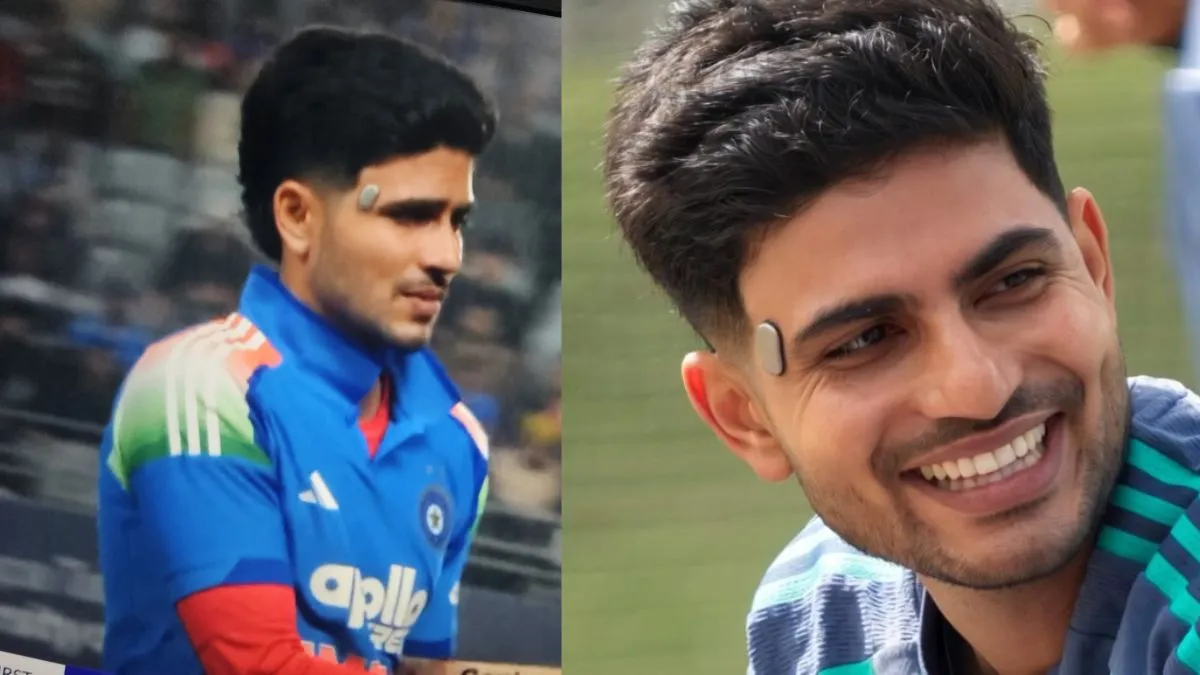
Cricket fans noticed something odd during India’s first ODI against New Zealand. CaptainShubman Gillhad a small device on the side of his forehead. Social media lit up with the same question: what is it? It is not a sticker. It is a wearable sensor, which aims to track blood flow linked to the brain.
Unlike regular fitness trackers, which focus on heart rate, steps and sleep, this device aims to provide information about changes in brain-related activity. But what does it actually measure, and can it help athletes improve their performance?
Shubman Gill’s Sticker On His Forehead Explained
Shubman Gill was first spotted wearing a device during the recent match. It was also visible during the opening match at Eden Park, New Zealand.
The small wearable is fastened to the skin by an adhesive, close to the temple. It has also been seen worn by Indian badminton player PV Sindhu in international badminton events.
But Gill hasn’t yet made it public why he is employing the device. It’s not known if he is testing it for personal training purposes or a larger performance-monitoring program.
What Is The Device And How Does It Work?
The device is a wearable health and fitness monitoring device. It is used to monitor changes in cerebral blood flow. This is the flow of blood around the brain that provides oxygen and nutrients to the brain for normal functioning.
https://x.com/DrRichakS/status/2117805780166713603
The wearable, according to publicly available descriptions, is based on optical sensors that are able to sense changes in blood-related signals around the forehead. These readings are then analyzed to give information regarding physiological responses.
The apparatus is designed to demonstrate the variations in the internal reactions in the body during exercise, rest and stressful situations.
It is important to understand that a wearable reading is not the same as a detailed medical assessment of brain function.
What Does The Device Measure?
The device is intended to provide information about several physiological parameters.
1. Changes In Cerebral Blood Flow
Blood is essential for the brain to work. Changes to physical activity, posture, and other physiological factors may affect blood flow.
Its goal is to trace the changes in signals related to the flow of blood in the brain. This can provide more data on the body’s reaction to exercise.
But a change in a sensor reading doesn’t necessarily mean that the brain is better or worse functioning.
2. Cognitive Load And Mental Effort
The term cognitive load is used to describe the effort that a learner must expend in completing a task.
This may include making instant decisions, reading the bowler’s movements and making judgement calls and keeping concentration in a stressful situation for a professional cricketer.
Physiological parameters reflecting mental effort could be useful to researchers for understanding bodily responses to challenging situations.
But it cannot be used as a direct indicator of intelligence, concentration or decision-making power.
3. Physical Stress And Recovery
High intensity training involves stress to the body. Rest and recovery (as well as sleep) is also crucial to sustaining performance.
Its goal is to monitor changes in the physiology that could be related to physical exertion and recovery. This information may be able to supplement other monitoring systems utilised by sports scientists.
It alone cannot be used to decide if an athlete is completely recovered or medically cleared to play.
4. What Is The Entropy Score?
The device also measures an Entropy score. Its developers call it an indicator of ‘physiological effort or strain’.
The score should reflect change related to factors like exercise, sleep and stress.
It’s a measurement by the device, however. It should not be confused with a standard medical measurement or used to diagnose fatigue, stress or a neurological condition.
Can Brain Monitoring Wearables Improve Athletic Performance?
Wearable brain-monitoring technology is an emerging area of research. Scientists are exploring how changes in brain-related signals can be studied during movement, exercise and everyday activities.
A 2024 review published in the journalSensorsexamined the challenges of using near-infrared spectroscopy (NIRS) to monitor cerebral blood flow. The researchers found that movement, changes in sensor contact and other
This is important for athletes because their bodies are constantly moving during training and competition. A device may collect physiological signals, but those readings need to be accurate and properly interpreted before they can guide performance decisions.
There is currently not enough independent clinical evidence to establish that the device improves concentration, reaction time or sporting performance.
What Does Shubman Gill’s Device Mean For Sports Technology?
The sight of Gill wearing the device reflects the growing interest in technology that goes beyond tracking steps, heart rate and calories.
Professional athletes already use several tools to monitor training intensity, sleep and recovery. Wearables that study brain-related physiological signals could add another area of information in the future.
However, the technology still needs independent testing to establish how reliable and useful its readings are in real sporting conditions.
For now, the device offers an interesting example of how sports science is exploring the relationship between the brain, physical effort and recovery. Its actual benefits for athletes will depend on stronger scientific evidence.


