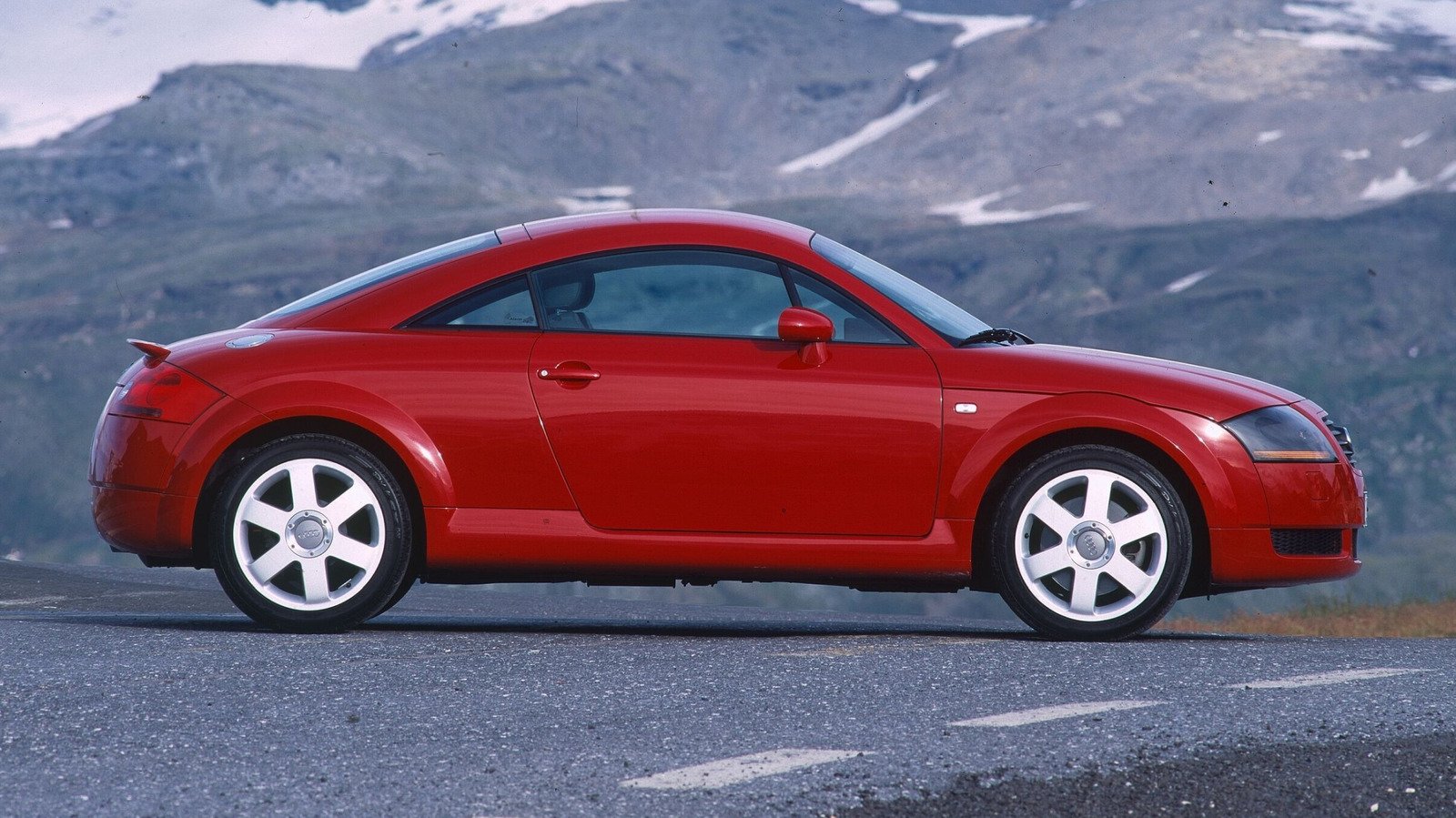
The Audi TT’s somewhat controversial name has two meanings, and “twin turbo” is not one of them. Interestingly, the official and unofficial meanings of the TT badge were written by the same man. The official TT badge pays homage to a famous motorcycle race that began in 1907: the Isle of Man Tourist Trophy. The Tourist Trophy, or TT Race, was where the production Audi TT got its name. To understand why it was named this way, we have to go to the pre-war era.
Before Audi became the German premium brand we know today, it was part of Auto Union AG, which was formed in 1932 when Audiwerke, Horchwerke, DKW and Wanderer (hence the four interlocking rings logo) merged. DKW had the strongest ties to racing and its cars competed in four-wheel Tourist Trophy racing in the 1930s. Volkswagen acquired Auto Union in 1965 and merged the German auto brand NSU with Auto Union in 1969. NSU machines competed in the inaugural Isle of Man TT and continued to do so until the 1930s, further cementing the Touring Trophy DNA within the union.
Audi TT designer Freeman Thomas made a small sketch of the two-seat convertible sports car during a business trip to Germany in 1994. Audi’s then-design chief Jay Mees saw the sketch and took it to Dr. Ferdinand Piech, CEO of VW, and his support led to the car being shown at the 1995 Frankfurt Motor Show. Thomas needed a name for his concept car, so he borrowed it from a vintage NSU TT racing car, and an icon was born.
There is another meaning behind the name TT
As for the informal meaning of TT, the car’s designer Thomas Freeman took into account considerations of tradition and technology when refining the car’s final shape. The “Tradition” part refers to the Audi TT’s minimalist Bauhaus styling cues. No Audi had looked this good before the TT’s production debut in 1998 (2000 in North America), and it instantly became iconic for retaining its concept car styling cues.
As far as technology goes, the Audi TT led the way without boasting about it. It was the first mass-produced car with a four-cylinder turbocharged engine, a five-valve-per-cylinder 1.8-liter unit producing 180 horsepower. It was also the first to use VW’s 4Motion all-wheel drivetrain in a production model. In 2004, Audi gave the TT a 250-horsepower 3.2-liter VR6 engine and paired it with a dual-clutch automatic transmission (DCT). The second generation Audi TT, launched in 2006 (coupe) and 2007 (roadster) was the first generation to have magnetic adaptive suspension, while the third generation model, launched in 2014, was Audi’s first to have a fully digital virtual cockpit.
The final edition Audi TT goes on sale in 2023 to celebrate 25 years of sports car heritage. But that’s not the end of the story, as the stylish Audi Concept C is being built as its successor. It may not follow the tourist trophy connotations of its predecessor, and it is certainly going beyond established conventions. But it stays true to the “technology” aspect that was part of the birth of the Audi TT all those years ago.