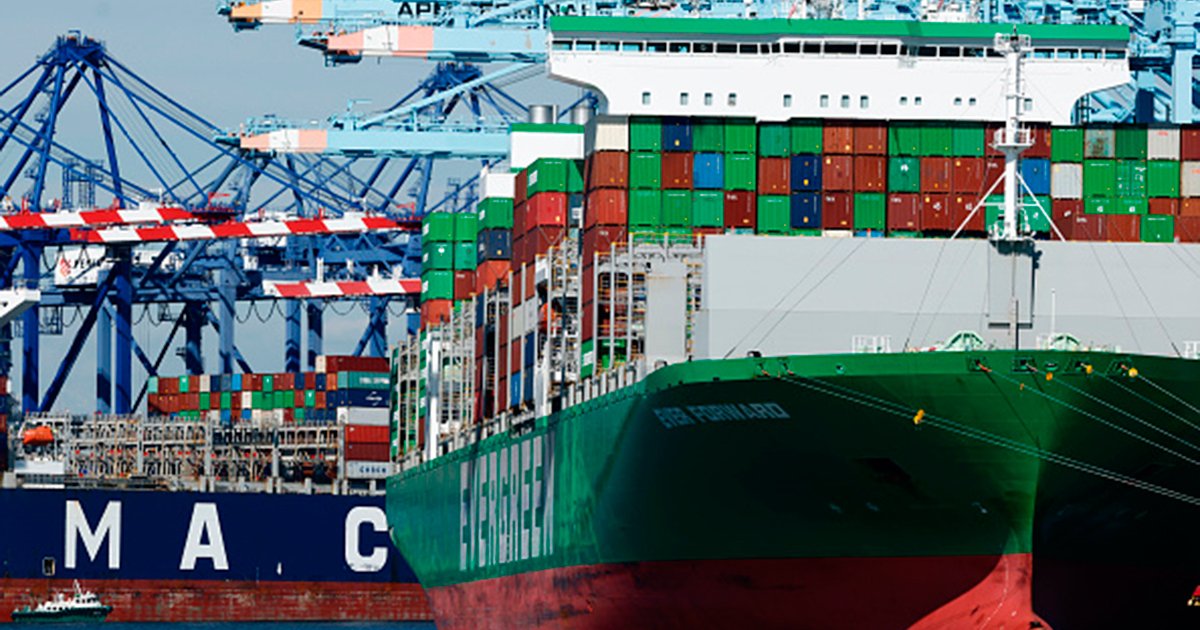
Shipping cranes stand above containerships loaded with shipping containers at the Port of Los Angeles. (Mario Tama/Bloomberg)
key takeaways:
- Energy and shipping interests are lobbying President Donald Trump on whether to extend a 150-day Jones Act waiver allowing foreign ships to carry cargo between U.S. ports.
- Oil and gas groups say the exemption lowers fuel costs and improves supply, while maritime advocates warn it threatens shipbuilding investment, jobs and national industry capacity.
- Trump must decide next month whether to extend or end the waivers, with political pressure, midterm dynamics and potential targeted waivers shaping the outcome.
Energy and shipping industry executives are locked in an increasingly bitter lobbying battle over the future of the century-old Jones Act, struggling to determine the long-term fate of the crucial protectionist law.
Oil and gas companies are excited by President Donald Trump’s wartime decision to allow foreign tankers to carry cargo between U.S. ports, and argue that the 150-day waiver implemented during the Iran war proves American consumers will enjoy lower-priced gasoline, oil, jet fuel, ammonia and other products without the law’s protectionist restrictions.
Trump faces a deadline next month on whether to extend or end a waiver on the law that requires ships carrying cargo between US ports to be built, owned and crewed in the US.
Supporters of the Jones Act, including influential Republicans such as House Speaker Mike Johnson (R-La), argue that withdrawing from the law could lead to sweeping changes to the nation’s maritime industry and undermine Trump’s pledge to boost American shipbuilding and broader efforts to fight globalization. Private lenders are already blocking domestic marine funding citing uncertainty in the law.
The emerging expansion has led to a flood of lobbying, advertising and social media influencer posts from industries ambivalent about measurement. Ultimately, the decision may come down to what Trump prioritizes more: lower prices or American manufacturing.
“Once you see something like this you can’t ignore it,” said Mike McKenna, a Republican strategist and energy lobbyist who lauds the relief for opening new energy pathways to the US.
Support the Jones Act. Put America first.
chairman @realdonaldtrumpTrust your intuition.
Eliminate discount.
Get Americans back to work. 🇺🇸➡️ pic.twitter.com/StIsrW2FEB– AMP Maritime 🇺🇸 (@AMPmaritime) 26 May 2026
With mid-term elections approaching, the oil lobby may gain the upper hand. Gasoline prices remain high as traffic has dropped to its lowest level in a month due to the recent attacks in the Strait of Hormuz. Overall, the costs from the President’s tariffs continue to rise. And Trump had previously expressed skepticism about the Jones Act, but ultimately backed off from administrative action to weaken provisions of the law in his first term.
Energy Secretary Chris Wright said that this issue has been in discussion recently. “It’s been very effective in moving energy around,” Wright said at an event hosted by Reuters on June 24. “I’m sure there will be ongoing conversations about what to do there.”
Even without renewal, the 150-day waiver has created an opportunity for Jones Act opponents to call for its removal.
The American Petroleum Institute is pushing for policy changes that would create market-based triggers to automatically activate Jones Act allowances in a number of circumstances, including fuel supply shortages, disruptions and price increases. Koch-backed Americans for Prosperity has spent more than $100,000 on digital ads calling for repeal of the Jones Act.
The path through Congress for actual repeal is difficult, especially given opposition from key House Republicans. Earlier this month, 52 House Republicans, including Johnson and House Majority Leader Steve Scalise (R-La.), asked Trump to allow the existing exemptions to expire.
But the administration could still enact industry-specific exemptions or provisions that would make it easier to offer exceptions.
Supporters of the Jones Act worry that shipbuilding investment will falter due to uncertainty over the future of the law. Previous US presidents have occasionally granted waivers – for days or weeks – such as after natural disasters including Hurricanes Harvey and Irma in 2017.
Jones Act supporters say the 106-year-old maritime law has contributed to an expansion in the number of cargo ships built in the U.S., which are largely made up of tugboats, towboats and barges that handle trade in the Gulf and along inland or coastal waterways.
The number of Jones Act-compliant ships, not including passenger or crewboats, is expected to increase by 14% between 1991 and 2023, to 42,574 units. Still, U.S. shipbuilding capacity pales in comparison to other countries, including China, which will produce about 1,800 large commercial ships in 2022 compared with the U.S.’s five, Transportation Secretary Sean Duffy said. wrote Last year.
Domestic shipbuilders are still worried. A planned capital raise of $1 billion from the US Maritime Investment Forum has already been put on hold due to uncertainty over the waiver. data From the Shipbuilders Council of America. About $6 billion in fleet capitalization could be at risk over the next five years, according to the trade association’s internal estimates seen by Bloomberg.
“Banks and investors are not going to spend capital on something that could potentially disappear,” said Lawrence Strohm, a Philadelphia-based ship’s captain.
The American Maritime Partnership created a digital ad in favor of the Jones Act, and since mid-May more than a dozen social media influencers have posted supportive messages.
“The facts increasingly suggest that the president is being misled,” said Clay Heil, vice president of global government relations at U.S. shipping company Crowley Maritime Corp. Heil argued that the relief would not significantly reduce energy costs, while leaving America’s maritime power in limbo due to potentially lost jobs and halted investment in shipbuilding capacity.
Bingo. There is almost zero shipbuilding (0.03% of global production) and far more effective/efficient means of providing US civilian crews to meet sealift requirements. The Jones Act is a failure. https://t.co/PHae1KxIQe
– Colin Grabow (@cpgrabow) 13 July 2026
Still, according to Colin Grabow, an associate director of the libertarian Cato Institute, which opposes the legislation, Trump’s waiver shatters the notion that the Jones Act is invincible.
“Modernizing and reimagining the Jones Act is very appropriate, especially given the successes we have seen over the past few months,” said Anne Bradbury, CEO of the American Exploration and Production Council, which represents independent oil and gas producers.
During Trump’s first term, his administration briefly considered expanding Jones Act requirements to ships carrying equipment for offshore oil and gas facilities. But he later also considered relaxing Jones Act orders to facilitate shipments of liquefied natural gas to Massachusetts and Puerto Rico.
Trump ultimately abandoned that LNG plan due to political pressure from prominent Republicans, including his trade adviser Peter Navarro. But two advisers – Trump’s former chief economist, Casey Mulligan, and current National Economic Council Chairman Kevin Hassett – suggested in a pair of books that although Trump chose to postpone action amid political pushback, they remain skeptical of the protectionist measure.
“President Trump hates the Jones Act,” Mulligan wrote.
Written by Amy Stillman, Ari Natter and Jennifer A. Dlouhy