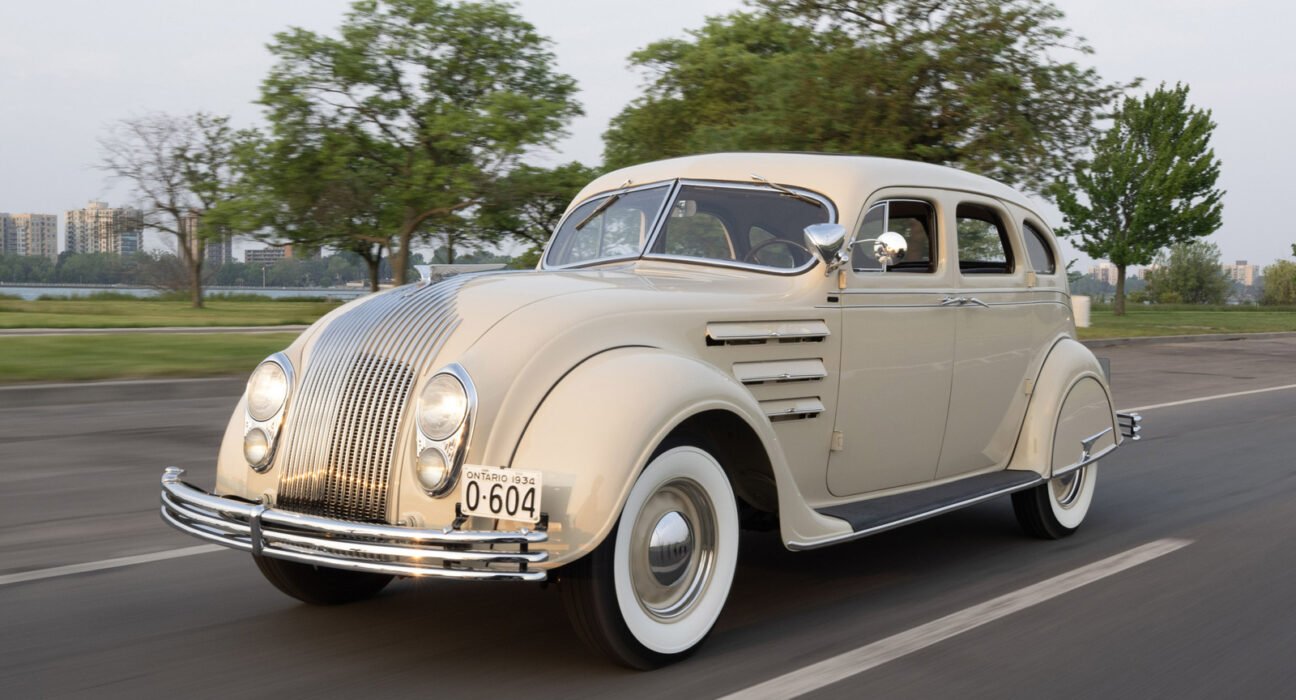
Truth be told, many observers might say that the Chrysler Airflow was a flop in the ’30s – at least partly because of its innovative design. The look departed dramatically from what drivers of the time expected from their cars. For example, compared to rivals such as the Buick Series 60 of the time, the Airflow was much smoother and sleeker, with headlights that were integrated into the front body work and an attractive waterfall grille that flowed neatly onto the hood. Nor did it have the upright greenhouse and long hood of the Buick.
And it wasn’t just art for art’s sake. The Airflow’s exterior was the result of an intensive effort led by Chrysler engineer Carl Breyer to apply the same focus on aerodynamics to the world of four-wheel transportation in the growing aviation industry. Anecdotally, he was inspired when he saw a group of airplanes traveling in a formation in the sky above.
Breyer’s starting point was to build a small, 2- by 3-foot wind tunnel to help see how air flowed around a scale model – the first time it was used in automotive applications. In addition to informing the shape of the airflow’s design, it also changed the car’s proportions compared to its competitors. The result was that Breyer and his team found that it was better for aerodynamics to have a vehicle that was essentially tapered from front to back – like airflow – than the other way around, as was the case with its competitors. But the buyers weren’t having it. Chrysler retired the Airflow in 1937, after selling only about 55,000 examples during its four-year lifespan.
What were the common problems with air flow?
It wasn’t just a case of people getting distracted by the fierce form of airflow. Chrysler introduced several impressive mechanical innovations with the vehicle, including unibody construction. However, the company started production of the car before all its shortcomings were resolved. One story claimed that Chrysler was rushing to beat a GM vehicle coming to market. But whatever the reason, customers weren’t happy with the results.
The problems actually started with production delays. Chrysler received thousands of Airflow pre-orders during the car’s debut at the 1934 New York Auto Show, but could not get them off the assembly lines until three months later. Many of those who had placed their orders apparently chose other cars in the interim, and people began to blame the delays on Chrysler’s perceived inability to deliver on the benefits of the Airflow.
Then there were the mechanical flaws themselves. Most attention, and rightfully so, went to faulty engine mounts, which can cause the motor to drop to the road while you’re driving. According to automotive historian, there were also concerns about the structural integrity of the Airflow. aaron seversonBreer collected a significant collection of letters from owners complaining about problems in early Airflow models.
It’s also worth looking a little more closely at that “structural integrity” business, because its origins may lie in the aggressive anti-airflow advertising of competing automakers. For example, the “Steel is not enough” campaign portrayed the Airflow’s all-steel construction as unsafe for passengers – although, of course, this was not the case. The Karma was one of those advertisers for GM when it brought out the Chevy Corvair.
Was the Chrysler Airflow expensive?
Another major issue was time. Just months after the Department of Labor (DOL) consideration, Chrysler attempted to launch a family of expensive new cars. worst year ever For unemployment in American history. Excluding members of the military, about 25% of the workforce, representing about 12,830,000 people, were without a job in 1933. And this was on top of a 29% decline in real GDP between 1929 and 1933. Sure, the economy began to slowly recover from that nadir, but then the country suffered massive work stoppages, many of which resulted in violence. The DOL counted 1,856 work stoppages during 1934. All this means that when Airflow was launched the economic situation was not particularly good.
Meanwhile, the relatively low-cost DeSoto-branded Airflow model was priced at $995 in 1934. Yes, that’s about $25,300 today, but at the time, the average annual income was $946, so that was a very large percentage of a person’s annual salary. Remember, that’s more than $66,000 per year in 2026, when 74% of people think new cars are unaffordable.
The Chrysler Airflow took the cost of entry to the next level. Jay Leno has a 1934 Chrysler Imperial Airflow CX that cost $2,345 when new, which is about $60 more today. As for the range-topping model CW Airflow Imperiale Custom Eight, which cost more than $5,000 – at the time, the cost was about the same as you’d pay for a Mercedes-Benz S 580 4Matic in 2026.