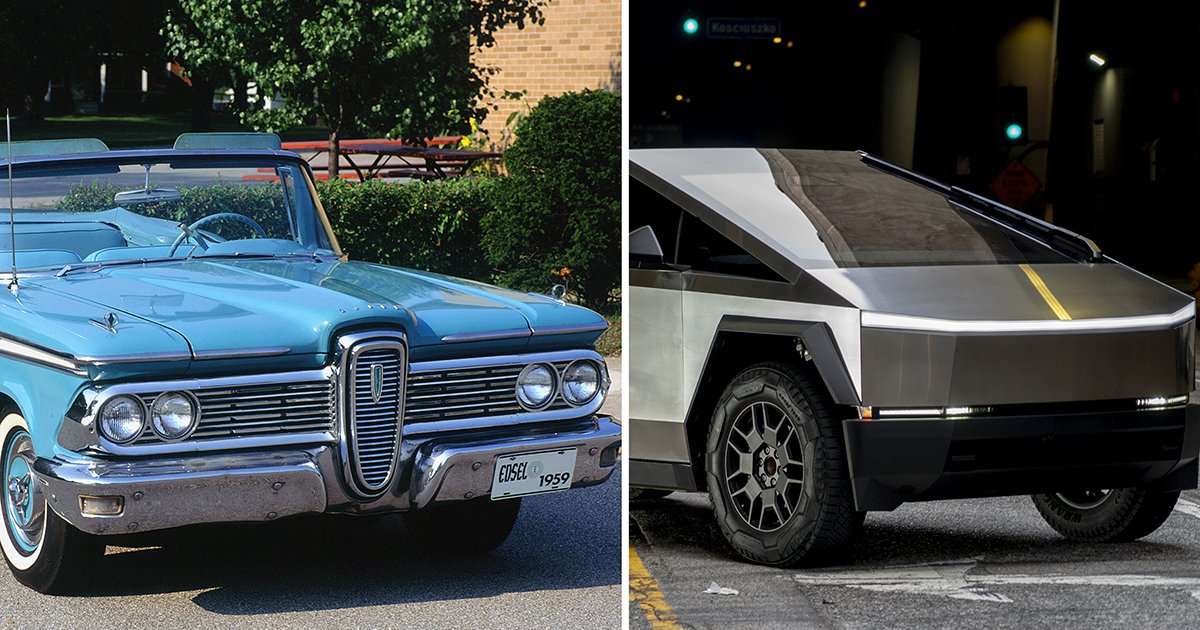
Ford Edsel (left) and Tesla Cybertruck. (Bloomberg)
key takeaways:
- Tesla’s Cybertruck is being compared to Ford’s Edsel after sales expectations fell sharply after deliveries began in 2023.
- US Cybertruck registrations totaled 7,133 as of May, while production issues, recalls, high prices and Musk’s politics hurt demand.
- Analysts said Tesla may try a new design or variant, but the Cybertruck is unlikely to be discontinued within the next year or two.
Nearly 70 years ago, the Ford Motor Company introduced a car that was widely viewed as the biggest automotive flop of all time. Tesla Inc.’s Cybertruck may be on its way to claiming that title.
Ford’s Edsel, unveiled in 1957, was introduced as an entirely new kind of car, with an oval-shaped front grille like a horse’s collar. The company estimated it would sell 200,000 units in the model’s first year on the market. Ford sold less than one-third of that goal, and the Edsel’s design became a laughing stock.
Tesla begins deliveries of its unusual angular Cybertruck in 2023. CEO Elon Musk called it the company’s best product to date and estimated the carmaker could build more than 250,000 annually depending on demand. Tesla sold less than a sixth of that number in its first year, and the truck’s blocky look became a punchline.
Edsel sales declined each year the model was on the market, and Ford discontinued the car in 1959. Cybertruck sales got off to an even worse start. Only 7,133 were registered in the US as of May this year, according to S&P Global Mobility data provided to Bloomberg News. With the creation of SpaceX, this count has been increased by Musk’s other companies. Fleet Of Cybertruck.
Tesla didn’t break out Cybertruck sales in its financial releases, and investors will be more focused on the company’s spending for driverless vehicle and robotics ambitions when it reports second-quarter earnings on July 22. While the Cybertruck has been a major disappointment for Tesla, Garrett Nelson, an equity analyst at CFRA Research, thinks it’s unlikely the company will announce its discontinuation in the next year or two.
“It’s possible that they try to do some kind of redesign, or come out with a different version to try to increase sales,” he said, “but we think that would really be a wasted effort.”
Most likely, Nelson said, “it’s probably going to be over.”
Tesla did not respond to a request for comment.
Certainly, the Edsel and the Cybertruck have plenty of company.
In the early 1980s, John DeLorean introduced his eponymous stainless-steel sports car with gull-wing doors. Quality issues and a price more than double that of the average new car mean that only about 9,000 cars have ever been produced.
When General Motors’ Pontiac brand introduced the Aztek in 2000, the mid-size SUV’s plastic-clad body was so sharply criticized that it was redesigned after just a few months. Aztec could only reach 37% of this 75,000 sales target in its peak year, according to car-buying researcher Edmunds. GM discontinued it in 2005.
But initial sales projections for neither of these models were as ambitious as those for the Edsel and Cybertruck.
great expectations
Ford launched the Edsel with a prime-time TV special to show off its vertical grille, a rotating dome speedometer, and the “TeleTouch” push-button shift option in the center of the steering wheel. Its base-model price was less than $2,500—about $30,000 in today’s dollars—in an effort to make it affordable for the middle class.
Car buyers were not impressed. In 1958 America was in a recession and consumers were watching their wallets. Despite Ford’s extensive consumer research for the Edsel, the car’s design did not appear modern.
Journalist and auto historian Don Sherman said, “To most people it was downright ugly.”
Musk had talked about Tesla’s first EV truck for years. He unveiled it in 2019 with a Blade Runner-inspired introduction, saying, “You want a truck that’s actually tough, not fake tough.”
When Tesla’s chief designer, Franz von Holzhausen, smashed the truck’s steel exterior with a sledgehammer, there wasn’t a scratch. But then von Holzhausen threw a metal ball at the truck’s “armor glass”, which shattered. Even after Musk announced a starting price of $39,900, customers pre-ordered the pickup by the thousands.
Initial reviews were mixed, with Road & Track calling the design “wacky”. By the time Tesla began delivering the pickup, several years behind schedule, the company charged early buyers more than $100,000.
“The Cybertruck is very unique,” said Stephanie Valdez Streete, director of industry insights at Cox Automotive. “The design can be very polarizing. It’s expensive.”
Quality and design issues
The Edsel’s steering-wheel-based Teletouch transmission system often malfunctioned and drivers became confused – many attempting to blow the horn ended up trying to reverse their car.
Ford built the Edsel on the same assembly lines as its standard Ford and Mercury vehicles. Quality suffered, as workers had to change tools and then switch back without slowing the production line. This led to Edsels being shipped incomplete, with some parts in the trunk to be installed at the dealership.
The Cybertruck faced production challenges from the beginning. Its stainless-steel body was difficult to shape and weld together. It has been plagued with recalls, and Tesla has been sued because its truck doors would not open after a crash.
A banner is left outside a Tesla showroom during a demonstration in 2025. (Armando Franca/AP)
Musk’s polarizing political activities haven’t helped. The world’s richest man was the largest individual donor to the 2024 presidential election and faced Democratic backlash for his support of President Donald Trump. He led the Department of Government Efficiency which cut federal programs and their workforce, leading to protests at Tesla showrooms and calls for a boycott. Some Tesla owners sold their vehicles, and the Cybertruck in particular became synonymous with Musk.
In the end, the failure of the Edsel cost Ford about $350 million, or $2.5 billion in modern dollars. Yet many collectors today appreciate the novelty of the Edsel and pay up to $35,000 for restored models.
It’s unclear what the Cybertruck’s appeal might be in the coming years.
“Like the Edsel or Aztec, the Cybertruck’s unconventional styling was always going to limit its appeal to a niche audience rather than traditional, practical car buyers,” said Jessica Caldwell, head of insights at Edmunds. “It essentially acts as a rolling billboard for divided public sentiment, creating as much brand friction in the market as it does attracting attention.”