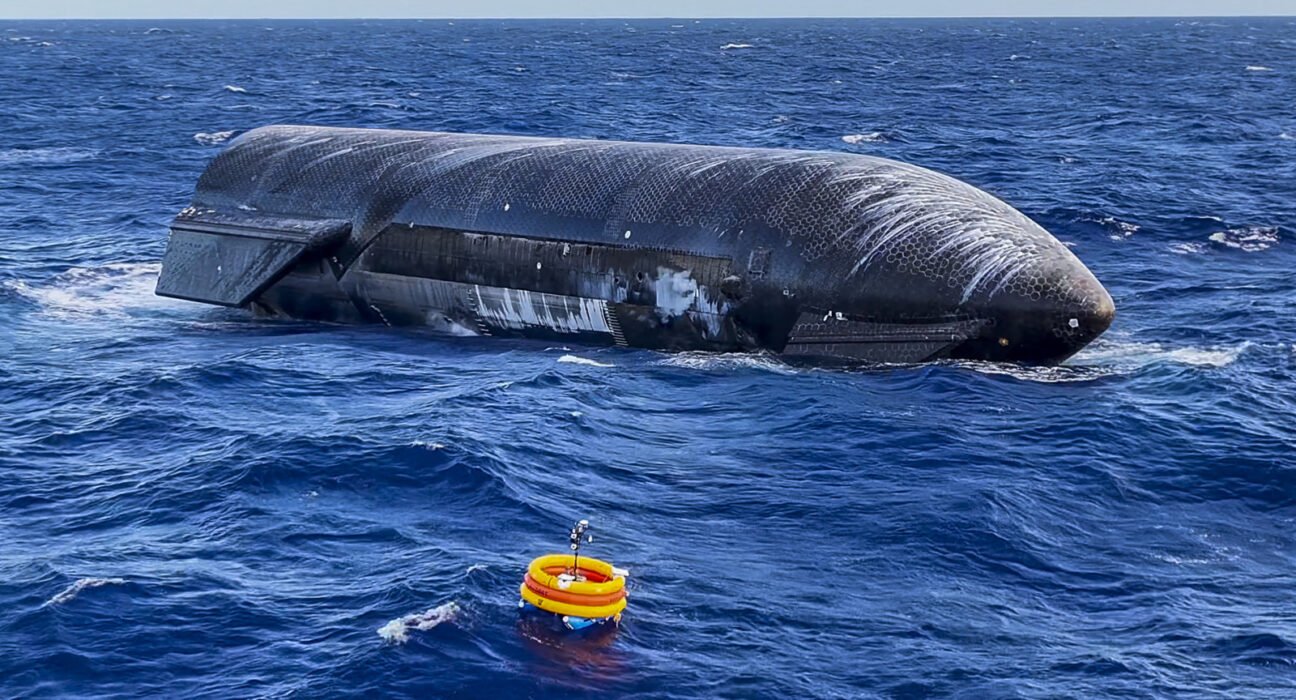
The latest SpaceX Starship is hovering quietly in the middle of the Indian Ocean. It may not seem like where a space rocket wants to be, but it actually represents a successful splashdown for the upper stage of the latest Version 3 model. It could also be landed on the target and recovered by boats and towed back to shore. But the problems are hidden there. It seems that like CEO Elon Musk’s other company Tesla, SpaceX is also struggling with the problem of panel gap. In particular, the heat shield shows clear white streaks, indicating that extremely hot air has got between the heat shield tiles during atmospheric reentry. And that’s not even the worst issue. Starship V3 has a long way to go before it’s ready to land astronauts on the Moon.
To be clear, heat shield Work done, In the sense that the starship’s upper stage made it back to Earth in one piece. Even the heat shield is mostly in one piece. Only a small number of its 18,000 tiles fell. But it did not pass this test: According to a joint post By current and former space professionals, “several dozens to hundreds of tiles were broken, broken and substantially damaged.” Combined with the white-streak indication of panel gaps, that brings the condition of the heat shield into serious question. Maybe it’s okay! Then again, maybe that’s not the case, in which case it will need to be replaced with a brand new one. In any case, the only way to know would be to spend weeks or months examining the shield.
If this sounds familiar, it’s because this is exactly the same process that the Space Shuttle had to go through during its life cycle, e.g. Ars Technica notes. This is part of what kept the shuttle from flying as often as the airplane, one of the original hopes of that project. SpaceX has the same hope for Starship, and in fact, its extremely high (albeit falling) valuation depends on it. To be worth trillions of dollars, SpaceX needs to deliver on a number of promises, including huge satellite constellations, AI data centers in space, and frequent trips to the Moon for both personnel and cargo. Only Starship, not the Falcon 9, the company’s reliable workhorse, can do all this. However, it requires doing all that, which means frequent flights. This is not possible if the heat shield has to be carefully checked every time.
long term problem, long term solution
In fairness, this is a long-term problem. The current heat shield system will be sufficient to test Starship, which is still in its prototype stage. This will likely be enough to begin launching new Starlink V3 satellites, that can only fit on a starshipNot Falcon 9. (SpaceX In fact Bet the farm on the starship.) So it won’t be for many years until the starship will need better heat shields.
The trouble is, however, that this is also a decades-old problem. Starship’s shield uses the same basic technology as the Space Shuttle. After NASA created that technology, all future R&D was canceled due to budget cuts. Certainly it would be nice if NASA got some more funding instead of constantly being threatened with more cuts (although Congress is trying to help). This kind of government-funded basic research supports the entire space sector and, by extension, the entire country. Without it, heat shield technology remains stagnant. SpaceX is aware of the issue and is conducting its own R&D, but has no promises as to when or if it will yield results. Even if that happens, it would be proprietary, which is great for SpaceX and no one else.
The pros and cons of Starship V3’s first flights
So the heat shield has some issues to solve, but what about the rest of the new Starship V3 rocket? It has been flown only twice so far, and the results have been mixed. In both cases, the upper stage reached its target area. But in both cases, the first stage booster could not gain sufficient control and crashed into the sea. Yes, the boosters were always intended to go into the ocean for these test flights, but these were accidents, not controlled descents.
The main gremlins here are the upgraded Raptor engines, which are also on their third version (obviously everything is). They are simply not working reliably. On their maiden flight on 22 May, engine failure occurred on both the booster and upper stage; Secondly, engine failures actually scuttled the original launch attempt on July 16 and then surfaced again during the booster’s landing on July 24. Rockets are hard and that’s why prototyping is important, so it’s not a crisis for SpaceX, but it is a real problem. Job number one right now is to make those Raptor engines as reliable as the Falcon 9 engines.
It should be mentioned that the July 24 flight had also successfully deployed the first Starlink V3 satellites. Because of this, SpaceX currently has zero of them active. This is because, as you well know, satellites are required to be in orbit. Starship still has never flown there. This suborbital flight tested the machinery for deployment, but as expected, the satellites immediately burned up in the atmosphere. Then, to get to orbit, you need those engines to actually work.