The alternator is turned by the engine to generate electricity to run everything from lights to seat heaters, but this overloads the engine, limiting power output and reducing fuel economy. Some automakers have attempted to address this with 48-volt electrical systems that use a larger battery to provide electrical power, but this adds weight, and you still need to charge it. on mad russians garage 54 There is another idea.
These are the same video-producing mechanics who converted a Subaru boxer engine into an inline-four and made a V16 from a chainsaw engine, so they’re not going to be thinking along traditional lines. They came up with an alternator option that is powered by exhaust gases like a turbocharger, instead of a belt, like a conventional alternator. The spinning motion is still used to generate electricity, making the device like a miniature version of the turbines used in power plants. To make sure it would generate enough power, the Garage 54 crew measured the RPM of a conventional alternator, giving them a specific insight into the design.
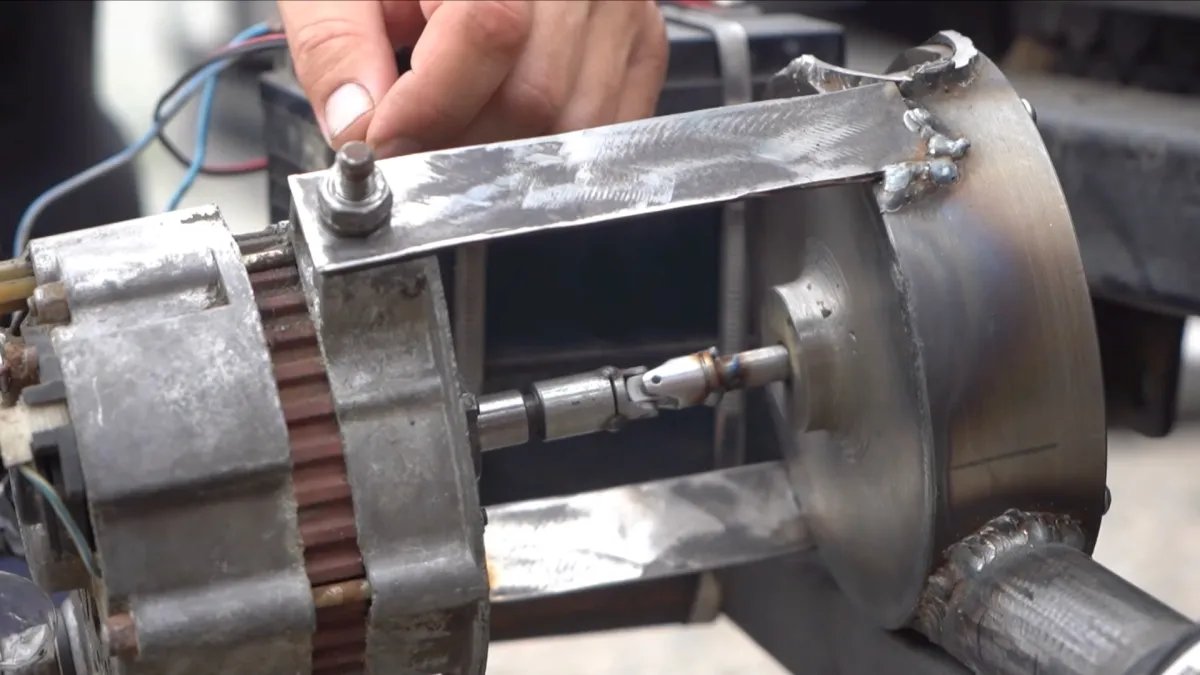
The turbine alternator consists of a round housing and a fan-like wheel made of flat steel blades that are rotated by the engine’s exhaust gases. Those gases enter and exit through ports that have to be precisely positioned to give the gases a chance to rotate the wheel. For example, if they were located exactly opposite each other, the gases would not have to travel very far. The clearance between the wheel and the housing must also be as tight as possible to extract maximum energy from those exhaust gases, and the entry port and total chamber volume – defined by the diameter of the housing and the number and position of the blades – must be kept as small as possible to maintain pressure. This required a little trial and error.
The finished device is quite compact, but the installation isn’t what you’d call OEM-approved. The turbine drives a conventional alternator via a short driveshaft, and is fed directly into the tailpipe. So instead of sitting under the hood, the entire rig hangs from the rear bumper on a modified trailer hitch. After all, this is just an experiment.

Exhaust driven turbo-generator for car – will it work?
But was it a successful experiment? Like. The bar was set quite low; Rather than powering the entire car’s electrical system, the goal was to illuminate just three light bulbs. The turbo-alternator was able to do this with about 2,500 rpm from the engine, and produce a devilish noise the entire time. The hosts were worried that too much throttle would cause it to fall apart, but low throttle dimmed the light bulbs.
That’s the problem with turbines. They need to move constantly, usually at high speed, to perform meaningful work. Anyone who knows even a little about cars is familiar with turbo lag, and while modern turbos and engine management systems have largely eliminated it, it’s a little more difficult to do the same for power output. This is why Jaguar had to bail on the turbine range extender for its C-X75 supercar (before bailing on the car itself). The belt is a more efficient way of using the engine’s rotation, which is why belt-driven alternators operate at very low engine speeds. Still, the folks at Garage 54 deserve credit for trying.