
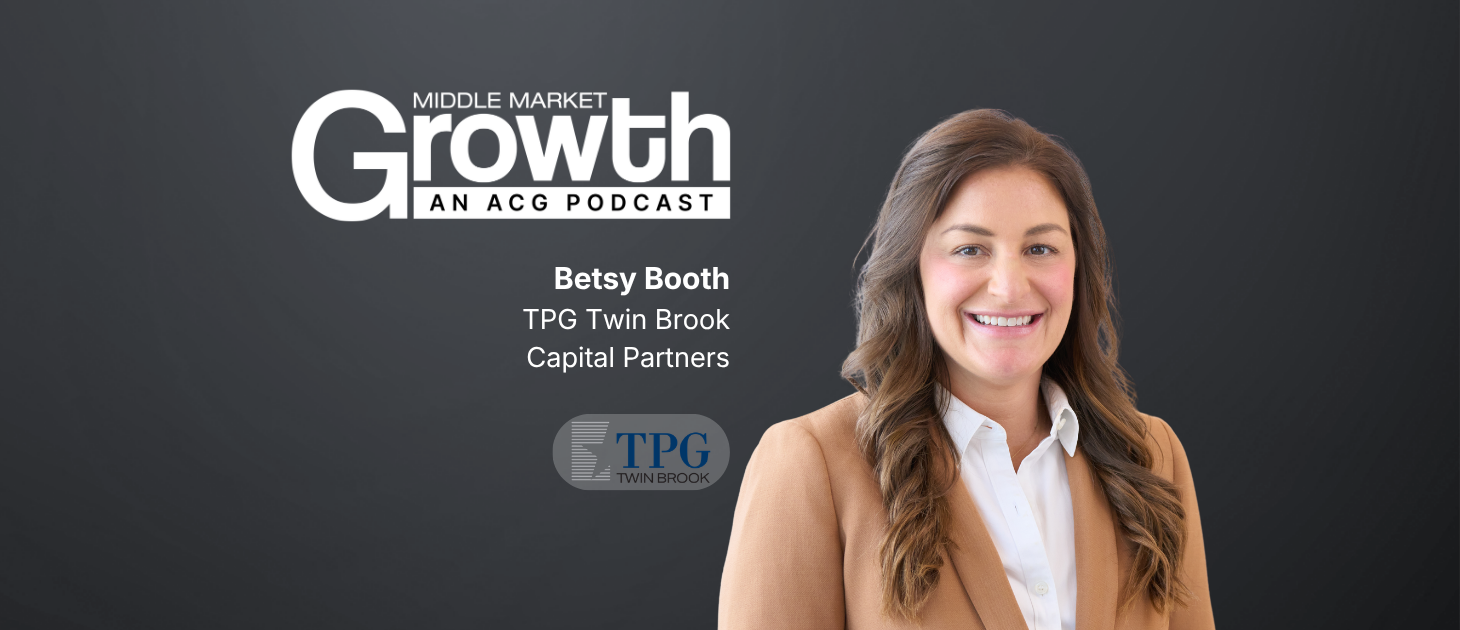
According to Bain, average hold periods for buyout funds have extended to roughly seven years, necessitating a recalibration in approach for both sponsors and lenders. TPG Twin Brook’s Betsy Booth is back with the podcast to talk about this new normal, how dealmakers are strategically adjusting, how LPs are responding, and how sponsors can plan for the next few years.
This episode is brought to you by TPG Twin Brook Capital Partners. Learn more at twincp.com.
Read a transcript of the podcast below.
Middle Market Growth: Welcome to ACG’s Middle Market Growth Podcast. I’m Carolyn Vallejo. Since 2021, average private equity hold periods have extended to about seven years, according to Bain, and sometimes even longer. Here with us today to reflect on whether this is the new normal and how deal makers can adjust accordingly is TPG Twin Brook’s Betsy Booth. Betsy, welcome back to the podcast.
Betsy Booth: Thanks for having me.
MMG: Can you start us off by telling us a little bit about your role at TPG Twin Brook and what you focus on there?
BB:Sure. So I’m a partner at TPG Twin Brook where I focus on sourcing and originating new deal opportunities for private equity-backed middle-market companies and managing these investments through their life cycle. So my role sits at the intersection of sponsor relationships, underwriting, and portfolio management. We partner with sponsors to provide financing solutions that support leverage buyouts, growth initiatives, and add-on acquisitions while at the same time maintaining a disciplined focus on downside protection and long-term credit performance.
MMG: Okay. And just for a bit of fun, if you could pick any walk-up song, what would your walk-up song be?
BB:Oof, I had to think about this one, but I’d have to go with Dog Days Are Over by Florence and the Machine. It’s hard not to feel energized when that song comes on, although I’m not sure what choosing it says about my outlook on the credit markets. <laugh>
MMG: That’s a really good point. Great song though. Well, let’s turn to our topic today, that three- to five-year hold period that used to be the norm. It seems like it might be a relic of the M&A boom that we saw back in 2021. So Betsy, set the table for us. What are some of the factors that are driving sponsors to hold onto these assets for six, seven, sometimes even more years?
BB:Yeah. The biggest factor is simply that market has changed. The environment has changed. When you look at the years between 2010 and 2021, sponsors benefited from a combination of multiple expansion, low borrowing costs, and a very active M&A market. Today, we remain in a higher for longer interest rate environment. We experience elevated seller expectations and buyers are more selective. And so the result is that achieving an attractive exit valuation often requires more operational value creation than it previously did, or more EBITDA growth in the absence of multiple arbitrage. And so additionally, when you think about what the post-COVID vintages have endured, many sponsors believe their companies experienced one, two, or even three lost years depending on the industry.
MMG: Right. Yeah. Let, let’s talk about valuation for a minute because, you know, back in 2021 during that M&A boom, as I mentioned earlier, you know, valuations were quite strong. And since there has been this really persistent valuation gap, a lot of sellers are hoping to get a lot more than investors might be willing to spend, quite frankly. And I’m curious if this lengthening of the holding periods is maybe a temporary reaction to those valuation gaps or if we’re looking at this, you know, this new normal, this long-term potentially permanent trend for the industry.
BB:I don’t think seven-year hold periods become the new norm, but I do think they’re likely to remain elongated versus the traditional three to five-year model that many of us grew accustomed to. When you think about the evolution of this asset class, I mean, private equity has, has matured. It’s been around for quite a while. The industry is larger, assets are more expensive. And again, that value creation that I mentioned previously has become more operationally intensive. Um, so even if exit activity accelerates, I think sponsors will continue to be more flexible about timing than they were, say, a decade ago.
MMG: Well, these longer hold periods also, they don’t necessarily mean that sponsors are unable to offload their assets when they want to. So I wanna ask what specific kind of, um, operational characteristics, credit characteristics might make a company attractive for this extended hold period that we’re seeing? And then also, how do you kind of underwrite that differently when you know an asset might be held significantly longer than what might be considered the historical norm?
BB:It’s really a function of back to the basics for us. The businesses that hold up best over longer ownership periods tend to have recurring revenue, strong cash flow conversion, compelling value proposition that can drive pricing power, diversified customer base, and knowledgeable management teams that find ways to grow or at least maintain share in both positive and difficult times. So I wouldn’t say we’re actively underwriting longer hold periods or that it changes how we’re underwriting opportunities. However, we are more closely evaluating durability and stress testing the key drivers of these business models to have confidence that the proposed capital structures can withstand potential headwinds. So we are spending more time understanding is the business exposed to technological disruption? Can margins withstand elongated inflation? And do they have the pricing power if their costs continue to increase?
MMG: Continuing from this lender’s perspective, obviously the interest rate environment is going to be influencing a lot of, a lot of the M&A environment, the, the holding periods in particular. What are some other primary factors that you’re seeing that are influencing sponsors to rethink their, their exit timeline?
BB:There’s no shortage of variables impacting sellers decisions to go to market and also how buyers weigh in on the opportunity versus the risk. I mean, if you think about it, you’ve got geopolitical conditions, the labor markets, regulatory environments, supply chain, tariffs, et cetera. I mean, the list goes, goes on and on. And then at the same time, the private equity industry does still remain flush with capital relative to, again, this large inventory of assets seeking exits. So with more companies competing for buyers’ attention, buyers can afford to be selective, which again, elongates some of these timelines.
MMG: These longer hold periods can also, as I understand it, change what a sponsor or an acquisition target needs from a, a capital structure perspective. What are, what are borrowers asking now that they maybe weren’t asking for three years ago in the context of these longer hold periods?
BB:More flexibility is certainly top of mind. In addition to flexibility, I think more certainty not only to close the initial platform, but to scale for add-on acquisitions and upsizes and ensure that the financing does not require refinancing every time the investment horizon or the scope changes. Historically, we have seen some sponsors choose to go with a lower cost bank deal to start, knowing that the bank likely won’t scale as the credit facility increases with a plan to refinance with a direct lender as the business grows. However, we are seeing less interest in that option and more emphasis on longevity and dry powder when selecting a lender. Another example is the term of the facility. The historical five-year standard has increasingly moved to six years, reflecting the reality of longer hold periods. And this ability for lenders to extend maturity will continue to be important over the next 12 to 24 months as sponsors and borrowers face the, you know, proverbial maturity wall of COVID vintage deals.
MMG: And we’re also seeing this increase in GP-led secondary transactions in continuation funds. So I’m curious what you, what you see on the lender side when an asset you finance moves into say a continuation vehicle, what does that look like? What, how does that change what the capital structure and, and the capital strategy is gonna look like?
BB:From a lender’s perspective, the first question is whether the credit remains attractive. Fundamentally, we’re still underwriting the company, not simply the ownership structure. Oftentimes, we view a single asset continuation vehicle as a positive signal because it typically means the sponsor believes there is meaningful value still to be created and is willing to continue investing behind the business. I mean, these businesses tend to be among their top performers. Y- you know, notwithstanding though, we reassess everything. Governance, ownership dynamics, business performance, proposed leverage level, and future strategy all get revisited. We treat it as an opportunity to reaffirm the credit case rather than simply roll forward an existing decision.
MMG: Right. Yeah, that’s interesting. You, you mentioned how the sponsor still sees that there’s value to be created and, um, it’s an interesting point of conversation because LPs are also kind of, you know, watching what’s happening and, and they’re wanting, you know, they’re wanting their investments back. So what are you seeing in terms of how LPs and maybe some of the pressure they’re putting a, uh, for an exit, is there any willingness on their end to wait? Are you seeing any influence from LPs affect, you know, some of the clients that you’re working with?
BB:LPs understandably want liquidity. Distributions have been below historical norms for several years now, and many investors have been waiting longer to receive their capital back. At the same time, LPs also recognize that forcing exits into, you know, suboptimal markets can either destroy value or leave some money on the table. So the most sophisticated LPs would rather see sponsors sell the assets at an attractive time rather than simply sell it quickly. Um, so there, there is pressure, but there is also an understanding that timing matters. Investors want distributions, but they also want strong returns. And so this is where solutions such as a single asset CV come into play as it gives the option for liquidity, but also allows the sponsor time and fresh capital to execute on the rest of the value creation plan. Mm-hmm.
MMG: Now, you, you touched on this a little bit about how you’re kind of looking at the holistic, you know, potential value health of the, of the company, um, as these hold periods extend. How is this all changing your approach to monitoring portfolio health along the extended hold period?
BB:Monitoring doesn’t change as much as you’d think. Again, it’s business as usual for us. If anything, we’re spending more time during the new deal underwrite to evaluate strategic positioning, market share trends, customer behavior. Um, management succession has become a top priority at the onset. And then certainly, you know, technology adoption and where they sit in the industry.
MMG: Okay. Now, as I mentioned frequently on this podcast, a lot of conversations that we have cannot, cannot negate AI. It’s been such a huge topic of conversation in middle market M&A across the deal lifecycle. So I wanna ask you how you incorporate the risks of AI disruption into your investment decisions for, you know, these, these long dated holes. And then on the other hand of this, I’m curious how TPG Twinbrook is using technology to maybe enhance risk mitigation and risk management across these longer hold periods.
BB:Yeah. To your point, AI is probably the most frequently discussed diligence topic among deal teams and at investment committee. And I think a lot of that is because its impact is, is difficult to predict yet, you know, potentially very significant. And so when we el – we evaluate it from both an opportunity and risk considerations, so on one hand, can the company leverage AI tools to improve productivity, improve customer experience or efficiency? And conversely, could AI reduce barriers to entry? Could it compress pricing or automate portions of the company’s value proposition and therefore narrow the scope of their offering? Uh, so those are a lot of the considerations that we look at the onset from both the opportunity and risk perspective. From a portfolio management perspective, technology increasingly helps us identify trends earlier. It also helps us to compare trends across similar portfolio accounts. For example, if you have a handful of landscaping businesses in the portfolio, what are the individual companies experiencing and how do they compare to their peer set? Differences could be industry-wide or could be specific to the company’s geographies or revenue mix, but all of this provides the initial dataset to ask those follow-up questions.
MMG: All right. And to kind of wrap us up today, we’ve, we’ve talked about a lot of factors and a lot of ways that these extended hold periods are impacting deal making, portfolio management, et cetera, in the middle market. And, you know, as we look at this intersection of these longer hold periods with the maturing private credit market, what guidance would you give sponsors and, and management teams when it comes to planning around these, these longer hold periods for the next few years?
BB:My advice would be to build for endurance rather than build for exit. If you think you might own a company for seven years, for example, instead of four, you may have to invest differently. That may mean deeper management teams, stronger systems, better data infrastructure, and a longer term approach to innovation. The companies that will perform best are those that continue creating value regardless of market conditions. And, and the exits will come, and ultimately, longer hold periods don’t change the objective. Sponsors, lenders, and management teams all want the same thing, sustainable growth, resilient cash flow, and a business that’s more valuable tomorrow than it is today.
MMG: The exits will come, so build for endurance rather than building for exit. I love that. That’s right. Piece of advice. All right, that’s TPG Twin Brook’s Betsy Booth. Betsy, it’s always great to speak to you. Thank you again for joining the podcast.
BB:Thank you.
This transcript was prepared by a transcription service. This version may not be in its final form and may be updated.
The Middle Market Growth podcast is produced by the Association for Corporate Growth. To hear more interviews with middle-market influencers, subscribe on Apple Podcasts, Spotify or Soundcloud.


