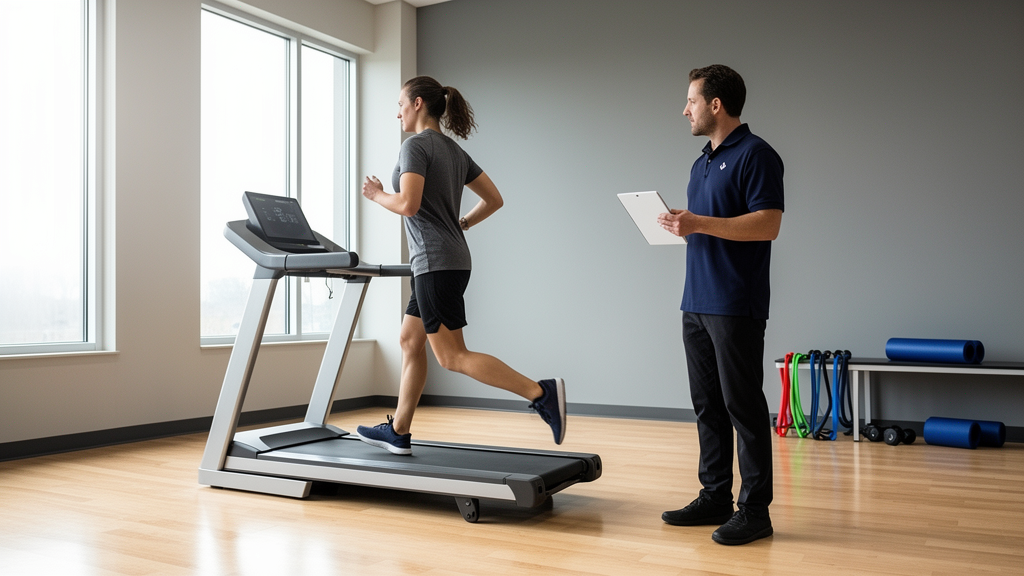
Human factors researchers have developed and validated the Intervention Usability Scale for Exercise, a concise eight-item instrument designed to systematically evaluate how users interact with and experience prescribed exercise programs. Physical activity interventions consistently demonstrate substantial preventative and therapeutic benefits across a broad range of chronic illnesses and physical injuries. Despite these established benefits, public health data from the World Health Organization and the Centers for Disease Control and Prevention show that approximately one in four adults globally meets recommended physical activity levels, falling below twenty percent among women and below thirty percent among men. Poor adherence to prescribed exercise routines routinely undermines the practical effectiveness of evidence-based regimens in clinical and everyday practice. While individuals frequently cite barriers such as constrained time, low perceived value, limited social support, and insufficient enjoyability, clinical medicine has historically lacked validated, participant-level measurement instruments capable of evaluating the practical usability of the exercise programs themselves.
To address this measurement deficit, the research team adapted principles from human factors engineering and ergonomics to establish a conceptual framework for exercise intervention usability. Under international definitions established by the International Organization for Standardization, usability denotes the specific degree to which a given product can be used by specified target users to attain designated objectives with verified effectiveness, efficiency, and satisfaction within a clear real-world context. In translating this technical standard to behavioral exercise medicine, the study authors conceptualized usability not merely as a set of static digital interfaces or delivery devices, but as a broader, integrative behavioral construct reflecting how individuals perceive, navigate, and engage with physical routines in daily life. Existing evaluation tools borrowed from implementation science or digital health, such as the System Usability Scale or the Acceptability of Intervention Measure, were predominantly formulated for software interfaces, electronic devices, or administrative healthcare provider assessments rather than the physically embodied, context-dependent complexities of exercise regimens.
The developmental process was executed across three sequential phases adhering strictly to the COSMIN taxonomy of measurement properties and established psychometric standards for educational and psychological testing. In the initial phase, investigators generated an exhaustive candidate pool of measurement items derived from established behavioral theories, including Self-Determination Theory and the Theory of Planned Behavior, alongside known empirical barriers and facilitators of adherence. Content validation commenced through structured interviews with nine multidisciplinary exercise stakeholders, including athletic trainers, physical therapists, exercise coaches, and academic researchers, who evaluated item relevance, clarity, and theoretical coverage using a premortem failure analysis. Following stakeholder feedback, automated readability assessments verified that candidate items conformed to or fell below a high school reading grade level. Ten representative target end-users subsequently completed cognitive think-aloud interviews over video conferencing while evaluating a simulated prescribed exercise regimen, ensuring that item instructions, phrasing, and response formats were interpreted precisely as intended.
The empirical evaluation and psychometric testing
The empirical evaluation and psychometric testing of the generated items proceeded via an extensive online survey administration involving 526 adult participants recruited through an undergraduate psychology participant pool and two national online research panels. After eliminating aberrant submissions identified via automated page timing thresholds and attention check failures, researchers analyzed the demographic composition of the final sample, which averaged 42.2 years of age and comprised 49 percent men, 48 percent women, 1.7 percent nonbinary individuals, and diverse ethnic representations. Participants were randomly assigned to evaluate one of two distinct standardized strength training regimens designed to align with American public health recommendations for twice-weekly muscle-strengthening exercise across major muscle groups.
Initial psychometric reduction was conducted on an early pool of thirty-six candidate items that employed both five-point semantic differential and Likert response formats. Ten items demonstrating inadequate test-retest reliability across repeated administrations were promptly eliminated from the provisional pool. The remaining twenty-six items underwent comprehensive dimensionality evaluation utilizing parallel analysis alongside exploratory factor analysis with oblimin rotation. The parallel analysis demonstrated the presence of three distinct underlying dimensions that respectively accounted for thirty-one percent, sixteen percent, and six percent of the common variance. An exploratory bifactor model using bi-geomin rotation confirmed that the candidate items loaded substantially onto both a single overarching general usability factor and three clear domain-specific subscales, producing a total omega coefficient of 0.96 and a hierarchical omega coefficient of 0.71, with explained common variance on the general factor reaching 0.58.
To further refine the scale into a practical and concise instrument, researchers deployed item response theory using polytomous graded response modeling across each identified factor. Item information curves were plotted to identify questions providing optimal discriminability and information coverage across varying levels of the underlying latent trait. Twelve items exhibiting redundant information curves, low discriminative capacity, or inconsistent difficulty characteristics were methodically excised. The resulting refined instrument, designated the Intervention Usability Scale for Exercise, was finalized as an eight-item scale comprising three distinct, theoretically grounded subscales: program value and usefulness, ease of understanding and execution, and social compatibility. For operational simplicity and intuitive interpretation across clinical and applied environments, raw average responses were mathematically rescaled to a standard zero-to-one-hundred continuous score, mirroring legacy scoring conventions utilized in classic systems testing.
The final eight-item scale demonstrated high internal consistency
The final eight-item scale demonstrated high internal consistency and measurement precision, yielding an overall Cronbach’s alpha of 0.86, alongside subscale alpha coefficients of 0.86 for perceived value, 0.84 for ease of use, and 0.83 for social factors. The complete eight-item scale also achieved an omega total of 0.92 and an omega hierarchical of 0.67. Test-retest reliability assessments conducted on a subset of participants who evaluated identical exercise programs across separate administrations produced an overall test-retest correlation coefficient of 0.78, with subscale correlations ranging from 0.79 to 0.85 and a minimal within-subject typical error of 7.3. Mean score differences between baseline testing and retesting were small and statistically indistinguishable from zero, confirming that participant scoring remained exceptionally stable across repeated evaluations when the underlying exercise intervention parameters remained unchanged.
Construct validation analyses confirmed robust convergent and criterion validity when comparing the scale against established external measurement batteries. The overall scale demonstrated strong positive correlations with the Intervention Appropriateness Measure at 0.79, the Intervention Usability Scale at 0.71, the Net Promoter Score at 0.71, and self-reported behavioral intention to use the program at 0.75. Demonstrating clear discriminant validity, the scale exhibited substantially weaker correlations with external motivation items from the Situational Intrinsic and Extrinsic Motivation Scale, producing an association coefficient of 0.42. In formal hypothesis testing, the instrument successfully differentiated between the contrasting exercise programs: participants evaluating the high-usability program assigned significantly higher overall usability scores and higher individual subscale scores compared to those assigned to the low-usability program, with the most pronounced differences appearing within the ease of use subscale.
During the developmental process, several candidate items targeting traditional components of usability failed to survive empirical factor retention thresholds. The authors noted that in the context of behavioral exercise evaluations, end-users naturally perceive time demands and operational resources as direct components of whether an intervention is worthwhile rather than treating them as separate operational mechanics. Similarly, while the social subscale explained a modest proportion of total variance within the hypothetical survey environment, its theoretical significance in supporting long-term behavioral maintenance justified its inclusion as a specialized subdimension.
The study authors identified clear methodological parameters
The study authors identified clear methodological parameters and boundaries governing the interpretation of these findings. Because participants evaluated hypothetical exercise programs through digital survey prompts rather than completing the multi-week training protocols in real-world settings, the investigation captured behavioral intentions rather than verified longitudinal adherence metrics over extended periods. Furthermore, while the developmental study established structural validity through exploratory factor analysis and item response theory within a diverse cross-section of English-speaking adult residents of the United States, confirmatory factor analyses and structural equation modeling within independent clinical populations remain necessary to verify the stability of the three-factor architecture. The researchers concluded that the Intervention Usability Scale for Exercise provides an empirically sound, scalable diagnostic framework that clinicians and intervention designers can readily deploy to identify practical design barriers, optimize exercise prescriptions, and systematically enhance prospective participation.
Subject of Research: Development and validation of the Intervention Usability Scale for Exercise (IUSE)
Article Title: Evaluating the pulse of exercise programs: Developing and validating the intervention usability scale for exercise (IUSE) to enhance implementation and adherence
Article References: Mørtvedt, A. I., Ageberg, E., Elmer, S., Trewartha, K., & Petushek, E. J. (2026). Evaluating the pulse of exercise programs: Developing and validating the intervention usability scale for exercise (IUSE) to enhance implementation and adherence. Human Factors in Healthcare, 10, Article 100142. https://doi.org/10.1016/j.hfh.2026.100142
Keywords: exercise medicine, intervention usability, human factors, scale development, psychometrics, exercise adherence, physical activity, behavioral science, content validity, item response theory, factor analysis, bifactor model, test-retest reliability, construct validity, implementation science, qualitative interviews, rehabilitation programs, health measurement
News. Researchers Validate New Eight Item Scale to Measure Usability of Exercise Programs. Scienmag