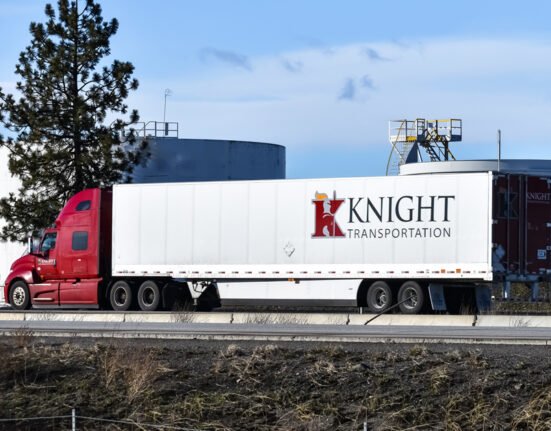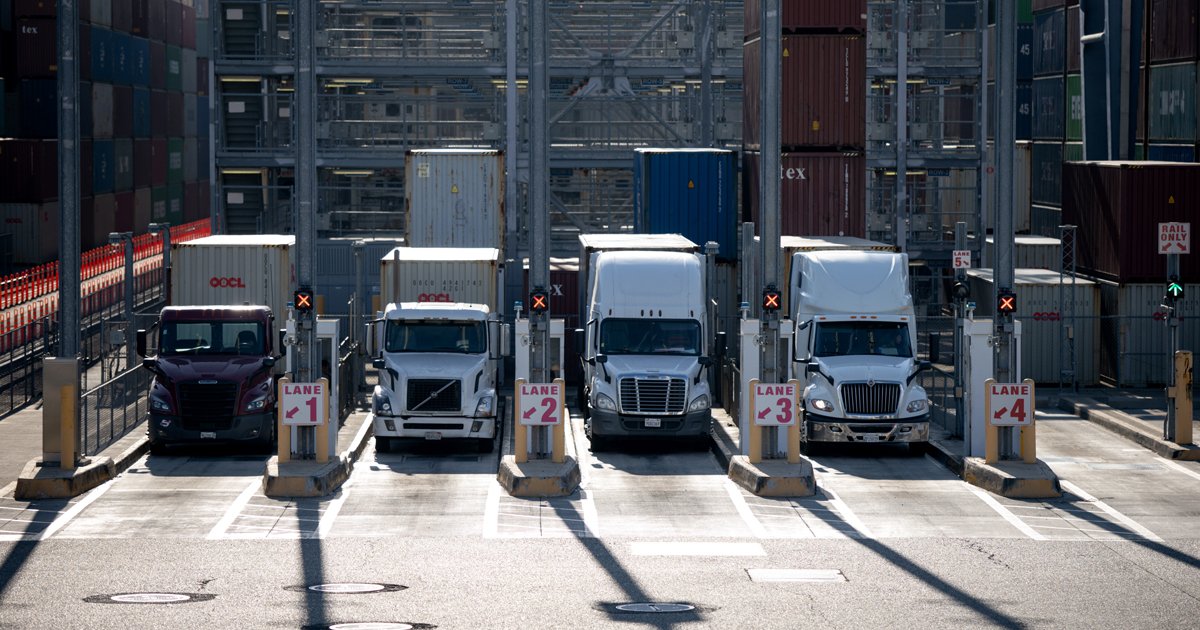
“The reality is that my members are still not in a very good position. We still find ourselves in a freight recession,” Loya said. (Eric Thayer/Bloomberg)
key takeaways:
- Trucking companies serving the major ports are under pressure despite import gains at the Port of Los Angeles and the Port of Long Beach in May.
- Descartes said U.S. container imports rose 11.5% year over year, but carriers cited weak rates, fuel costs, congestion and appointment delays.
- Shippers frontloaded cargo ahead of a potential tariff increase on July 24, while port carriers continue to optimize operations amid uneven market conditions.
Trucking companies serving the nation’s largest ports are still struggling against tough market conditions, even as port volumes continued to rise in May.
Descartes Systems Group reported in its monthly global shipping report that container import volumes in May rose 11.5% from a year earlier to 2,428,758 20-foot-equivalent units. It rose 6.6% sequentially, but the report still expressed unease over ongoing geopolitical risks ranging from the Strait of Hormuz to escalating trade tensions.
“You’re seeing this increase in import volume,” said Robert Loya, CEO of the Harbor Trucking Association. “The devil is in the details. Imports have increased, yes, but what the ports don’t report is what goes to the dock, what’s on-dock rail, versus what goes out the gate.”
Port of Los Angeles container volume rose 17% to 840,165 units from 716,618 a year earlier amid continued uncertainty over trade policy and global supply chains. Port of Long Beach volume increased 31.7% to 842,030 from 639,160, with port officials viewing the results as a demonstration of resilience against tariffs and geopolitical uncertainty.
“Both ports report that their import volumes have increased, which is great, and you would think that would mean more trucks,” Loya said. “But the reality is that my members are still not in a very good situation. We still find ourselves in a freight recession.”
Loya attributed much of the increase to shippers frontloading cargo ahead of a potential increase in tariff costs when some rates expire on July 24. But he also said the market is not affecting all of his members the same way, with some doing well while others have continued to struggle since the coronavirus pandemic.
“The reality of the situation is that in L.A.-Long Beach, we are still struggling due to the fact that there were a lot of carriers who infected during COVID,” Loya said. “It’s a race to the bottom, and rates are still an issue, fuel is still an issue for my members.”
(Eric Thayer/Bloomberg)
Loya said the recent decline in fuel costs is not enough as many brokers serving ports are requesting composite rates. He also noted that much of these carriers’ business is often tied to ports, so it may be difficult to walk away when volume is not sufficient. Loya has noticed that these problems increase as he moves to the West Coast.
“Because of the uncertainty we all have to learn to adapt to reduce our costs and our overhead,” Loya said. “Everyone is getting creative, using AI, using algorithms, outsourcing out of state, back-office stuff to reduce costs.”
Loya said larger carriers have more ability to invest and adapt, although he has still seen some of their smaller and medium-sized members finding ways to manage their businesses well. But they have seen others forced to accept lower rates even while trying to compete. IMC Logistics is also facing the problem of congestion at ports.

Cox Fleet’s Kevin Clark discusses how fleets must rethink their maintenance strategies to remain efficient and flexible. Tune in by going above or RoadSigns.ttnews.com.
“Throughput issues remain at Newark Terminals,” said IMC CEO Joel Henry. “(Global container terminals) are currently averaging 2.5 hours per gate move, while all other terminals are 1-1.5 hours per gate move. This has been an ongoing issue for over a year; the emphasis has been on chassis availability.”
IMC over the past 45 days in New Orleans and Mobile, Ala. Throughput issues at the terminals are tracking an increase, with the main challenges focused on overcrowding and lack of appointment slots. The Oakland International Container Terminal is also struggling with throughput, but Henry doesn’t believe it’s a congestion issue because volumes are flat.
“LA/LBC throughput has been steady throughout the year so far with no moves per gate,” Henry said. “We are experiencing greater delays in getting an appointment at most terminals, increasing to more than 1.5 days upon discharge, an increase from approximately one day to 30 days in advance of getting an appointment. Available space is tighter than in previous months.”
IMC is ranked 50th on Transportation Topics’ Top 100 Largest For-For-For-Car Carriers list in North America and 6th on the Intermodal/Drayage list.
Separately, Bally Express Services was recognized by Long Beach leadership for its efforts to establish a green truck corridor between the port and Mexico. The move reflects ongoing efforts by the port to become more environmentally friendly as well as increasing trade with Mexico.
Other major ports reported mixed results for the month.
- The Northwest Seaports Alliance reported container volume declined 5.1% to 238,021 from 250,851.
- The South Carolina Ports Authority reported container volume declined 2.2% to 214,478 containers from 219,255.
- Port Houston reported container volume increased 4% to 398,322 containers from 381,640.
- The Port of Oakland reported container volume increased 1.9% to 190,958 from 187,389.
The Port Authority of New York and New Jersey did not have its monthly volume numbers available at press time.