Olectra Targets 25%+ Share In Electric Truck Market, Plans Six Products By FY27-End
Utkarsh AgarwalNov 09, 2026
Olectra Greentech is preparing to enter the electric truck segment with six heavy- and medium-duty products, while targeting over 25 per cent market share
Utkarsh Agarwal
India’s electric commercial vehicle market has largely been driven by electric buses, particularly through government-backed procurement by State Transport Undertakings (STUs). However, electric trucks are beginning to attract attention as manufacturers look at the next opportunity in commercial vehicle electrification. The opportunity is significant, considering that India’s truck market sold approximately 9.12 lakh vehicles in FY26, compared with around 1 to 1.2 lakh buses.
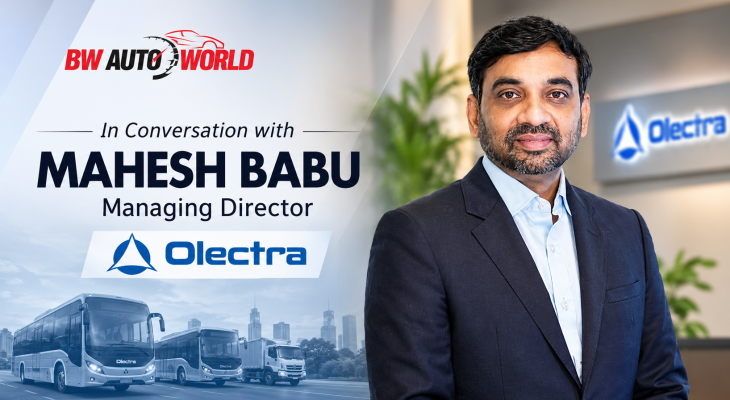
Olectra Greentech, which has already established a strong presence in the electric bus segment, is now preparing to enter the electric truck market with around six heavy- and medium-duty products by the end of FY27. The company is targeting over 25 per cent market share in this segment and is also working on next-generation electric buses, greater localisation and international expansion. In this exclusive conversation with Utkarsh Agarwal, Editorial Lead of BW Auto World, Managing Director Mahesh Babu discusses the opportunities and challenges in India’s electric commercial vehicle market, the economics of electric trucks, charging infrastructure, emerging technologies and Olectra’s long-term growth ambitions.
Q. How is the electric commercial vehicle industry evolving in India? Which segments are seeing stronger adoption?
The electric commercial vehicle industry has two broad segments – passenger transportation through buses and goods transportation through trucks. At present, buses are the most promising segment because they are witnessing good traction in EV adoption.
The Government of India wants to accelerate bus electrification, particularly city buses, because they operate largely within urban areas. Their electrification can have an impact on city pollution, as they cover more kilometres, while also helping reduce oil imports. Government initiatives such as FAME I, FAME II and the current schemes around public transport electrification have played an important role. Around 21,500 electric buses have been registered in the country so far.
In the first half of FY27, around 5,000 buses were registered in the STU segment, of which approximately 3,700 were electric, close to 70 per cent. This clearly shows that government policies are working and that the total cost of ownership (TCO) is making sense.
It is also a win-win for STUs because they do not have to purchase the vehicles and invest substantial capital. They operate through Gross Cost Contract (GCC) models, where payments are made on a per-kilometre basis. This makes the model mores issuing direct tenders alongside government-backed procurement. So, city buses are leading EV adoption
Q. The truck market is considerably larger than the bus market. How do you see the opportunity, and what are Olectra’s plans for entering this segment?
The bus market was around 1,00,000 to 1,20,000 vehicles in FY26, considering everything from small buses to larger buses. The truck market, however, is much bigger. India sold approximately 9.12 lakh trucks in FY26, making it eight to nine times larger than the bus market.
In the truck segment, we have witnessed significant growth over the last three years. India registered 842 electric trucks in FY26, while registrations in the first half of FY27 have already reached 1,442. Despite the smaller base, this clearly indicates that electric trucks are gaining traction.
Currently, electric trucks are being adopted mainly in sectors such as steel, cement and ports, where there are controlled routes and predictable loading patterns. I believe these pilots will prove successful. I strongly believe that truck electrification will gain substantial momentum over the next 10 years, and we need to be prepared for that opportunity.
At Olectra, we have around 4,500 electric bus registrations since inception and approximately 8,000 bus orders. We are number one in the bus segment since inception and continue to remain among the top two players in registrations.”
We are now entering the truck segment by the end of this financial year, with around six products lined up, primarily in the heavy- and medium-duty categories. We believe these segments will see good adoption and will also contribute towards reducing the country’s oil imports.
Q. Charging infrastructure and customer readiness remain key challenges for electric trucks. What needs to happen for fleet operators to make the transition?
If you ask me whether customers are ready today, my answer would be no. They need to see more electric trucks operating successfully. Seeing is believing. Over the last 10 years, there have been several questions about whether EVs will succeed and whether they can become an alternative. I think those questions are largely behind us. People are now seeing what is happening in two-wheelers, three-wheelers and passenger cars. The trust in EVs has been built across the industry.
For electric trucks, we need to prove two things. First, the total cost of ownership over the vehicle’s lifecycle must be better than diesel. Second, adequate long-term financing should be available so that the customer’s monthly cash flow remains positive after adopting an electric vehicle.
This is something I worked on when I was involved in launching the Treo three-wheeler at Mahindra. I believe we need to follow a similar approach, and we are ready to do that. Charging infrastructure along highways is also important, particularly for trucks and intercity buses. According to me, this should develop over the next five years, with the government making efforts and private players also entering the space.
Q. What is Olectra’s market-share ambition in the electric truck segment?
Our aim is to achieve more than 25 per cent market share. That means we want to become a dominant player, with one out of every four heavy- and medium-duty trucks sold coming from Olectra.”
We are working on around six products. Our strength lies in developing products that are suitable for customers and offering customisation wherever required. We are keen to work closely with customers to make the products successful in terms of TCO and other operating requirements.
Q. What is your localisation strategy for the next-generation electric buses and trucks? Do customers also consider where a vehicle is manufactured?
For our next-generation products, which we plan to launch towards the end of this financial year, everything other than the cells will be localised. We have partners supplying powertrains and battery packs. Our intention is to maximise localisation and create value addition within the country.
As an industry and government, we care about localisation because we have to look at the long term. However, even customers are increasingly asking where products are manufactured. For example, in other consumer industries, following geopolitical developments, people are specifically asking companies to declare where their products are made. This shows that customers want to know where something is manufactured so they can make an informed choice. I am not saying everybody will buy only locally manufactured products, but people want to know.
We also have genuine supply-chain challenges. Permanent magnets, for instance, are one area where we are facing challenges today. This makes local manufacturing important.
Q. Are customers now looking beyond established OEM brands when purchasing commercial vehicles? What are their key priorities?
One of the changes brought about by EVs is that customers are no longer looking only at big brands. If you look at the top five manufacturers in the bus and truck segments, you will find several new players alongside traditional OEMs.
Even we are relatively new, having been in this industry for the last eight years. Customers are increasingly looking at value, total cost of ownership and the manufacturer’s ability to stay close to them and support the vehicle throughout its lifecycle.
From a technology perspective, they want higher range, longer-lasting components and trouble-free operations. Commercial vehicles need very high uptime. At Olectra, we are working towards 98 to 99 per cent vehicle uptime. This is an important metric for any commercial vehicle customer. If the vehicle runs, the customer earns; if it does not run, the customer cannot generate revenue.
Q. How do you see battery technology evolving in electric commercial vehicles? Will higher battery capacity and faster charging make electric trucks morerage battery capacity was around 200 kWh three to four years ago. Today, it is more than 300 kWh. Similarly, in the truck industry, higher battery capacities and fast-charging capabilities will be the next big developments
For example, if megawatt charging becomes available, the TCO of electric trucks will become much moreh charge to cover another 200 to 300 kilometres
Higher battery capacity and faster charging infrastructure will therefore play an important role in making the electric truck market
Q. Do you also see battery swapping becoming relevant in commercial vehicles?
Battery swapping is currently at the pilot stage. It requires significant investment and patience to prove the process. There are also standards being released or discussed to ensure compatibility across different manufacturers and systems.
I hope these standards are established because that will make swapping moredoption will depend on when it becomes commercially
Q. Retrofitting existing trucks with electric powertrains is also being discussed as an alternative to scrappage. Does Olectra see an opportunity here?
Retrofitting is a good idea. As an OEM, our primary focus will remain on selling our products and building our brand, but we will closely monitor the retrofitting scenario. I strongly believe that EV components account for almost 70 per cent of the value of the product.
Retrofitting will not be easy. It requires proper standard operating procedures and quality control because some EV components are sensitive to silica dust and electrostatic discharge. They need specialised facilities and proper handling.”
However, instead of investing more money in purchasing new trucks, retrofitting could provide fleet owners with another way to increase electric vehicle adoption. As long as the lifecycle cost of ownership and month-on-month cash flows are favourable, customers will consider it. If we feel retrofitting becomes a
Q. With electric, CNG and hydrogen technologies being explored, which powertrain do you believe will dominate commercial mobility?
There will not be just one technology. Given India’s growth rate and increasing energy requirements, we will see EVs, CNG, hydrogen and other technologies. The question is which will dominate.
According to me, EVs will dominate because of their efficiency, cost of operation and the national interest associated with reducing oil imports. They will play a vital role as one of the dominant alternative energy
At Olectra, we are already working on hydrogen fuel-cell technology for both buses and trucks. We will continue evaluating technologies such as hydrogen fuel cells, battery swapping and solar through R&D experiments and pilot projects so that we are ready to scale them up whenever the market demands it.
Q. What is Olectra’s growth vision for the next three to four years? Do you also plan to expand into international markets?
Our vision is to achieve fivefold growth over the next three to four years and work towards a tenfold growth journey in the long term across our products and services.
We want to be present across clean technologies. We are already in the electric bus segment and will commercially enter electric trucks. We will also continue evaluating other technologies and undertake R&D and pilot projects to be ready when the market wants to scale them up.
Our vision is not limited to India. We also want to enter export markets and make India an important part of the global value chain in mobility and commercial vehicles. We are currently evaluating various countries. India has also signed free trade agreements with several countries, and we are studying the opportunities arising from them.”
Our primary focus next year will be on launching the next-generation buses and trucks in the Indian market while continuing to evaluate export opportunities. The products are being designed to address the requirements of international markets as well. We plan to focus more actively on exports a year later.
Q. Are you also evaluating strategic partnerships to support your expansion?
We will continue evaluating opportunities. We are receiving proposals, but we will pursue only those partnerships that are suitable for us and that we can manage effectively. If there is anything concrete, we will certainly inform the media about it.

Utkarsh Agarwal
BW Reporters
As Editorial Lead of BW Auto World, automotive vertical of BW Businessworld, & Special Correspondent for BW Businessworld, Utkarsh operates at the centre of a rapidly evolving automotive & technology landscape, where the story extends beyond products to business, policy, and shifting consumer behaviour. His work spans product reviews, executive interviews, and feature stories that track and interpret the forces shaping India’s automotive & technology sector.
Alongside his core automotive & tech coverage, he also brings prior experience in political, lifestyle, and travel content creation.