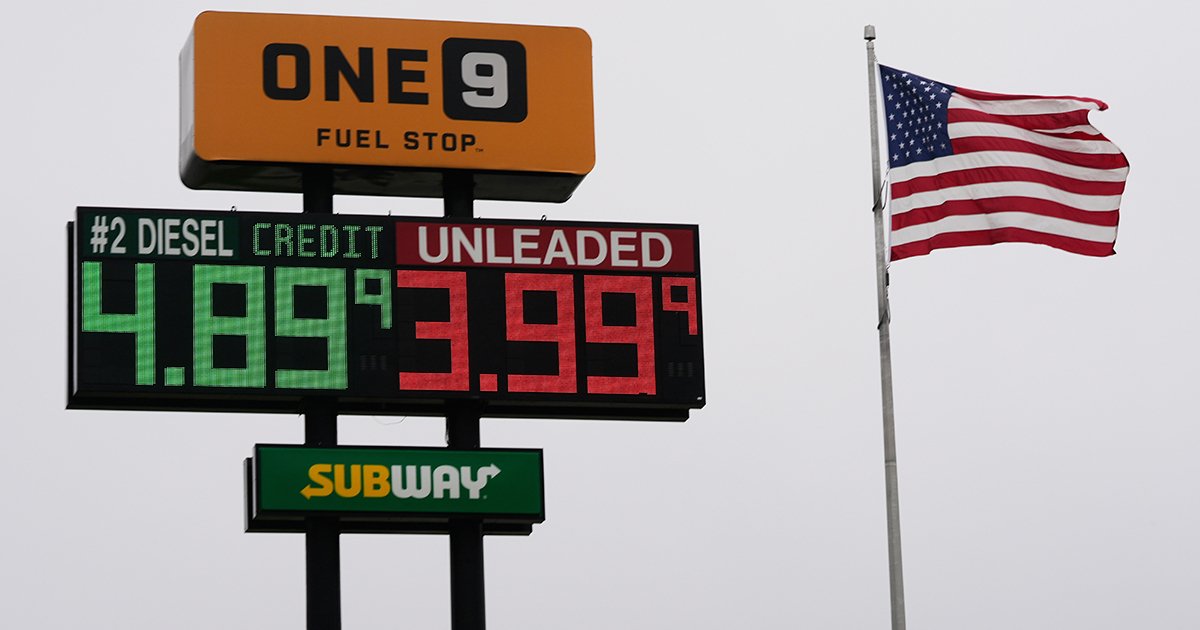
The American flag flies next to a One9 Fuel stop sign displaying diesel and unleaded gas prices in Wilmington, Ohio, on June 10. (Caroline Caster/AP)
| Update:
key takeaways:
- Oil prices fell after Iran announced a temporary deal to end the war and reopen the Strait of Hormuz.
- After repeated false starts, investors were betting that this time the war could end.
- It may take several months for oil prices to stabilize due to the disruptions caused by the war.
New York – Stock markets around the world are rising June 15, and oil prices are falling after the United States and Iran reached a temporary agreement to extend their cease-fire and reopen the Strait of Hormuz to resume global flows of crude.
The S&P 500 rose 1.5% on hopes that this time, the announcement of the Iran-US deal will mean a long-term resolution to a conflict that has sent inflation painfully upward for much of the world. As of 10 a.m. Eastern time, the Dow Jones Industrial Average was up 611 points, or 1.2%, and the Nasdaq Composite was 2.4% higher.
Shares rose after the price of a barrel of Brent crude oil fell 4.7% to $83.25, its lowest level in early March. While that’s still higher than the pre-war price of about $70 more than three months ago, it’s also lower than the $100-plus price of a few weeks ago.
The hope is that lower oil prices will ease pressure on households and businesses that have had to pay higher prices for everything from food to fuel and fertilizer because of the war with Iran.
Iran ratified the agreement but indicated that its implementation would not begin until it was signed, with Pakistan saying it would take place on June 19 in Switzerland. Comprehensive talks on issues such as Iran’s nuclear program are expected to continue for the next 60 days. This leaves room for hiccups that could derail the deal. And even if the deal reopens the Strait of Hormuz, it will take months for the energy industry to get back up to full speed.
However, there is a wave of relief in financial markets around the world right now.
ship traffic in the strait #hormuz By June 15 at 11 am UTC.
based on @Kpler According to the data, crossings are still limited, while there are more than 500 commercial vessels that have given AIS signals in the Persian Gulf during the last 24 hours.
through video @MarineTraffic. pic.twitter.com/vZoWP9dj33
– Nikos Pothitakis (@nikospoth) 15 June 2026
On Wall Street, stocks of companies with big fuel bills became instant winners. United Airlines soared 4.2%, American Airlines climbed 3.9% and cruise operator Carnival rose 5.4%.
Shares of companies involved in the artificial intelligence industry also rose. These stocks have fallen sharply in recent weeks, from hitting record highs to falling sharply. The bigger concern is whether AI mania has caused such stocks to jump too high or too fast, and their cautious moves sometimes change direction by the hour.
Micron Technology rose 7.7% and Advanced Micro Devices gained 7.3%. Nvidia’s 1.8% gain was the strongest force pushing the S&P 500 upward as the AI chip company is Wall Street’s most valuable company, giving it a greater weighting on the index than any other.
SpaceX, Elon Musk’s rocket company which also owns AI company xAI, rose 7.9% in its second day of trading on Wall Street. Its successful debut on Nasdaq shows that there is still strong demand for AI among investors. The market has given SpaceX a total valuation of more than $2.1 trillion, making it bigger than the combined value of Exxon Mobil, Bank of America and Coca-Cola.
In the bond market, Treasury yields edged lower on hopes that lower oil prices would take pressure off central banks around the world to raise interest rates.
The yield on 10-year Treasuries fell to 4.45% from 4.48% at the end of June 12.
Europe’s central bank last week became the first major bank in the world to raise interest rates to tackle high inflation. Higher interest rates may curb inflation, but they also slow the economy and cut prices of all types of investments, including stocks and cryptocurrencies. He particularly hit out at investments considered to be the most expensive, and some critics are calling the AI industry a bubble where investment has gone too high.
The Fed will announce its latest decision on interest rates later this week, the first under its new Chairman Kevin Wersh. President Donald Trump has nominated Warsh for the post, and Trump has been loudly calling for lower interest rates.
But traders see it as a near certainty that the Fed will leave its key interest rate steady after its two-day meeting ends on June 17. Traders were speculating that the Fed might actually have to raise interest rates this year because of how much inflation has risen and how solid the US job market remains.
But the temporary agreement between the United States and Iran means traders are now betting on only a 54% chance of a hike this year, up from 71% a week ago, according to CME Group data.

Mark Hill, CEO of PCS Software, examines what “agent AI” means for modern fleet operations. Tune in by going above or RoadSigns.ttnews.com.
Elsewhere on Wall Street, Roku dropped 2.4% after the company announced Fox Corp. is buying the streaming leader in a cash-and-stock deal worth about $22 billion.
Roku’s stock had already surged 20% on June 12, when initial media reports emerged about a deal that would give Fox the Roku Channel, first-party data, and access to more than 100 million global streaming homes. Fox’s shares fell 18.6%.
Stock markets abroad, indices in Asia and Europe rose. Japan’s Nikkei 225 jumped 5% for one of the world’s biggest gains and ended at a record.
“This is very good news,” said Takashi Hiroki, chief strategist at Monex. “The market is being boosted by buying by foreign investors in anticipation of easing tensions over the situation in the Middle East.”
South Korea’s Kospi rose as much as 5.2% on continued rallies from AI winners such as Samsung Electronics.
AP Business writers Matt Ott and Elaine Kurtenbach and senior producer Mayuko Ono contributed to this report.