A column by Ethan Newton.
A few years ago I had a revelation that was so primal that I don’t know why it had never occurred to me before. Every year and every season we make clothing history – as product designers it is our responsibility, and a great opportunity.
There are eras of garment design that capture my imagination, about which I will consume all the information I can find – lore and legends, catalogues, advertisements, all examples from history that are painted layer upon layer to create a movement.
That these movements were born out of industries like the ones we find ourselves in today makes me realize what an important role we can play in the history of design.

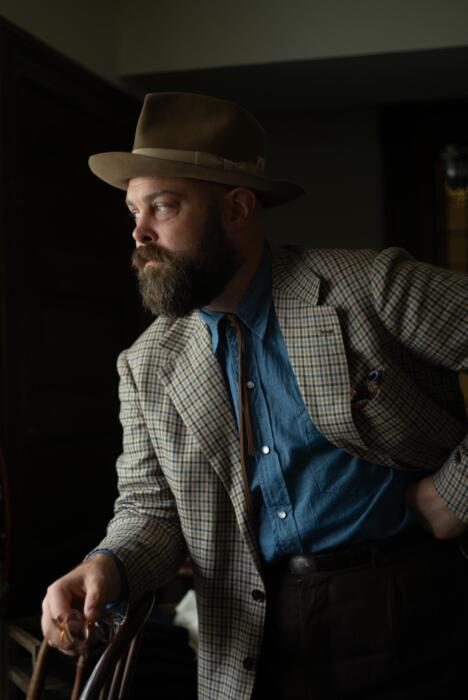
My father once told me that I was named after a character from the western film ‘The Searchers’ – John Wayne’s Civil War General Ethan Edwards – and I remember this being associated with many other early memories.
My father used to recite the opening rendition of Frankie Laine’s ‘Wanted Man’ with a theatricality that I still imitate today. Sunday afternoon western movies where boots, holsters and saddles mingle with the sound of my mother’s sewing machine in the background. Roy Rogers and Gene Autry rub shoulders with the Sgt. Pepper-era Beatles in my own personal ideology. Western utilitarianism and home flowers in the 1960s.
You realize over time how much these things are part of your own design philosophy, whether you realize it or not. These influences were so deeply ingrained in me that I didn’t really realize it until years of clothing inspired by them had fallen apart and faded.
nathan turk
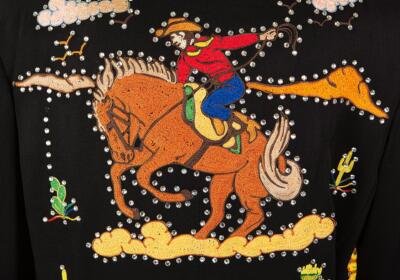
You can start that story by talking about Nathan Turk (above). Turk was a Hungarian-Jewish immigrant who, from his shop in North Hollywood in the 1930s, brought his Eastern European Jewish heritage, Norwegian Rosmelding design, and the influence of Swedish Kurbitz to the American West.
With the Cornely chainstitch machine, he gave the austerity of early Western garb a distinctly Eastern European flavor, which came to represent Hollywood’s image of the American cowboy. When the Sons of the Pioneers sang ‘Cool Water’, or original singing cowboy Gene Autry came on stage, their Americanness was deeply influenced by Nathan Turk’s Eastern European roots.
Nathan Turk walked so that Nudy Cohn could run – just as Tex Williams walked so that Elvis Presley could strut.

Nudie Cohn (above, left) took the singing-cowboy aesthetic a step or three further. European chain stitch was reinterpreted in rhinestones and sequins, turning into florals, sequined cannabis leaves, as seen on Tex Williams a few decades earlier, and naked women on Gram Parsons’ iconic white nudie suits (above, right).
Elvis’s sequined jump suits were equally influenced by singer Spade Cooley’s outfit, just as Elton John’s ostentatious stage presence was influenced by Elvis.
Manuel Cuevas and others
Manuel Cuevas continued the series. As a Mexican master tailor working under Nudy, he took these Eastern European folk influences and gave them an authentic Mexican perspective.
The traditional hand embroidery of charro suits and mariachi uniforms influenced the next generation of stage performers – folk florals combined with religious symbolism, roses and crosses realized in metallic thread.
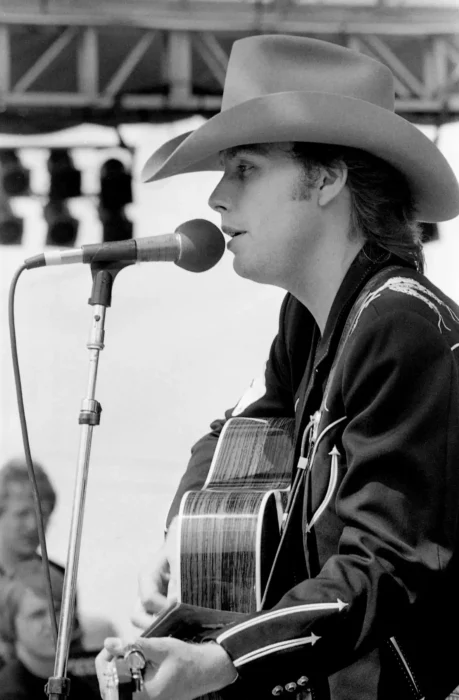
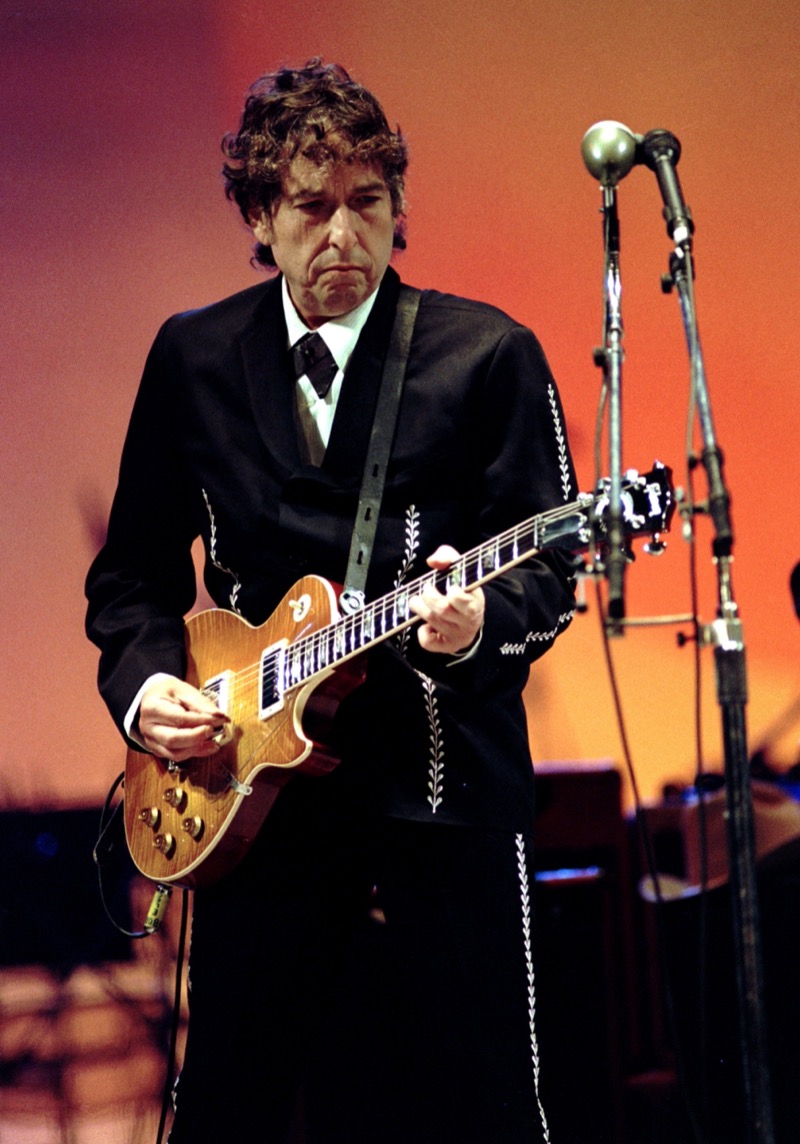
The boxiness of the ’40s cowboy suits evolved into something more elegant and architectural under the influence of ultra-tailored charro suits and campesino costumes, with Bob Dylan, Marty Stuart (above, right) and Dwight Yoakam incorporating their work into their styles.
When musician Orville Peck uses fringes and masks to create his particular Western persona, or designer Alessandro Michele brings sleek glamor to Gucci, they have Nathan Turk to thank, whether they know it or not (and I suspect they do).
From Eastern Europe to North Hollywood to the back streets of Harajuku (where our Bryceland store is today) these influences and cultures are mixed and mixed, and at the receiving end of it all is me – an Australian whose father dreamed of the cowboy life, and a mother who can still quilt and embroider more cleverly than I can.
Whatever era we live in, as designers, we have a hand in creating the design style of that era. For each iconic moment in clothing, a designer or artisan realizes their own vision, shaping the world around them for the next generation. Although none of us owns the wheel, we all have the opportunity to steer the course a little bit in our own direction.
Lazy design, driven by heavy branding and novelty, tries to distract us from our path. It is our responsibility to be diligent in design, and to make this era referable in years and generations to come.