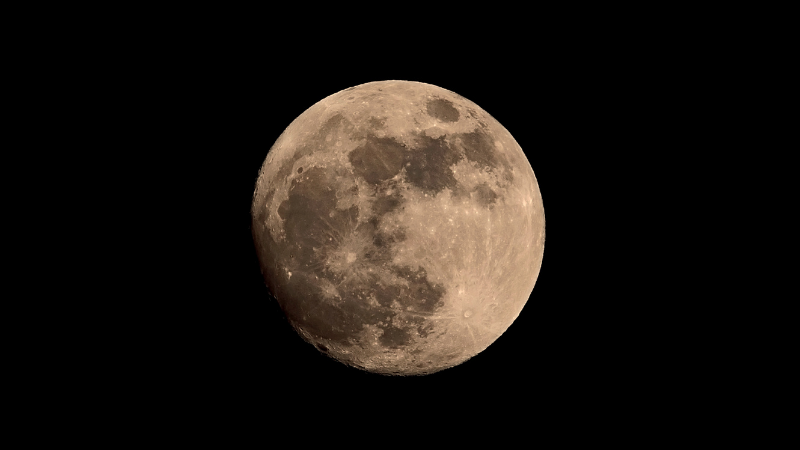
In some ways, I’ve been going to the moon most of my life. As a child of the space age, whose father worked in the space industry, I have followed activities in space, sometimes closely, sometimes less. Satellites, the space race, people on the moon, and all the science-fiction and commercial kitsch that came with it were part of growing up in the sixties. Even now, I pay attention to the night sky, not only in the context of the growing space industries, but also on the sky itself, and certainly on the Moon. That’s the way it goes, isn’t it?
Article continues after ad
It’s hard to explain the connection I feel with it, something that’s developed in me since I was very young, like trying to explain why I love peanut butter. But it’s more than just a taste. Perhaps you could call me crazy, someone hopelessly attracted to the moon as if I were a tide locked in its pale, changeable gravity. I find the comings and goings of the moon familiar, comforting and inspiring. Almost a personality. Even though it is thousands of miles away, looking at the moon amazes me. And not just me.
It has been our common heritage since the dawn of humanity, owned by no one, shared by all. A symbol, an oracle, a myth. Despite multinational plans to build settlements, roads and fuel stations, dig mines and tunnels, build nuclear reactors and surround it with satellites and Internet connections, I want the Moon to remain as it has always been. Something that unites us. Something whose beauty and mystery fascinate and inspire us. Living. Our moon. Everyone’s moon.
Is the Moon destined to become an interstellar gas station, a resource to be mined and sold? Who takes decisions? At a truly transformative moment in human and cosmic history, we cannot afford to look away.
Three years ago, I started writing a book about going to the Moon. However, I am not an astronaut, not even an astronomer. I can guarantee you that I will never, ever set foot inside a spacecraft locked in a tight compartment with one or three humans in fear of an explosive liftoff, never go into space traveling at 25,000+ mph in said tight compartment for at least three days, bump against my fellow astronauts weightless, with their hair falling out, eat food out of reconstituted pouches, and drink my own recycled urine.
Not being able to breathe fresh air, not being able to stand up, walk or open a door, and eventually passing out before reaching lunar orbit some 238,000 miles away from that little blue dot: Earth, my home. I will certainly never orbit above the beautiful but desolate moon’s surface and look forward to attempting a landing, hoping it will be successful. I would not need to imagine what would become of me, left or vaporized human body in outer space.
“moon!” I called out to him, like an old friend looking back.
Three years ago, I knew just by looking at the Moon what everyone in the world already knows about the Moon, its shape, size, faces, colors, phases, time of appearance. Its stability. I wasn’t going to write anything about it. The Moon is older than mankind and has been observed and recorded since prehistoric times. People do not even need to see the moon to know such things. You can check the calendar or weather app on the phone in your pocket. Or do a quick online search. Plus, these days, an AI assistant can tell you everything you want to know. With illustrations. Or video. No one anymore needs the actual object to know as much as they want about the Moon.
But I recently learned that one of my poems will be included as part of the Lunar Codex, which will be engraved on nickel nanofiche and sent to the Moon in a time capsule. It will travel by rocket and land on the surface of the Moon where it will remain forever. While I wasn’t going to the moon in the regular sense of that phrase, the poem – something I created and was a reflection of myself – was going. It felt amazing and as close as I could ever get.
Last November, I went outside to watch the full moon rise. The “Beaver Moon”, as NASA advertised it, rose from behind the houses across the street, brilliant, full and deep. I saw it passing through the hazy clouds, the shimmering silver, the carvings. Huge. Wonderful. “moon!” I called out to him, like an old friend looking back. Although I knew that my iPhone would not be able to take a good photo, there was nothing I could do about it. I took one anyway. I always try. Like a poem, a photograph is another way of remembering, of trying to capture the fleeting, of recapturing a fleeting moment. And the Beaver Moon appears only in November, just once a year.
Then, as now, I also sought Mare Crisium, the “Sea of Troubles.” It is a large, dark spot near the right edge of the full moon when seen from Earth. Somewhere in that vast basaltic plain my poem and the Lunar Codex landed successfully in March 2025. Yes, it’s right there. Very strange. Amazing, but. . . Strange. As much as I wanted to take it all in, I couldn’t stand staring at the moon all night, although I did watch for several minutes before finally going back inside. I didn’t keep track of time.
But I can keep track. China claims it is on track to send people to the Moon by 2030 in less than four years. Not to be outdone, our current administration later issued an executive order to return people there by 2028. As I write this, four brave humans have returned to Earth after flying around the Moon, NASA’s first crewed mission in fifty-four years. Although China’s space program has been more focused and overall successful so far, it remains to be seen which country will return to the lunar surface first.
Somehow, with only 12-13 full moons per year, there are now fewer than 52 uninhabited full moons left to see. If so, if you think about it, there would only be four of them Beaver Moons.
I do.
__________________________________
going to the moon By Sally Ashton Available from Duke University Press.