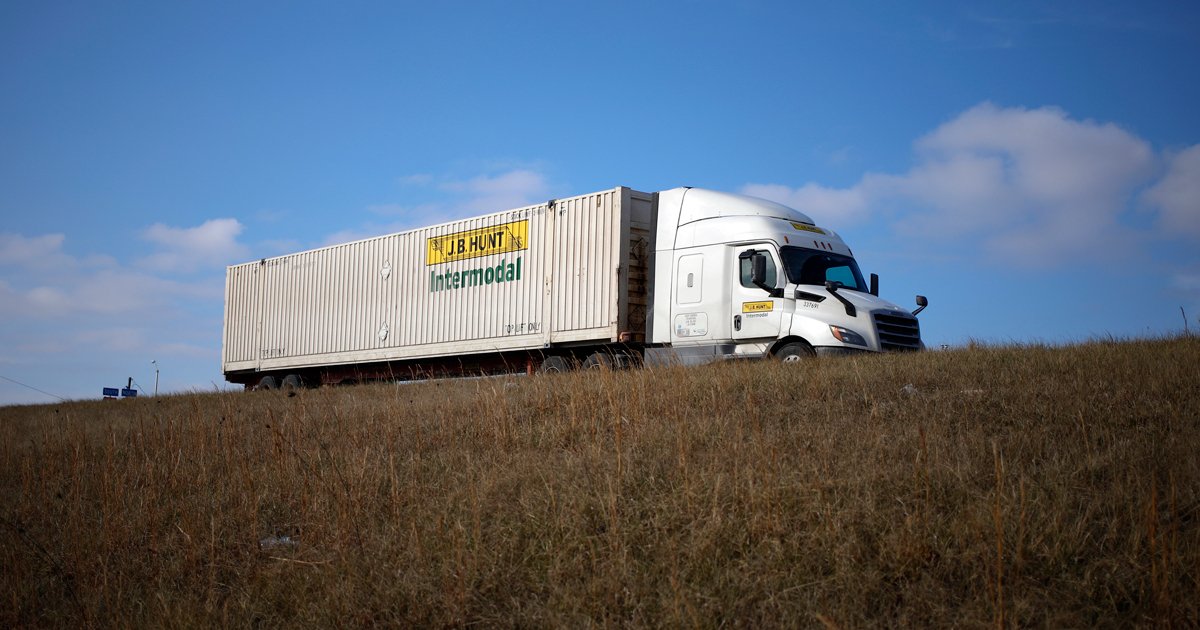
Intermodal segment revenue increased 22% to $1.75 billion from $1.44 billion. Operating income increased 58% to $150.9 million from $95.8 million. (Luke Sherratt/Bloomberg)
key takeaways:
- J.B. Hunt executives said the freight market is increasingly tightening due to regulatory enforcement on July 15 as the company reported strong second-quarter earnings and revenue.
- Stricter CDL and language enforcement and rising costs are accelerating capacity cuts, higher spot rates, tender rejections and increasing planning challenges for shippers, officials said.
- The company expects customer demand for flexible capacity and pricing to continue, with growth associated with intermodal conversion, mini bids and consolidation toward larger providers.
Executives at JB Hunt Transport Services reported July 15 that the freight market is structurally changing at an accelerated rate amid ongoing capacity reductions.
The Department of Transportation bucked the trend late last year by tightening enforcement on non-domiciled commercial driver licenses and language proficiency standards. JB Hunt executives report on the company, highlighting how it has accelerated market change Second quarter financial results.
“Ongoing regulatory enforcement continues to reduce truckload capacity,” said Spencer Frazier, executive vice president of sales and marketing at J.B. Hunt. “At the same time, many carriers are facing high operating costs that are not fully supported by prevailing rates.”
Frazier said many industry indicators are headed toward levels seen in 2022. These include high tender rejections, high spot pricing and low driver employment. He said the pace of change has created real planning and implementation challenges for customers, with many shippers unprepared for the speed and magnitude of these changes.
“They are now looking for the best providers who can help them create more sustainable and flexible plans around capacity, cost, service and mode,” Frazier said. “In the second quarter, total freight demand improved modestly from the first quarter. Demand is improving in many industrial markets, and U.S. consumer demand remains resilient.”
JB Hunt reported that it gained market share across all of its services as demand for its range of offerings outpaced the market in the second quarter. This was supported by record volumes in the intermodal segment as well as double-digit volume growth in both the truckload and integrated capacity segments. It also reported strong retention, and pipelines continue to expand across all units.
“As demand improved and capacity strengthened, pricing and planning conversations with customers became more transparent, more frequent and more flexible,” Frazier said. “We saw customers initiate more out-of-cycle/mini bids.”
Frazier said customers are also becoming more conscious of the carriers they trust. He has seen them consolidate their businesses with providers that can provide capacity at scale. JB Hunt offers a mode-neutral business model which it believes to be valuable alongside continued investment in people, technology and capability.
“The strongest areas of customer engagement are focused on highway to intermodal conversion, dedicated fleets and access to safe, secure and reliable capacity,” Frazier said.
The Lowell, Ark.-based carrier reported net earnings of $181 million, $1.91 per diluted share, for the three months ended June 30. This compared to $128.6 million, up $1.31 during the same period last year. Total revenue increased 19% to $3.5 billion from $2.93 billion.
The results exceeded the expectations of investment analysts on Wall Street, who were expecting quarterly revenue of $1.71 per share and $3.19 billion, according to the Zacks Consensus Estimate.
“The environment we are in today presents new opportunities for us,” said Darren Field, president of intermodal operations at JB Hunt. “I think the number of mini bids, or the number of times customers are reaching out to us looking for answers, I can’t remember it ever being stronger than it is right now.”
Section wise results
- Intermodal segment revenue increased 22% to $1.75 billion from $1.44 billion. Operating income increased 58% to $150.9 million from $95.8 million.
- Dedicated contract services segment revenue increased 9% to $920.7 million from $846.8 million. Operating income increased 9% to $102.5 million from $93.6 million.
- Integrated Capability Solutions segment revenue increased 49% to $388.5 million from $260.2 million. Operating income was $1.7 million, compared to a loss of $3.55 million the previous year.
- Truckload segment revenue increased 35% to $239.7 million from $177 million. Operating loss was $1.34 million, compared with a net profit of $3.37 million a year earlier.
- Final Mile Services segment revenue declined 6% to $198 million from $210.6 million. Operating income fell 30% to $5.56 million from $7.99 million.
J.B. Hunt is ranked No. 3 on Transportation Topics’ Top 100 Largest For-Haul Carriers in North America list, No. 2 in the Truckload/Dedicated Area list and No. 1 in the Intermodal/Drayage segment. JB Hunt is also ranked fourth in the TT Top 100 list of the largest logistics companies.