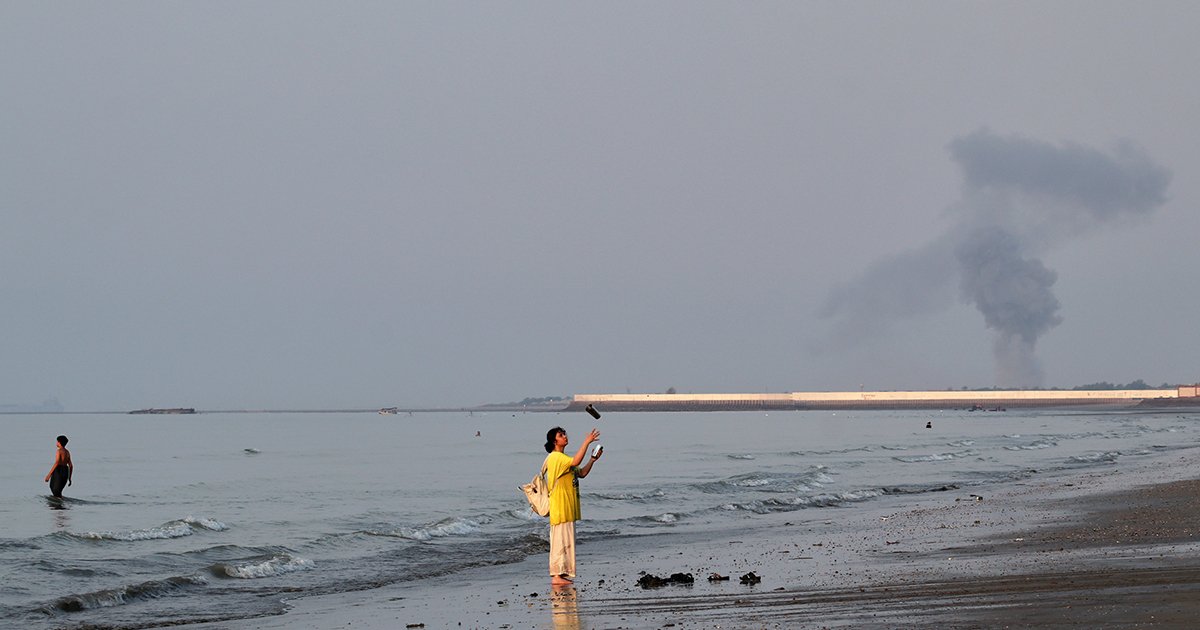
A woman stands on the water’s edge along the Strait of Hormuz as a plume of smoke rises in the background after an explosion near Bandar Abbas, Iran, on July 13. (Razieh Paudat/ISNA via AP)
key takeaways:
- The United States and Iran exchanged attacks on July 13, while both claimed control of the Strait of Hormuz following escalating attacks in the Middle East.
- The conflict has disrupted a key global oil and gas route, with Iran targeting ships and traffic falling sharply as security concerns outweigh direct transit options.
- Tensions will escalate as US forces continue to attack, Iran is refusing inspections and mediators from regional countries are pressing for de-escalation and fresh talks.
DUBAI, United Arab Emirates – The United States and Iran both claimed on July 13 that they controlled the Strait of Hormuz after a weekend of attacks in the wider Middle East, threatening any diplomacy to end the war.
The attacks, which followed Iran’s attack on a containership off the coast of Oman on July 12, again underlined that the waterway through which one-fifth of the world’s crude oil and natural gas trade still passes remains a key issue in the talks. The narrow mouth of the Persian Gulf has been disrupted by navigation since the war began as Iran maintains control over it by attacking commercial vessels and threatening shipping lanes around it.
The 60-day interim agreement between Iran and the United States was almost halfway through, allowing negotiations for a permanent end to the war to begin. Instead, it has devolved into a series of attacks on the strait and its future, leading world leaders to worry that an all-out Iran war could erupt again.
“A return to full-scale hostilities would have devastating consequences,” UN Secretary-General Antonio Guterres said in a statement.
US says it has attacked dozens of targets in Iran
The US military’s Central Command said its forces targeted dozens of sites in the July 13 attacks, including air defense systems, radar sites, missile and drone equipment and small boats.
Today at 5 p.m. ET, US Central Command forces launched further strikes against Iran to reduce their ability to attack civilian sailors and commercial vessels freely transiting the Strait of Hormuz. The Commander in Chief has directed strikes to capture the Iranians… – US Central Command (@CENTCOM) 12 July 2026
“The Strait of Hormuz is an important maritime corridor for global trade,” the Central Command said. “Iran doesn’t control this.”
The EU’s top diplomat, Kaja Kallas, also called for keeping the strait open as before the war.
“The Strait of Hormuz must be opened, freedom of navigation must be respected,” he said.
Iran’s paramilitary Revolutionary Guard, a key powerhouse in the country’s theocracy that controls its ballistic missile arsenal, swiftly rejected the US statement.
“The Strait of Hormuz is our territory and we will not allow a rogue and child-killing force from the other side of the world to continue its illegal interference in it,” the Guard said.
Missile alert sirens sounded three times on July 13 in Bahrain, home of the US Navy’s 5th Fleet, and Kuwait said it was stopping hostile fire. There was no immediate information on damage in any country.
(associated Press)
In Jordan, the kingdom’s military said it shot down four Iranian missiles in an incident that resulted in “zero casualties or material damage.” Jordan also hosts US military forces and aircraft.
Authorities in Iran reported attacks in Hormozgan, Khuzestan and Markazi provinces and at least two people were killed, according to state news agency IRNA. Semi-official Iranian media also reported attacks on Sistan and Baluchistan province.
Meanwhile, a drone strike on July 13 hit a base belonging to the armed wing of the Kurdistan Freedom Party, an Iranian Kurdish opposition group based in Iraq’s semiautonomous Northern Kurdistan region. Kurdistan Militia Corps commander Rebaz Sharifi said the attacks targeted the group’s Chamshar base, without giving details about casualties or damage. No group immediately claimed responsibility.
The battle centered on the position of the strait
The US military said early Sunday that it hit about 140 targets, including missile and drone launch sites, ammunition dumps, communications equipment and other sites – a far heavier assault than two previous rounds of strikes last week.
‘Wait and see’: Trump considering return to war with Iran https://t.co/J2S9a3gO0z pic.twitter.com/scu2EcJJFi
– Meet the Press (@MeetThePress) 12 July 2026
“We bombed them last night,” US President Donald Trump said on NBC’s “Meet the Press.”
Iran retaliated by attacking countries hosting US military forces in the region, while insisting that it alone should control the strait and potentially levy tariffs on ships traveling through it.
The July 12 attacks extended to Bahrain, Kuwait, Qatar, Jordan and even Oman – which shares territorial waters with Iran. Oman, which has long been a negotiator between Tehran and the West, summoned an Iranian diplomat to criticize the attack.
Iran described the strait as closed, while the US military and Trump said it would remain open.
However, Iran’s grip on the strait has loosened as US forces have provided assistance to ships sailing along the southern route along Oman’s coastline. That new route has angered Iran, which has repeatedly attacked ships using it.
Iran’s stranglehold over the strait led to a global energy crisis, although oil prices have fallen sharply since wartime highs of $120 a barrel. But traffic numbers through the Strait of Oman route on the Strait of Oman route “fell to minimal levels over the weekend, indicating that operators continue to prioritize perceived safety over more direct transit options,” ship-tracking website MarineTraffic.com said.
Iran’s Foreign Ministry spokesman Ismail Baghai blamed Washington for the chaos in the Middle East.
Baghai told reporters on July 13, “Considering the fourteen clauses of the memorandum of understanding, the Americans have, in this short period of time, destroyed various components of it, in one way or another.”
Baghai also said Iran would not agree to a 2025 visit by the International Atomic Energy Agency to Iranian nuclear sites bombed by the US, where Tehran’s reserves of highly enriched uranium are believed to still exist.
The attacks took place after more diplomatic talks


Alex Fraser from Cox Fleet discusses how fleets should respond when a roadside breakdown occurs, testing their safety, compliance and customer service systems simultaneously. Tune in by going above or RoadSigns.ttnews.com.
Trump suggested last week that the interim agreement on the war was “over.” But mediators including Pakistan, Qatar and Egypt continue efforts to reach a final agreement to end the war.
A regional official involved in the mediation, speaking on condition of anonymity to discuss the talks, said efforts to consolidate the ceasefire would continue on July 12. Pakistan said its foreign minister spoke on phone with Iran’s top diplomat and urged both sides to “de-escalate tensions”.
Iran’s new supreme leader, Ayatollah Mojtaba Khamenei, invisible since the war began, vowed in his first statement after the funeral of his father, Ayatollah Ali Khamenei, on July 11 that Iranians would avenge his killing.
Associated Press writers Munir Ahmed in Islamabad and Stella Martini in Erbil, Iraq contributed to this report.