Ice Baths Help Some Athletes but May Hurt Lifters
In A Nutshell
- Regular post-lifting ice baths may slightly reduce muscle and strength gains.
- Cold plunges eased soreness but briefly weakened jumping.
- Limb-only soaks were tied to smaller strength gains than full-body dips.
- Evidence was low quality, with few women studied.
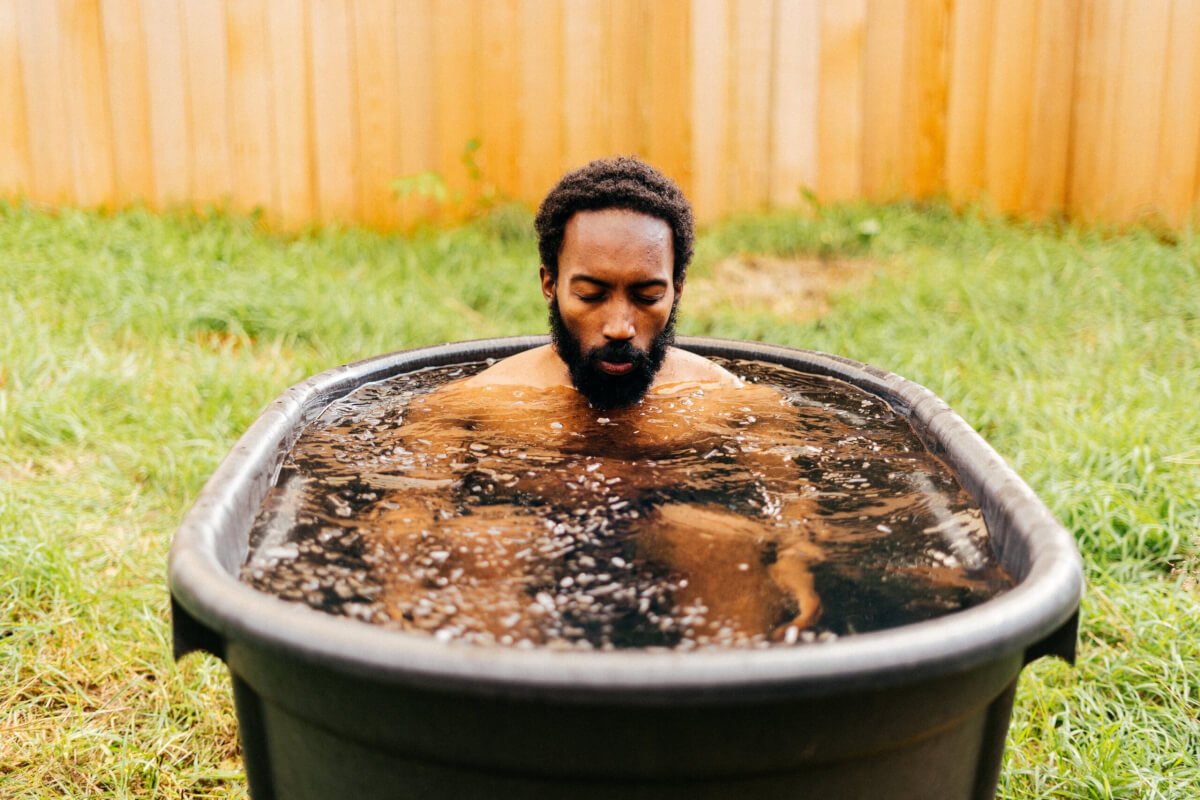
Lifters who end a workout by sinking into a tub of ice water may be undercutting the very thing they just trained for. Repeated ice baths after weightlifting may reduce muscle and strength gains, according to a new analysis of cold-water immersion research, and the effect appeared with regular use rather than after a single dip.
Drawing on 15 research reviews of cold plunges after exercise, the analysis found that cold water helps with some things, like easing soreness. Who is dunking, and when, changes the picture.
Cold plunging has become a fixture of gym culture, widely used as a fix for sore muscles and slow recovery. The review, published in Sports Medicine – Open, points to timing and purpose rather than blanket use.
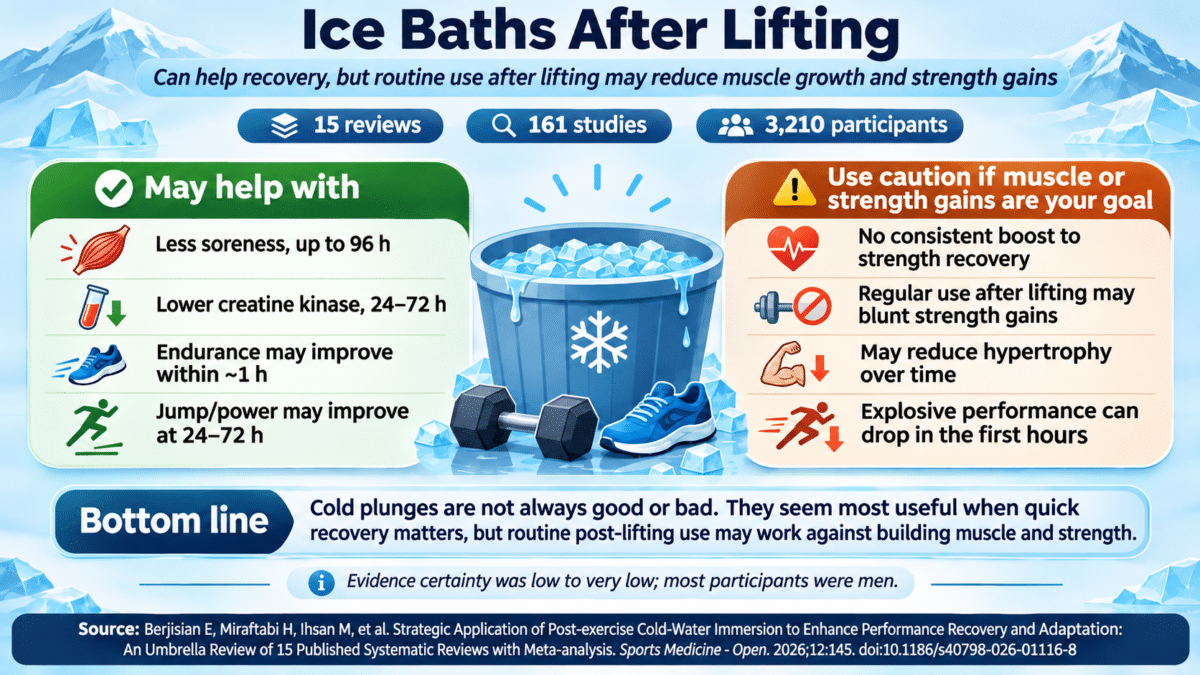
Researchers Gathered 15 Reviews on Ice Baths Covering 3,210 Participants
Rather than running a new experiment, the research team gathered existing reviews of cold-water immersion after exercise and judged how trustworthy the evidence looked as a whole.
Eight scientific databases were searched, and two researchers independently screened the results, leaving 15 qualifying reviews published between 2011 and 2025. Together, those reviews drew on 161 individual studies with 3,210 participants. Most were healthy young adults, a mix of people with no training background and well-trained athletes. The cold-water sessions in the underlying studies lasted 3 to 20 minutes in water between 5 and 15 degrees Celsius (about 41 to 59 degrees Fahrenheit), sometimes covering the whole body and sometimes only the exercised limbs.
Ice Baths Reduce Soreness but Weaken Jumping for the First Few Hours
Timing mattered for nearly every outcome. For endurance, such as running or cycling, one review found a boost within the hour after a cold dip, while others found no consistent benefit at 24 hours or later. That short window may matter most for athletes who must compete again within the hour, as in tournament play. Jumping and explosive power followed a different pattern. Jump performance got worse in the first hours after a cold plunge, possibly because cooled muscles cannot contract as powerfully right away, which makes a dip before a same-day sprint session look like a poor plan. By 24 to 72 hours, though, reviews linked the same cold dip to better jump and power output.
Muscle soreness eased, with reductions lasting up to four days in one review, especially after intense workouts. A blood marker of muscle damage also dropped one to three days after exercise, while inflammation markers showed no clear change. Dips of 10 to 15 minutes in water between 50 and 59 degrees Fahrenheit appeared best for easing soreness, while longer dips of 16 to 20 minutes were not consistently helpful.
Regular Cold Plunges After Lifting May Reduce Strength and Muscle Gains
For lifters, the results were less welcome. Cold water did not clearly speed recovery of maximum strength at any point tested, up to a week after exercise. When people used cold plunges again and again after weight training over several weeks, their gains in maximum strength, lifting stamina, and explosive power were smaller than those of people who skipped the cold water.
A separate review on muscle size found that regular cold exposure after lifting likely reduces muscle growth, though only slightly. Lab research cited by the authors points to cold water dampening the signals muscles use to build new protein after a workout.
Where the cold water touched the body seemed to matter, too. Soaking only the trained arms or legs was linked to smaller strength gains, while whole-body immersion showed “no clear detrimental effect,” in the authors’ words. That is not a green light, though. Because the strength and muscle-size conclusions draw on many of the same trials, and the whole-body result covers strength only, full-body plunges have not been shown safe for muscle growth.
In one review, endurance training gains were similar with or without cold water, so the downside seems to hit strength and power athletes more than runners or cyclists.
Evidence for Ice Baths Is Rated Low Quality, With Few Women Studied
Despite the popularity of cold plunging, the researchers rated how far the evidence can be trusted as low to very low for many findings. Inconsistent results and small samples were common problems. Several reviews also mixed different workout types and weather conditions, which can blur what cold water really does. All 15 reviews were rated low or critically low in quality.
Women made up roughly one in ten participants, 320 of 3,210, so whether cold plunges work the same way for female athletes remains unknown. The authors called for more women in future trials.
For lifters chasing muscle, the ice bath may be a habit worth breaking after heavy sessions, and a tool better saved for moments when quick recovery matters more than long-term gains, such as back-to-back matches in the heat.
Disclaimer: This article summarizes a single published research paper for informational purposes only and is not medical advice. Anyone considering changes to exercise or recovery routines should consult a qualified healthcare professional.
Paper Notes
Limitations
No new analysis combining the individual studies from the 15 reviews was run, so the results summarize what each review already reported. All 15 reviews were rated low or critically low in methodological quality, and certainty in the evidence was low to very low, mainly because of inconsistent results, imprecise estimates, and a lack of blinding, a method for preventing bias that is difficult to apply when participants know whether they are sitting in cold water. Most participants were young, healthy men, leaving open how the findings apply to women, older adults, or less healthy people. Several reviews pooled different workout types or mixed hot and temperate conditions, which may have blurred context-specific effects. Overlap among the original studies was moderate overall but reached 64 percent between the two reviews covering strength and muscle growth, meaning those conclusions come from a concentrated group of trials. One review was left out of the quantitative summary because it did not report an overall effect size. The paper also does not establish how much muscle an individual lifter might lose.
Funding and Disclosures
According to the paper, there was no funding for the article, and the authors declare no competing interests regarding the research. An acknowledgment notes that Edith Cowan University provided PhD research scholarships to Erfan Berjisian and Kai Alexander Homer.
Publication Details
Titled “Strategic Application of Post-exercise Cold-Water Immersion to Enhance Performance Recovery and Adaptation: An Umbrella Review of 15 Published Systematic Reviews with Meta-analysis,” the paper was authored by Erfan Berjisian, Hossein Miraftabi, Mohammed Ihsan, Kai Alexander Homer, Kristina Kendall, Llion Roberts, and Chris Abbiss. Berjisian, Homer, Kendall, and Abbiss are affiliated with Edith Cowan University in Australia, Miraftabi is an independent researcher in Muscat, Oman, Ihsan is at United Arab Emirates University, and Roberts is at Griffith University in Australia. It was published in Sports Medicine – Open (2026, volume 12, article 145) on September 30, 2026, after being received May 21 and accepted September 21, 2026. DOI: 10.1186/s40798-026-01116-8. The review was registered in advance with PROSPERO under registration number CRD420251103267. Correspondence: [email protected].