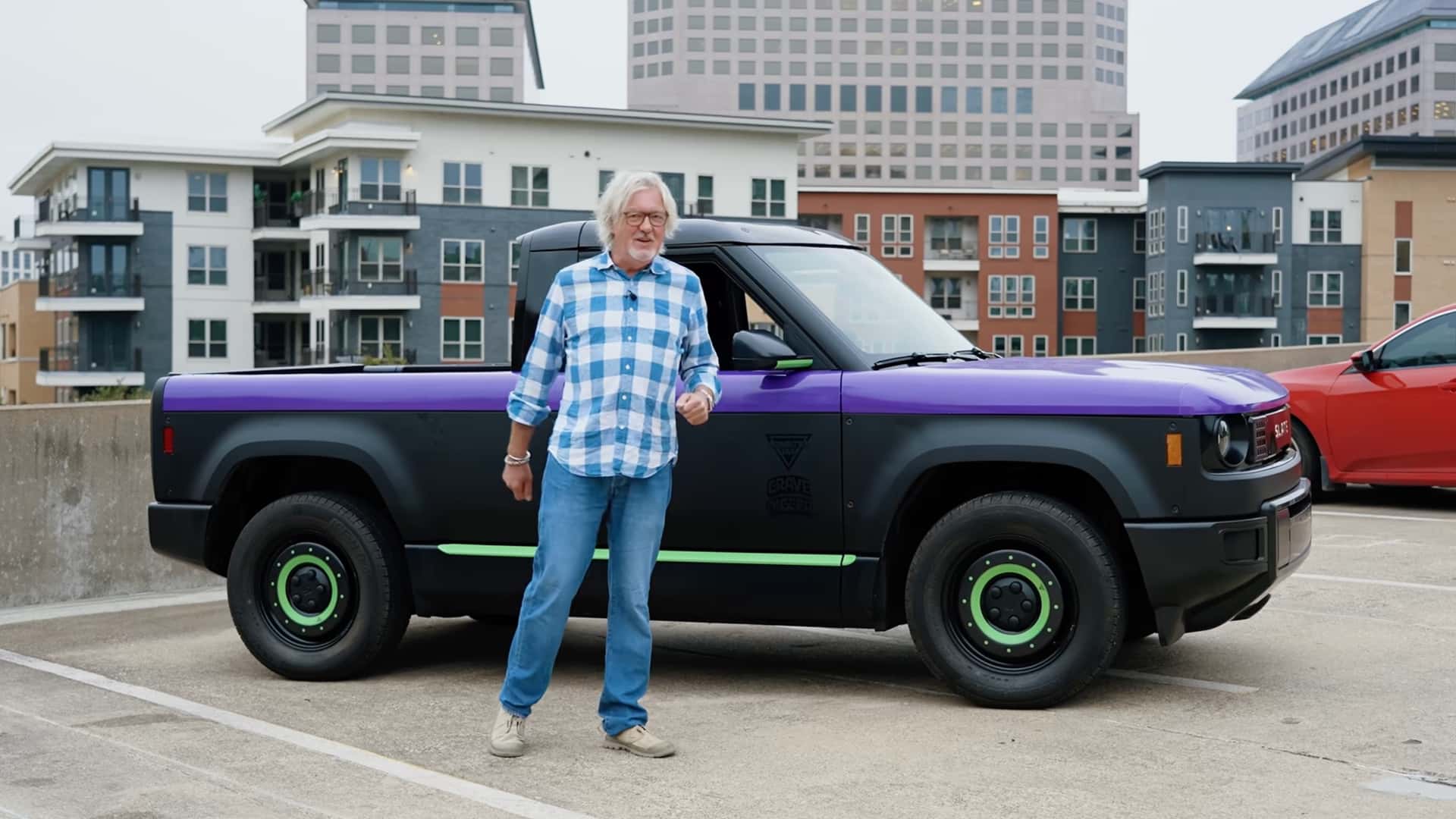
As a former Ford F-150 Lightning owner, a Samsung Galaxy Z Fold user, and someone who generally loves technology, I never expected to reserve a truck built around the absence of it.
Yet when Slate recently started selling a $30 Rand McNally 2027 road atlas under the tongue-in-cheek name “Screenless GPS”, I immediately understood the joke. What surprised me wasn’t the merchandise itself. It was how many prospective owners seemed to understand it too.
What started as a clever piece of merch got me wondering whether the map was really a joke at all, or whether it accidentally revealed something bigger about what some drivers are starting to want from their vehicles.
The Joke That May Have Revealed Something Bigger
When Slate added the road atlas
When Slate added the road atlas to its merchandise lineup, the move felt like a playful jab at an automotive industry that has spent years moving in the exact opposite direction. Modern vehicles are increasingly defined by giant touchscreens, digital interfaces, voice assistants, subscription services, and software features that often receive as much attention as horsepower or towing capacity.
The community reaction wasn’t outrage or confusion. Instead, enthusiasts described the idea as “cheeky,” praised Slate’s sense of humor, and generally embraced the concept.
That response is interesting because a paper map shouldn’t make sense in 2026. We all carry sophisticated navigation tools in our pockets. Yet the joke appeared to resonate because many of the people discussing it were already having a larger conversation about how much technology they actually want in their vehicles.
What If Drivers Aren’t Tired of Technology, Just Bad Technology?
The more I read through Slate discussions,
The more I read through Slate discussions, the more I noticed a recurring theme. People weren’t arguing against technology itself. They were questioning whether modern vehicle technology always improves the ownership experience.
In one discussion, a forum member argued that luxury might eventually shift away from larger screens and toward physical controls and hidden technology. Another shared a frustrating experience with a newer vehicle’s voice-command system and summed up their feelings with a simple response:
That sentiment showed up repeatedly in different forms. The issue wasn’t that buyers wanted to go backward. The issue was that they were growing frustrated with technology that seemed to complicate tasks that used to be simple.
For some people, simplicity is starting to feel like a premium feature.
Why a Tech Enthusiast Like Me Reserved a Screenless Truck
That’s the part of the Slate story that resonates with me personally.
I’m not buying into the truck because I
I’m not buying into the truck because I dislike technology. If anything, I’m probably the type of consumer most automakers assume wants more of it. I use a Galaxy Fold phone, enjoy gadgets, and tend to be an early adopter whenever something interesting comes along.
What changed my perspective wasn’t a desire to simplify my life. It was the realization that I was already carrying better software in my pocket than what I was using in my vehicle.
My Phone Already Does Most of What My Truck’s Software Does
During my time with the Lightning, I gradually realized I was relying on Android Auto for nearly everything. Navigation, music, podcasts, messages, and voice commands all flowed through my phone. Ford spent years developing SYNC, yet most of my daily experience was shaped by Google’s software, and leaving Android Auto to dig into Ford’s native menus felt like a step backward.
Unlike a factory infotainment system, my phone follows
Unlike a factory infotainment system, my phone follows me from vehicle to vehicle, gets constant updates, and already holds my apps and subscriptions. Even without Android Auto for Phone Screens, my Fold can display navigation, media controls, and other apps side by side in a layout that rivals most modern dashboard screens.
That is why Slate’s approach makes sense. Aside from a small digital cluster behind the steering wheel, the Slate skips a center touchscreen and built-in stereo altogether, offering a universal phone mount and leaving audio to optional accessory speakers or portable Bluetooth devices.
Importantly, Slate is not abandoning software. Its mobile app still handles battery state of charge, efficiency metrics, battery health, and charging data. Rather than removing software, Slate is simply relocating it to the device drivers already carry.
In many ways, this is the logical next
In many ways, this is the logical next step after Apple CarPlay and Android Auto. Drivers spent years pushing automakers to let them bypass factory interfaces in favor of their phones. Slate is just asking why a truck needs to build a second infotainment ecosystem in the first place. Seen through that lens, Slate is not rejecting technology.
Ford’s Fathom Is Making the Opposite Bet
This is where Ford’s upcoming Fathom makes the conversation particularly interesting.
Starting at $28,350 before destination, the 2027 Fathom targets many of the same value-conscious EV truck buyers who might otherwise consider Slate’s $24,950 base pickup. While the two trucks differ in size, capability, and intended audience, the more interesting divide is philosophical.
Ford appears to believe vehicle software can become a meaningful competitive advantage.
Slate appears to believe software has already become a commodity because most drivers carry a powerful, constantly updated computing device in their pocket.
Built on Ford’s new Universal EV Platform,
Built on Ford’s new Universal EV Platform, the Fathom features a centralized software architecture, a large touchscreen, embedded Apple Maps navigation, Apple CarPlay and Android Auto support, BlueCruise-capable hardware, digital-key functionality, and frequent over-the-air updates.
To be fair, Ford is not standing still. The company has openly acknowledged that the Fathom represents a clean-sheet approach compared with vehicles like the Lightning and Mustang Mach-E. Ford’s leadership clearly believes software can become better integrated, more capable, and more valuable to customers over time.
That’s a reasonable bet.
But it’s also a difficult one.
Can Automakers Really Build Better Software Than Your Phone?
This is the question I keep coming back to.
The challenge for automakers is no longer whether they can add more software. The challenge is whether they can build software that drivers actually prefer using over Android Auto or Apple CarPlay.
For many consumers, vehicle software isn’t competing against
For many consumers, vehicle software isn’t competing against another automaker. It’s competing against the smartphone they already trust every day.
Can a vehicle interface become so useful that drivers voluntarily choose it over the software they’re already comfortable with? Can an automaker create an experience compelling enough to pull drivers away from the apps, subscriptions, and ecosystems they’ve already customized?
Ford appears to believe the answer is yes.
Slate appears to be asking whether the question needs to be asked at all.
The Map Is a Joke, But the Question Isn’t
Nobody is throwing away Google Maps and navigating cross-country with a paper atlas. The $30 “Screenless GPS” is just a clever piece of merch.
What makes it resonate is the nerve it strikes.
For more than a decade, automakers have assumed
For more than a decade, automakers have assumed that bigger screens, deeper menus, more software, and subscription-based services represent progress. Yet Slate’s $24,950 pickup and Ford’s $28,350 Fathom are approaching that same market from opposite directions. One is stripping the dashboard back to the essentials, while the other is doubling down on centralized software and connected services.
In a way, Slate may be asking the logical next question after Apple CarPlay and Android Auto. If drivers spent years demanding the ability to bypass a vehicle’s software in favor of the software on their phones, why stop halfway? Why build two separate technology ecosystems in the first place when much of the vehicle’s data and daily software experience can live on the device already in your pocket?
Maybe Slate’s appeal comes down to price, customization, or repairability. Or maybe a growing number of drivers are realizing that the smartest, best-updated screen in their truck is the one they carry everywhere.
Question for readers: With the Slate truck
Question for readers: With the Slate truck and Ford Fathom landing in a similar entry-level EV truck price range, would you rather have a bare-bones cabin that relies on your phone, or Ford’s integrated software, touchscreen, and BlueCruise-capable platform?
Blake Lowry is a tech forward automotive enthusiast with a background in software development and animation working with clients such as Car & Driver, Hot Wheels, Google, Microsoft and the History Channel where he contributed on various interactive experiences. Blake’s automotive passion is centered around his hands-on experience with electric cars and trucks, alternative/green energy and practical applications in the real world. At Torque News, Blake’s articles focus on Ford F-150 Lightning, Chevrolet Silverado EV, GMC Sierra EV, Rivian R1T, Ford F-150 PowerBoost, Ford Maverick hybrid, Chevy Bolt and Slate Truck coverage.
Read more of Blake’s work on his author profile page.
You can also follow Blake here:
Renders by Blake Lowry. Image by Slate Auto.