Union Blocks G80 Hybrid Test Vehicle at Ulsan Plant 5 While Company Applies No Work, No Pay to About 800 Workers Amid Global Sales Falling 6.3% in October, Extending 13-Month Decline
The Genesis production line at Hyundai Motor’s Ulsan plant has partially halted due to a physical clash between labor and management over the introduction of new test vehicles. With global sales volume declining for 13 consecutive months and a growing sense of management crisis, the situation appears to be compounded by the added setback of production disruptions resulting from internal conflict.
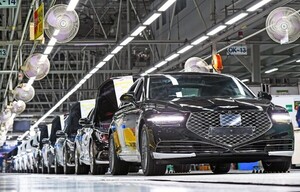
According to the automotive industry, friction occurred at around 9:00 a.m. on Nov. 2 in the Genesis assembly department of Hyundai Motor’s Ulsan Plant 5 between the company, which was attempting to introduce G80 hybrid test vehicles, and union delegates trying to block the move. When the line operation was suspended due to the union’s obstruction, the company responded firmly by announcing at around 10:05 a.m. that it would apply the no work, no pay principle to approximately 800 employees in the Genesis assembly department. Reports indicated that the suspended area was one of the two production lines within Plant 5, while the remaining line operated normally. The line in question failed to resume operation by 4:00 p.m. on Nov. 2.
The core of this conflict is the ‘Man-Hour (MH·Man-Hour)’ consultation conducted ahead of the mass production of new vehicles. Man-Hour refers to the workforce and labor input required to produce a single vehicle, and when a new car is introduced, labor and management must reach an agreement on the appropriate workforce size in accordance with process changes. Hyundai Motor pushed for consultations for the mass production of the G80 hybrid and G90 facelift models scheduled for release at the end of the year, but union delegates are opposing the introduction of test vehicles out of concern over potential workforce reductions. The company stated that discussions have not progressed because the on-site union delegates refused to engage in the consultation. On the other hand, it was reported that the union delegates rebelled against the company pushing forward with the introduction of test vehicles when prior consultations had not been concluded.
Delegates from the Genesis production line held
Delegates from the Genesis production line held a meeting on the evening of Nov. 2 to discuss response measures and whether to resume line operations for over an hour, but it is known that they failed to reach a conclusion.
Hyundai Motor’s internal struggles, coupled with external sluggish performance, are heightening concerns. Hyundai Motor’s global sales volume in October stood at 329,773 units, down 6.3% from the same period last year. It has been continuing a downward trend compared to the same month of the previous year for 13 consecutive months since October last year. In particular, domestic market sales volume stopped at 49,042 units, allowing a reversal by Kia, which recorded 51,007 units. Since Kia was incorporated into the Hyundai Motor Group, it has surpassed Hyundai Motor in monthly sales volume four times already this year alone. Hyundai Motor aimed for a sales rebound by launching new vehicles of major models such as the Grandeur and Avante in the second half of the year, but failed to break the declining trend.
Looking at the detailed performance, Hyundai Motor’s domestic sales in October decreased by 8.9% and overseas sales by 5.9% compared to the same month last year. The cumulative sales volume up to October this year also remains at 3,218,586 units, down 6.9% from last year. Cumulative domestic sales decreased by 15.6% to 497,223 units, and overseas sales fell by 5.1% to 2,721,363 units. On the other hand, rival Kia showed a contrasting growth trend by selling 291,219 units in the global market in October, an increase of 10.3%. Kia’s cumulative sales volume from January to October was 2,769,954 units, a 5.1% increase compared to the same period last year.
Industry sources anticipate that if this production suspension
Industry sources anticipate that if this production suspension prolongs, disruptions to the new vehicle launch schedule will be inevitable. It is an urgent time for Hyundai Motor to strengthen product competitiveness, as its third-quarter revenue regressed for the first time in six years. Hyundai Motor’s consolidated revenue for the third quarter was 45.1102 trillion won (about $34 billion), a 3.4% decrease compared to the same period last year, but its operating profit increased by 5.5% to 2.6772 trillion won. The company explained that production disruptions at domestic plants affected not only the decline in domestic sales but also the decrease in shipment volumes for export to major markets. The company plans to narrow differences through labor-management consultations and normalize the line, but as the difference in perspective between labor and management surrounding workforce deployment is distinct, the struggles are expected to continue for the time being.
Hur Sung-soopr@businesskorea.co.kr
View More Article
Copyright © BusinessKorea. Prohibited from unauthorized reproduction and redistribution