When was the last time a top speed of 67 mph was realized in the automotive world? 1930s? In a car, 67 mph is a cruising speed on most highways around the world, and yet that’s downright daunting for a large passenger ship. To get a big boat carrying people barely above the posted speed limit on most American highways, they need huge amounts of power. So much so that the figures start to boggle the mind. For example, the world’s fastest passenger ship is the HSC Francisco, built in Australia, and it uses 59,000 horsepower GE LM2500 gas turbine jet engines… two of them.
You read it right. The massive HSC Francisco has a total capacity of 118,000 hp. Those monstrous jet engines power two Wärtsilä LJX 1720 SR axial waterjets, capable of giving it a top speed of 67 mph. That may not sound fast, but on the water in a massive 325-foot-long ship filled with hundreds of passengers, cars, and even a few shops, it’s actually pretty fast.
To make such a big ship go fast you need a lot of power
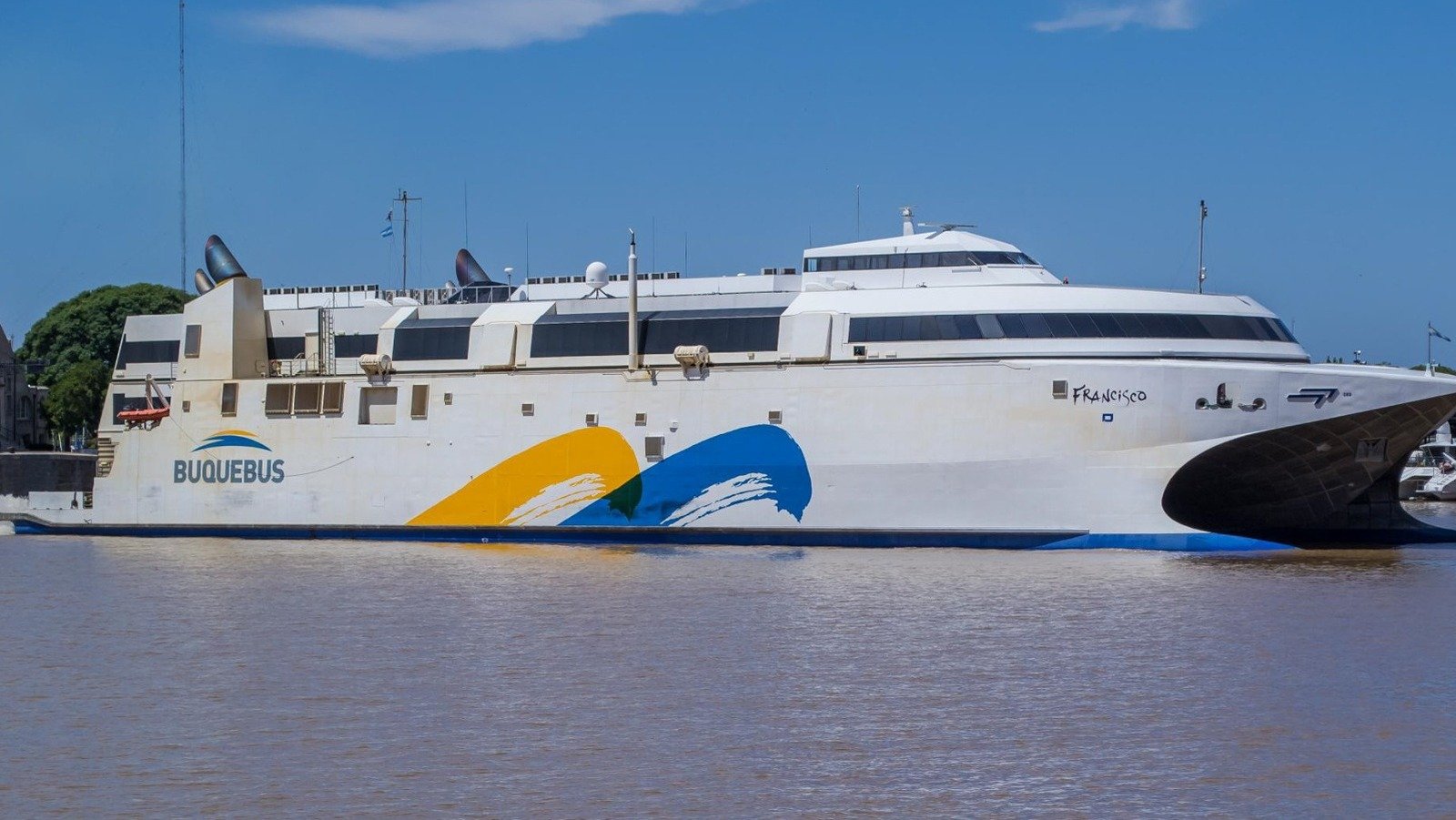
Named after Pope Francis, HSC Francisco is owned by Argentine ferry company, Buquebus, although she was built by Australian shipyard Incat in Hobart, Tasmania. It is used primarily on the 140-mile route of the Río de la Plata between Buenos Aires, Argentina and Montevideo, Uruguay. Francisco is a huge ship, capable of holding 1,024 people and 150 cars. But to keep all those people comfortable on the water, it also has a duty-free shop, a bar and even a first class lounge. So it’s like a floating, high-speed airport terminal.
That’s a lot of weight to push in the water, which is why it requires such a powerful propulsion system to get anywhere near its 67 mph top speed. So it’s no surprise that Incat used GE LM2500 turbines to power its waterjets. Each not only has as much power as 33 Bugatti Tourbillons, but also has a durable, reliable engine. The LM2500 family of engines has been in continuous development for over 50 years, with the first engine arriving in 1969. And while current engines are far more advanced, continued development has produced impressive reliability. According to GE, the LM2500 family of engines has a reliability record of +99%. And it is used in 95% of gas-fired turbine ships in the US Navy fleet.
But those turbines are useless unless they power something that can propel the giant HSC Francisco. For this, the ship uses two Warspite LJX 1720 SR axial waterjets. Each of those waterjets dispenses 24,000 liters of water per second, so you can see how fast the jets’ jumbo jets can go.
However, it’s not just power
When cars are too powerful, the trick is to reduce that power. The twin-turbo V8 is useless if the car’s tires are shredded. The same applies to a huge boat. You can have all the power in the world, but if the ship isn’t designed correctly, it either won’t go as fast or could be dangerous. But HSC Francisco is a cleverly designed catamaran, so it can take advantage of all its power, allowing it to reach its record-breaking top speed.
The wave-piercing catamaran design allows Francisco to enter the water at speed, while remaining stable. The inherent stability of the catamaran design is extremely helpful in reaching such speeds without disturbing the passengers. This also helps with packaging, as there are two hulls where Francisco stores its liquefied natural gas (LNG) tanks, to help maximize passenger space above. Francisco has four levels of passenger space, the lower level is for car storage, level two is for economy-class seating, duty-free shipping, restrooms, and a bar, and level three is mostly for first class and VIP lounges. While the single-hull design can handle heavy weight and multi-class design, as many cruise ships do, the twin-hull design allows Francisco to handle both payload and speed.
However, records are meant to be broken. So it will be interesting to see if any other ship can best HSC Francisco’s speed record. Until then, its 67 mph top speed will remain supreme thanks to its massive engine and clever design. If you’re ever in Buenos Aires, try taking a ride on this ferry, because it’s no ordinary ferry. This can be one of the most interesting marine experiences you can have.