“But why don’t we just sell Christmas baubles all year round?” asked my friend, a self-proclaimed entrepreneurial genius, as we stared in disbelief at the window of a Budapest shop lavishly decorated for the festive season. The sight wouldn’t have been quite so unusual had the sweltering August air not been swirling around our feet, while we, dressed in as little as decently possible, couldn’t have been further from thinking about decorations, snow and cinnamon-scented tea. Consumerism has long had our wallets in its sights, determined to catch them earlier and earlier, but surely this was taking things a little too far? The same thought crossed my mind this July, when I began noticing the first Halloween campaigns. Isn’t there something slightly absurd about contemplating pumpkins and Halloween costumes while wearing a swimsuit? Is there even a time when we can take a break from targeted marketing and the relentless building of hype around the next big occasion, still several months away? Is there ever a time when we AREN’T BUYING SOMETHING? Apparently not, because despite my bewilderment and objections, marketing has already coined a term for this phenomenon. It’s called Summerween. And everyone seems perfectly OK with it.
Halloween is one of those holidays whose commercial logic seems fairly straightforward at first glance. In the weeks leading up to 31 October, shops fill their shelves with masks, costumes, accessories and decorations, social media is flooded with transformations into favourite film characters, and the search for the perfect costume becomes part of a seasonal ritual that never fails to entertain us. For the fashion industry, however, Halloween offers something more than another opportunity to sell. It’s also a moment when clothing breaks free from its usual rules, giving brands an opportunity to capture the attention of an audience willing to experiment, choose something more dramatic and, for at least one evening, become someone else. According to the US National Retail Federation (National Retail Federation, NRF), Halloween spending in the United States is expected to reach $13.5 billion in 2026. This figure represents total spending associated with the holiday, including costumes, sweets, decorations and other categories, rather than fashion alone. But what’s particularly interesting is when consumers start spending: almost half (49 per cent) of those planning to shop for Halloween intend to do so in September or earlier. Summerween? Perhaps it’s not so ridiculous after all. Holiday spending, it seems, begins long before the holiday itself, and seasonal marketing campaigns follow suit. For fashion brands, then, the question isn’t simply how much they can sell, but how to capitalise on a moment when audiences are actively seeking inspiration for their own transformations, and the hype surrounding the occasion is already there.


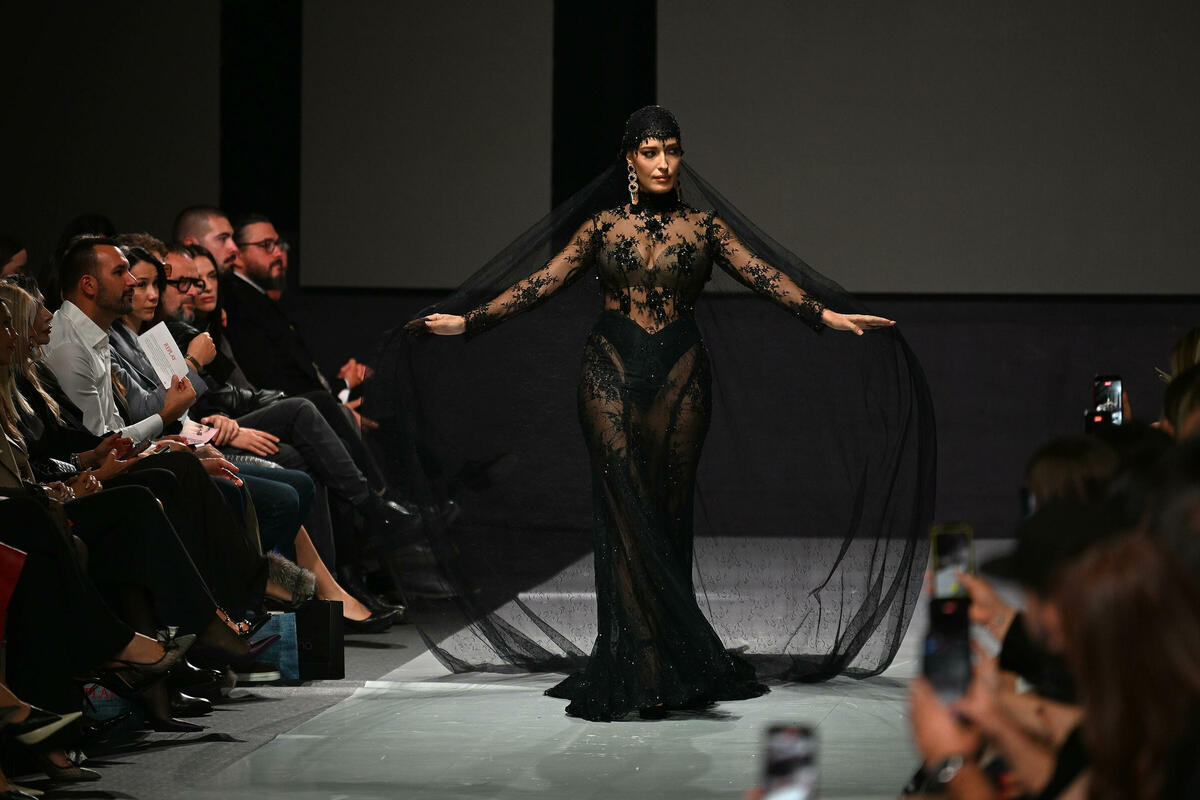
Alexander McQueen Fall 2021, Photo: Paolo Roversi
From costumes to pieces that stay in your wardrobe
When we think about Halloween and fashion, the first thing that comes to mind is a costume destined to end up at the bottom of a wardrobe after one wild night, with the smell of cigarettes still lingering in the fabric. Yet that very disposability, woven into the idea of a Halloween costume, creates room for a different strategy. It’s difficult to imagine anyone on the planet buying a corseted Dilara Findikoglu dress adorned with rotting cherries just for one night, just as it’s hard to believe someone would turn up at a Halloween party in a Gucci look from the autumn 2018 collection, carrying a replica of their own head. But that’s not really what luxury fashion brands are trying to achieve. As Vogue Business reports in Fashion Is Betting on Spooky Season, consumers are increasingly looking for individual costume pieces on platforms such as Depop and Vinted. TheRealRealreportsthatamongthemostfrequentlysearchedtermsthisyearare“Halloweencostume”,“Halloweendress”,“Halloweenbag”,“CoachHalloween”and“MoschinoHalloween”,suggestinganincreasinginterestinfashion-ledinterpretationsoftheHalloweenseason. But fashion brands themselves also see an opportunity here. Rather than offering customers products intended exclusively for one occasion, they position existing pieces from their collections as part of a costume: a black dress as the starting point for a Gothic look, an oversized leather coat as part of a transformation inspired by a cult film, or statement jewellery as the finishing touch.
Dilara Findikoglu Spring 2026, Acielle/Style Du Monde
This approach is particularly appealing to luxury brands, whose products don’t necessarily have to be designed for Halloween to fit its aesthetic. Sometimes, all it takes is a change of context. A piece that forms part of an everyday wardrobe throughout the rest of the year can take on an entirely new role in October, while a campaign presenting it in a more dramatic setting can attract an audience that might not otherwise associate it with that particular brand. The possibility of wearing it again is also important: if the same piece can be worn for Halloween and in everyday outfits (or at least on a night out), its value doesn’t disappear after one evening. Brands can therefore channel seasonal interest towards products in their regular collections while giving them additional visibility.

Halloween capsule collections
Over the past month, my inbox has been flooded with announcements about all sorts of collaborations, limited editions and Halloween-themed moodboards, regularly sent out by PR agencies alongside pumpkin emojis and adorably smiling ghosts. The general idea is this: instead of traditional costumes, fashion brands are launching Halloween capsule collections to connect with Gen Z and its fascination with spooky season and gothcore aesthetics. In doing so, they rely heavily on pop culture characters, nostalgia and limited-edition streetwear pieces.
High street brand Zara has launched a global Halloween collection of 20 clothing items, accessories and footwear created in collaboration with Andrew Lloyd Webber’s cult musical Cats. American Eagle decorated its Halloween capsule collection with nostalgic characters such as Snoopy, Casper and Frankenstein, while selected stores embraced the spooky season atmosphere even further by transforming their fitting rooms with Halloween-themed decorations. American retailer Pacsun introduced its largest Halloween offering to date this year, comprising 67 costumes, clothing pieces and accessories for women and men. “Halloween has become an important fashion moment for our customers, and we’re noticing that they approach it with the same sense of individuality they bring to their everyday style,” said Richard Cox, Pacsun’s head of merchandising.
Saint Laurent recognised this demand as early as 2019, launching a luxury Halloween capsule collection as part of its Rive Droite line. The collection included skeleton-motif knitwear, luxury masks, lifestyle accessories and specially designed black lipsticks. Despite its spooky aesthetic, most of the pieces were subtle enough to be worn long after Halloween. This is precisely one of the reasons why dedicated Halloween capsule collections remain relatively rare: it’s simply easier for brands to present existing products in a new, seasonal context. Changing the narrative is far more cost-effective than designing and producing an entire collection that could prove commercially unsuccessful the moment Halloween is over. After all, who wants to spend $400 on a jumper they’ll only wear for one night?


The value of attention, user-generated content and visibility
Halloween is a particularly interesting (and lucrative) marketing opportunity because audiences don’t just consume branded content; they create it themselves. Costumes inspired by fashion shows, celebrities and film characters, recreations of iconic runway looks and photographs shared on social media can give brands additional visibility beyond their official campaigns. Unlike traditional advertising, audiences often embrace this type of content precisely because of its spontaneity and sense of relatability. Someonerecreatingaparticularlookdoesn’tnecessarilyhavetobepaidtopromoteabrand,buttheycanstillgenerateadditionalvisibility.Ofcourse,thatdoesn’tmeaneveryviralcostume that takes social media by stormwillnecessarilytranslateintohighersales,butitdemonstratesthatHalloweencanofferfashionbrandsfarmorethanjustanotheropportunitytosell.
With this potential in mind, brands can encourage audience participation, collaborate with influencers or develop campaigns that invite creativity and personal interpretations of Halloween looks. ASOS’s #ASOSAlterEgo TikTok campaign is a great example, encouraging users to share their own transformations. According to a case study published by TikTok for Business, the campaign achieved a 219 per cent increase in relevant engagement. A lovely result for brand visibility, but not necessarily for the bottom line.
This highlights one of the most important distinctions when assessing the success of seasonal campaigns. Views, engagement and brand awareness are valuable marketing outcomes, but they don’t automatically translate into increased sales. To determine whether a Halloween campaign was actually profitable, we’d need to know how much was invested, how many additional purchases it generated and what return it delivered. This information can be gathered by tracking sales, using dedicated promotional codes and analysing consumer behaviour on e-commerce websites. Still, it isn’t always easy to determine exactly how many purchases were directly influenced by a particular campaign. Someone might discover a brand for the first time through a campaign, only to decide to make a purchase several weeks later. Inotherwords,althoughtheactualcontributiontosalesismuchhardertomeasureprecisely,thatextravisibilityishardlyworthless.
@charlottelooks#ad becoming my spider queen alter ego, using @asos face & body! #asosalterego#asosdoesdressup♬ ASOS Alter Ego – Meg J ft. Sarah New
Why do brands love occasions like Halloween?
The fashion industry has long relied on a calendar of events that encourage spending and create fresh opportunities to communicate with consumers. Holidays, festival season and major cultural events provide convenient reasons to put products in the spotlight, even when those products have little to do with the occasion itself. Halloween is particularly useful in this respect because it allows for a little more drama, theatricality and fashion excess, while giving audiences a role that goes beyond simply watching. In fact, without their participation, the entire concept would make very little sense. For brands, it’s an opportunity to reveal a less predictable side of themselves. They don’t necessarily need to produce costumes to play with horror aesthetics, Gothic references, theatrical styling or the idea of creating an entirely different, fictional character. A black dress suddenly becomes part of a witch-inspired look, a dramatic coat takes on the air of a film costume, and a piece of jewellery that might go unnoticed for the rest of the year becomes the perfect prop. In other words, it’s not always necessary to create a new product; sometimes, finding a new role for an existing one is enough.
Still, the enormous amount spent on Halloween in the United States tells us little about how much fashion brands actually profit from it, just as a viral campaign doesn’t automatically mean a brand has made a fortune. But perhaps the more interesting question here goes beyond Halloween itself: how much of fashion brands’ revenue today comes from the products they sell, and how much from the narratives they construct around them? Yes, we agree, storytelling matters. But does this whole circus really need to start in July?


Prefer our site in your
Google Search & AI results.
VOGUE RECOMMENDS
Long readThanks to Bucharest Fashion Week, Romanian fashion Is on the rise. These are the brands to watchPetar Trbović

Long readI recently returned from Armenia. I discovered the best of Yerevan Fashion Week in places I’ll never forgetTina Lončar


Long readIn conversation with Elizaveta Porodina on dreams, female identity and the things we hide from ourselvesTina Lončar


Long readJasminaTV and David meet the duo behind RICHERT BEIL to talk money, creative differences and independenceJasminaTV i David