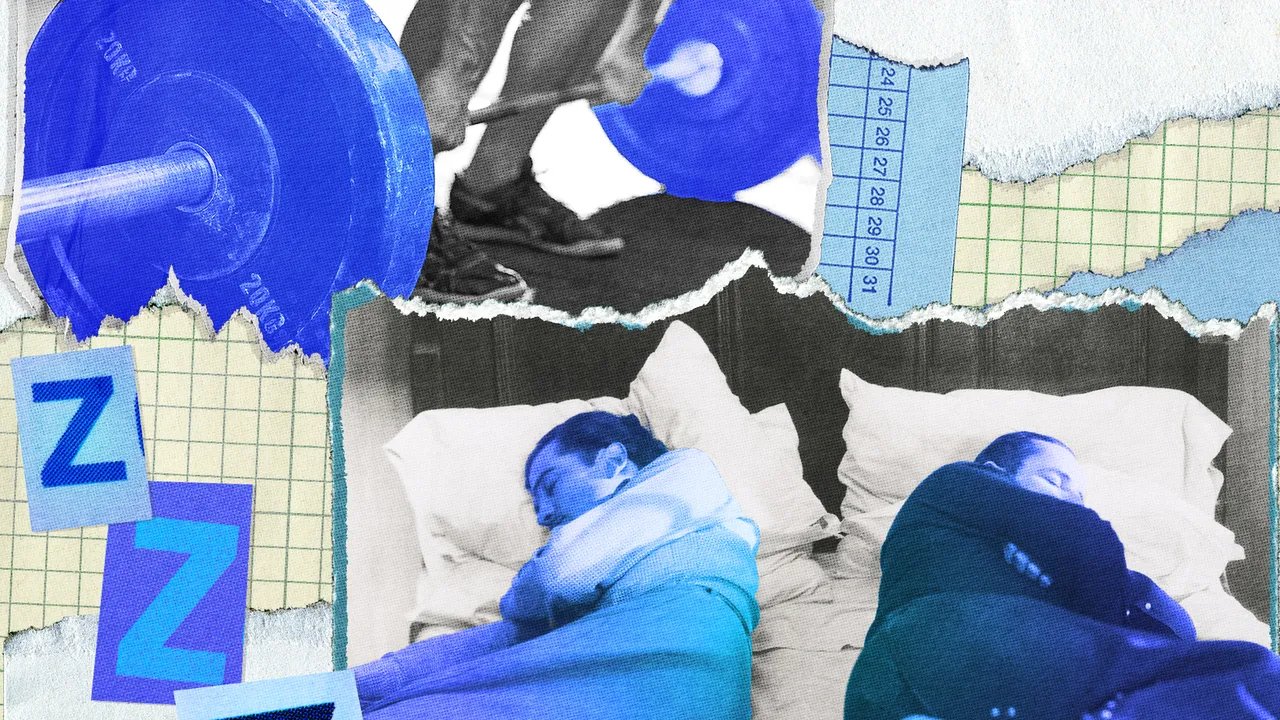
Have you ever noticed how some workouts put you to sleep while others make you feel like someone switched out your vitamins for caffeine pills? You are not going crazy. Exercise can have a significant impact on your sleep – for better or for worse – depending on when and how you exercise.
Unfortunately, the exercise-sleep relationship is not as straightforward as the internet’s sleepmaxers might have you believe. Although research has uncovered some valuable insights that you can start putting into practice tonight, there’s still a lot we don’t know. “The troubling thing about this is that we don’t have the mechanism completely turned off,” says James Wyatt, PhD, a clinical sleep disorders expert. Rush University System for Health in Chicago.
“It’s also important to caution that the data is extremely helpful, but there is a lot of individual variability,” says Kristen Holmes, Ph.D., global head of human performance and principal scientist at Whoop. At the end of the day (literally), sleep is a complex chemical equation that varies to varying degrees for each person.
But back to those valuable insights. From morning HIIT workouts that reset your circadian rhythm, to evening workouts that hack your body’s natural cooling system, here are some of the best ways to use exercise to fall asleep faster, according to experts.
Working out normally won’t make you fall asleep faster
Exercise can certainly reduce the time it takes to fall asleep, but not for the reason that many health influencers would lead you to think — that is, by promoting your body’s natural production of adenosine, a sleep-inducing compound that is also a byproduct of exercise.
The cells in your body depend on a molecule called adenosine triphosphate, or ATP, for energy. It is a universal fuel source that powers everything from muscle contraction to brain functioning. As ATP is used, it produces a compound called adenosine. Adenosine is not a waste product. In fact, it is extremely valuable. “In muscles, adenosine helps reduce inflammation and limit damage during periods of metabolic stress,” says Dr. Holmes. Meanwhile, adenosine continues to accumulate in the brain throughout the day, gradually making you feel sleepy. “In sleep science, this is called ‘sleep pressure,'” says Dr. Holmes.
So it seems entirely plausible that the key to falling asleep faster would simply be exercise. More exertion equals more adenosine and therefore more sleep pressure. a 2007 Study published in journal neuroscience In fact, it was found that when rats exercised intensely, the levels of adenosine in their brain increased significantly.
But it doesn’t work that way in humans. “Adenosine can do a lot of different things in the brain and body, but we have to differentiate them,” says Dr. Wyatt. This is because adenosine does not cross the blood-brain barrier – the covering around your brain that selectively lets some chemicals in and not others. “If you create adenosine in your body as a byproduct of exercise, it will not affect what happens in your brain,” says Dr. Wyatt. “That adenosine doesn’t go into the brain.”
Make no mistake, adenosine is still important for sleep in humans. “Adenosine itself is one of the key chemicals that helps us fall asleep at night and stay asleep deeply for the first few hours,” says Dr. Wyatt. But only adenosine produced in the brain will ultimately contribute to increased sleep pressure.
The timing of your workout may be more important than the duration
Experts aren’t entirely sure how hard or how long you need to exercise to fall asleep faster, or whether it even matters that much. “We don’t have a lot of data on the intensity of exercise that’s needed,” says Dr. Wyatt. It seems likely that the main reason for this is that the ability of exercise to improve sleep is likely not a direct function of intensity – or any single factor for that matter – but rather a combination of variables, including timing. For example, working out at high intensity may be helpful in the morning, but detrimental later in the day.