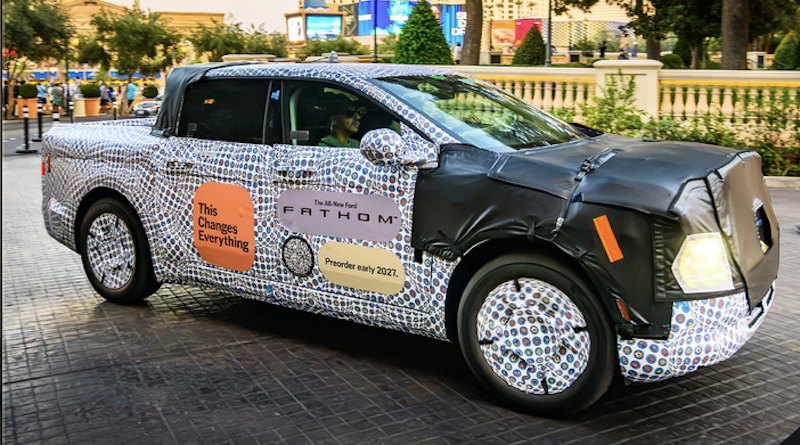
Ford’s new Fathom electric pickup truck — which is still under wraps — comes with a new bidirectional EV charging system that eliminates the cost of an external inverter (screenshot, courtesy of Ford).Support CleanTechnica’s work through a Substack subscription, on Patreon, or on Stripe. Help us produce all of the high-quality, original content we publish week after week despite the challenges of content-scraping AI, antisocial media, inflation, and other hurdles.
The Ford Motor Company has been playing its forthcoming Fathom electric pickup truck close to the vest, releasing few details ahead of volume production except for the MSRP of $28,350. Still, some clues have dropped. The latest news involves a newly released real-life data analysis of five-year battery capacity for the Ford Mustang Mach-E. The findings raise expectations for the next generation of Ford EVs, namely, the Fathom, which is the first vehicle to roll down the tree-like assembly line of the company’s new “Universal EV” platform.
The 2021 Mach-E EV Battery Numbers Look Pretty Good…
On one level, the comparison between the Mach-E and the Fathom EV battery is apples-to-oranges. The 2021 Mach-E deployed [correction: NCM (nickel-cobalt-manganese) batteries with Standard Range at 68 kWh usable capacity as launched, and Extended Range at 88 kWh usable capacity as launched]. Ford is equipping the Fathom with an LFP (lithium-iron-phosphate) EV battery. LFP is a relatively new, more economical formula than Li-ion. All else being equal the tradeoff is lower range, though some Ford watchers point out that drivers can order their Fathom with an optional extended-range battery.
The point is that the 2021 Mach-E is old news. The new news is the forthcoming Fathom, which Ford has been regularly teasing as the first product of its secret, not-so-secret “skunkworks” team for the past five years or so. The addition of a cost-cutting, internal inverter for bidirectional charging is the topic of the most recent news drop, indicating that Ford expects Fathom drivers to use their EV battery for stationary applications as well as drive time.
Drivers who routinely use the bidirectional feature will likely put their Fathom through more charging cycles than a typical EV, and prospective buyers will need some assurance that their zero emission pickup will be up to the task.
And, that’s where the 2021 Mach-E data comes in. Ford has just released the 5-year numbers for retained battery capacity over time, and they look pretty good. By releasing the data now, when the Fathom is nearing volume production, Ford has raised expectations that the new electric pickup truck will deliver similar, if not better, longevity.
The 2021 Mach-E Battery Keeps On Ticking
The 2021 Mach-E was sold with both standard and extended range battery packs, and the data combines both variations.
Relative to the Fathom’s bidirectional charging feature, the key finding is that high-mileage vehicles scored well. “More than 2,000 owners have crossed 100,000 miles on their original battery pack while maintaining >91% average health,” Ford explains. In the 2021 cohort, 30 drivers also ran past 200,000 miles while retaining an average capacity of about 88%.
Ford, which graciously shared an embargoed press statement withCleanTechnica over the weekend, also emphasizes that 95% of the 2021 Mach-E’s landed between 87% and 97% health, indicating that a relatively small number of outliers brought the average down to 92% overall.
Bidirectional Charging And The Death Of The Gasmobile
The Mach-E data will surprise nobody who has been paying attention to the latest news about EV battery lifespan. As it turns out, EV batteries last far longer than first anticipated. That’s significant enough when an EV battery is deployed for mobility purposes. Capacity retention takes on extra importance when the same battery is used to manage electricity use in homes and other buildings.
Ford provided some insights last month, when it posted a long form article describing the Fathom’s built-in inverter. An inverter is a device that converts the DC current from an EV battery into the AC current used in homes. A typical bidirectional charging system requires the property owner to install a wall-mounted inverter, adding another layer of expense. Ford has absorbed the cost of the inverter into the Fathom itself, a decision aimed at encouraging drivers to make use of bidirectional charging at home. The company has also been working with utilities to help motivate drivers to take advantage of the feature.
With bidirectional charging, EVs realize their full potential as rolling, zero emission power generating stations. Drivers can use bidirectional charging on an emergency basis, to keep the lights on at home in case of a grid power outage. They can also take advantage of utility incentives, which reward EV owners for deploying their stored ectricity during periods of peak demand or other stresses on the grid, benefiting all ratepayers in the service territory.
Some US utilities already offer discounted or even free rates for EV owners who charge up their battery during off-peak hours. Try that with your gasmobile!
The Steady Drip, Drip, Drip Of Information On The Ford Fathom
Stay tuned to this channel for further details about the Fathom and its battery. In the meantime, some Ford dealers have been passing along information from the automaker’s HQ. Here’s a representative example from the DC-area dealer Koons Ford:
“Battery options beyond the standard-range configuration have not been announced yet. Ford has confirmed a long-range battery option is planned and that its upcharge will be significantly lower than what Lightning buyers experienced, but specific range figures and pricing tiers are not yet public. This page will be updated as Ford confirms additional specifications.”
Okay, so much for that. Tonkin Hillsboro Ford in Oregon is hardly more forthcoming:
“Ford Fathom pre-orders will begin in early 2027, with a starting MSRP of $28,350 for the standard-range battery. While some specifications are still to come, there’s already plenty to know about this new Ford electric truck.”
“Ford has not yet released projected EPA-estimated driving range figures for the Fathom,” Tonkin elaborates. “The vehicle is currently being introduced with a standard-range battery, but an official EPA range estimate isn’t available yet.”
“This is one area where shoppers will need to wait for additional information,” the dealer adds.
Hmmm…let’s turn to the automotive press, where EV Charging Stations was somewhat more forthcoming. “The 2027 Ford Fathom electric pickup truck will not exceed 300 miles of range in its base form, but it likely will with the optional larger battery,” EVCS reports.
“The Ford Fathom has a 400-volt LFP battery system and 48-volt auxiliary electrical architecture. The truck features a cell-to-pack battery system (no modules), with prismatic battery cells being structural elements of the vehicle,” EVCS elaborates, further speculating that the extended-range battery could involve a higher-performing LFP formula or a switchover to the familiar NMC (nickel-manganese-cobalt) concoction.
EVCS also calculates that the standard EV battery will yield a range of under 220 miles, with the extended range version coming in at 300 miles, as Ford has indicated.
Meanwhile, the Detroit Free Press has noticed that a fully loaded Fathom with all the bells and whistles still comes in around the $40,000 mark, well below the $54,000 average cost of new EVs.
We won’t have long to wait for the full details to come out. Last week, Torque News was among those reporting that the Fathom is well into the final validation stages leading to full volume production.
With sales expected to begin late next year, the Fathom will face some competition from other EV makers that are aiming at the electric pickup truck market. One pickup stakeholder that Ford won’t have to worry about, though is Tesla, which is planning to halt production of the Cybertruck next year.




CleanTechnica uses affiliate links. See our policy here.
CleanTechnica’s Comment Policy