On a recent episode of Mary Beth Barone and Benito Skinner’s podcast, Ride, the hosts paused their conversation to talk about each other’s ’fits. “What is this kinda top?” Skinner asks, to which Barone replies declaring it vintage Miu Miu. Skinner goes on to cosplay an OOTD video, running through his full outfit: society archive T-shirt “vintage, of course”, vintage Ralph Lauren Polo shorts, and flip flops by The Row.
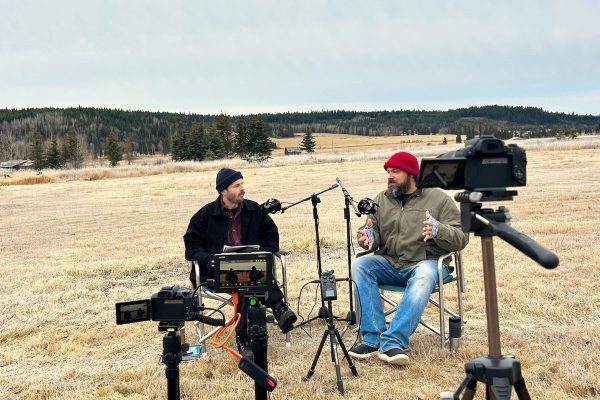
Ride is not a fashion podcast with a capital-F, but this moment underscores why podcasts today — now largely streamed as videos — are becoming important platforms for fashion. Brands are starting to take note. Skinner regularly sits front row at Prada, and has shot campaigns or content for Tory Burch, J.Crew and Ralph Lauren. Barone has attended the Tory Burch show for the last three seasons.
And on the podcast, their brand deals include workout label Tonal, hair brand K18, and Bobbi Brown’s Jones Road. And it’s not just Ride. During the Spring/Summer 2027 men’s and women’s seasons, podcasters were a front row fixture, including Therapuss’s Jake Shane at Calvin Klein and Dior Men, In Your Dreams host Owen Thiele at Louis Vuitton, and How Long Gone host Chris Black, who’s become a regular at Copenhagen Fashion Week, sometimes alongside co-host Jason Stewart.
It makes sense. The global podcast industry generated
It makes sense. The global podcast industry generated an estimated $9.2 billion in sales last year, up 23% versus 2024, largely based on a surge in video content, per Bloomberg. Apple and Spotify were once the primary podcasting platforms, but now major streamers including Netflix, Hulu, Tubi, and Disney+ are entering the space. Roughly 81% of weekly podcast listeners now tune into video, either on streaming platforms or YouTube.
Video helps podcasters grow their audience: in the age of clipping, many young people will discover new podcasters after seeing the show clipped on TikTok or Reels. “Over the last three years, the definition of a podcast has changed entirely,” says Rebecca Steinberg, creator agent at United Talent Agency (UTA), who represents Therapuss with Shane, Good Guys with Josh Peck and Ben Soffer, among others.
“The way audiences consume podcasts has shifted, and by extension, so has the way the industry defines and categorizes the format.”
With more podcasts signing streaming deals and launching video and live events, the medium is becoming more visual, driving its growth and creating an opportunity for fashion to tap in. But of course, there’s a balance to strike. As these beloved talents build major cultural resonance, it’s important they maintain the credibility and community they’ve cultivated.
The podcast ad read (where the host reads
The podcast ad read (where the host reads pre-records ads for the break) is the most traditional way for brands to tap into the market. And for the most beloved of podcasters, these reads, often featuring an in-joke or a tongue-in-cheek admission, can be compelling on their own. (In fact, podcast ads deliver the highest ad performance of any brand channel.) “Because people choose to consume podcasts [rather than being bombarded with content on the feed], their recommendations carry more weight,” Steinberg says.
“Podcast and creator audiences are incredibly sticky, and that trust creates a unique opportunity for brands to reach potential buyers.”
“Podcasters’ cultural power has grown significantly in recent years,” says Marissa Hurwitz, talent agent at WME, who represents Ride’s Skinner and Barone, alongside other podcasters like Paige DeSorbo (Giggly Squad), Tinx (It’s Me, Tinx), Alaina Urquhart and Ashleigh Kelley (Morbid), Bailey Sarian (Dark History), and Rayna Greenberg and Ashley Hesseltine (Girls Gotta Eat).
“It was previously a side door for talents while they worked on other projects. But now, podcasting is the main event. They’ve gone from being niche voices to [the talents] audiences trust the most.”
A.J. Leone is a UTA creators agent who’s worked in the podcast division for nine years. His client roster includes Bowen Yang and Matt Rogers (Las Culturistas), Emma Chamberlain (Anything Goes), Jonathan Van Ness (Getting Better), and Brittany Broski (The Broski Report and Royal Court).
Brands of all kinds want to tap into
“Brands of all kinds want to tap into podcasts today because of the long-form format where the audience is captivated,” he says. “The podcast audience is not just passively scrolling on TikTok. They’re clicking play on YouTube, on their podcast player, on Netflix, and they’re choosing to listen or watch for 45-60 minutes. As a result, a brand partnership that’s part of a podcast feels more authentic; when listening, people feel like they’re on FaceTime with a friend.”
Arbiters of culture in a tasteless world
As our feeds become increasingly filled with fleeting, transitory connections, and taste continues to convert into a valued commodity, podcasters provide a trusted barometer on what culture people should tune into — from books to movies to songs — or they function as a trusty friend, with whom audiences share in-jokes and a specific vernacular that feels familiar each time they listen.
Some have even gone as far as to conceive tongue-in-cheek, IRL award ceremonies, from the Las Culturistas Culture Awards to How Long Gone’s The Goneies, which launched this year, awarding Barone as It-girl of the Year, signifying their role as arbiters of taste, even if it’s esoteric. So, as the value of taste rises, and audiences seek intellectual influencers who enrich their knowledge rather than serve them slop, podcasters are primed to capture brand marketing revenue from traditional creators.
“Established podcasters should be understood as brands in their own right, and an awards show is the clearest sign of that. It’s not a side project, it’s the brand’s IP expanding into the exact territory traditional cultural figures already operate in,” says Parisa Parmar, strategist at culture and entertainment marketing agency Attachment. “Sustained conversation on relevant topics positions a host as a cultural barometer over time, rather than a one-off voice.
There’s a genuine appetite for an unfiltered point
There’s a genuine appetite for an unfiltered point of view, and it’s fueling what is known as the ‘credibility economy’, where having a genuine take is a form of social power or capital.”
Podcaster relatability is what moves the needle. “Culturally, we have a strange relationship with expertise. We want those people who don’t seem like they’re talking down to us,” says Annie Corser, pop culture analyst at Stylus.
“Podcasters have some more inbuilt credibility, so we allow them to be tastemakers, it’s different to other types of media like film or TV in that it is by and large non-fiction. So we’re going there for information.”
This is compelling for partners, adds WME’s Hurwitz. “You’re really getting to work with people who haven’t just necessarily also grown up and been like, ‘I want to be a star,’” she says.
“It’s people who have these really fascinating niche interests that they use their podcasts to share.”
Developing visual cues
The visual nature of modern podcasts is changing how podcasters work with brands, experts agree. Las Culturistas — the growing pop culture podcast hosted by Yang and Rogers — signed a new deal with Disney+ and Hulu on October 15, to stream the pod on both platforms.
Leaning into the visual side of the show,
Leaning into the visual side of the show, the duo launched a new video set over the summer, which has allowed for more product placements and brand interactions, says UTA agent Leone. “Fashion hasn’t tapped into the podcast space as significantly as other categories,” he adds. “But it’s only a matter of time, especially with the added visual component.”
Shane — who is increasingly booking major talent interviews — signed a deal with Netflix in January to stream his episodes on the platform.
“Bringing Therapuss to Netflix was one inflection point that signaled platforms traditionally associated with TV and film see real value in licensing and distributing creator-produced shows that originated on social and audio platforms,” Steinberg says. “Hollywood is seeing that these creators are the new frontier of entertainment — backing them with bigger budgets, new distribution, and the ability to story tell on a different stage.”
This summer, Alo tapped Shane as an ambassador, launching a workout series with him on the Alo app, after he spent three years training at the Alo Wellness Club in LA (and posting the difficult journey).
“It’s clear to the audience that there is a true relationship there, and I think the customer can just feel it and see it, and that’s why they connect with the brand more organically,” said Alo CEO Benedetta Petruzzo after the launch. Podcasters today are such prominent cultural figures that many of them are already being styled and photographed for events, Hurwitz says.
The audiences are so loyal and engaged
“The audiences are so loyal and engaged in a way that translates to real purchasing power. People with a podcast business like Benito, Mary Beth, Hannah Berner, Paige Desorbo, Tinx, you see all of them showing up at these fashion week events because fans truly want to see where they’re going, what they’re wearing, who they’re wearing, and how can they get their hands on it.”
Branching out to IRL events
The evolution of podcast video is “irrefutably big”, Stylus’s Corser says.
But the next avenue for growth, she shares, is IRL podcast recordings and events, presenting more brand activation opportunities. Barone and Skinner completed a Ride live tour last year, where they held IRL versions of the podcast across the US and Europe in sold-out venues. People turned up in T-shirts with in-jokes from the pod, Hurwitz says. “Baronies” are also increasingly staging their own IRL events, having connected via Instagram fan accounts and group chats, presenting a hyper-engaged audience for brands to tap into via sponsorship.
“People have chosen to go and see people that they think are friends, and then the assumption is these friends of mine will have chosen brands really carefully, so I’ll pay attention to them,” Corser says. “People want brands to help them get out of the house.”
There’s more and more brands that want to be part of that real-life podcast moment, says Leone. Podcaster Heather McMahan of Absolutely Not even staged a live event on a cruise.
Her fans are willing not just to go
“Her fans are willing not just to go on the road with her, but are willing to go on a boat and do a whole cruise with her,” he adds. “So it’s really the community that they build.”
Of course, the brands showing up on video or at live events need to align with the podcasters’ actual tastes. “One of the things that we really focus on at WME is trying to super serve [the audience] and ensure that we’re protective of the podcaster,” talent agent Hurwitz says.
Whether it’s on the pod or off, “we never want to do anything with the brand that would jeopardize the incredible relationship and community that they’ve built with the audience.”
Hurwitz points to a recent episode of Ride as an example of how to work with brands that fit. “One ad was for Squarespace, which Mary Beth used to build her website,” she explains. “Another of the ads was for Nocd, so Benny spoke about the fact he was diagnosed with OCD.
It’s about aligning partnerships with who they are as people.”
Alignment is “the biggest thing”, Steinberg concurs. “Brands need to let podcasters talk about a product in their own voice, and trust that they know their audience best and what will be entertaining, informative and actually resonate. If a brand is overly prescriptive about the creative, it can be difficult because there’s going to be misalignment.
Creators have a direct relationship with their audience,
Creators have a direct relationship with their audience, and they know what works.”
Live events allow brands to be part of a podcast community without interrupting the pod during an ad break. “Meaningful alignment means going where the fans already gather outside the show itself, and adding something rather than inserting something,” Parmar says. “That might mean a live event built around the podcast’s community rather than its content, a physical product collaboration that only makes sense because of who the host is, or simply showing up to genuinely help solve a problem that community already has.”
Based on their growing cultural power, podcast talents are expanding their careers across different fields, presenting more opportunities as they grow.
Yang (who was previously a regular on Saturday Night Live) is currently starring in Oh, Mary! on Broadway, Thiele acts in TV series Adults, while Skinner wrote and starred in series Overcompensating on Prime, which also features Barone and is currently filming season two. The podcast is a crucial platform for talents to build a closer community, boosting their external projects, Hurwitz says.
“Now, we can take a podcast business and build it into many other areas. Whether that is TV, is it a book? Is it a tour? Is it a venture deal? Is it more brand deals? That’s really helped differentiate some of the podcasters we represent.”