Annie Ernaux has always felt at once ahead of her time and entirely in step with it. The author of over 20 fiercely personal books, including gripping accounts of her then-illegal abortion in the early ’60s, she became the first French woman to win the Nobel Prize in Literature in 2022, mere months after Roe v. Wadewas overturned here in the U.S. Over the decades, Ernaux has examined class shame through close observation of her parents’ lives, accounted for all-consuming romantic obsession, and transcribed fleeting encounters in supermarkets and trains in the Paris suburbs. Her 1983 book A Man’s Place invented what became her form: an excavation of personal history without sentimentality or ornament, seeking to capture both the reality of the moment and the moment in which she is remembering. With 2008’s The Years— whose English translation was later shortlisted for the 2019 Man Booker International prize — she carved out another new style with a polyphonic memoir at once personal and collective about the postwar generation to which she belongs. A Girl’s Story (2016) was a pre–Me Too reckoning with her traumatic first sexual experience at 18 and the unbridgeable distance between the girl she was and the narrator she became. Writing, the Other Life, a volume of her letters, interviews, previously unpublished diaries, and essays about her literary and political contributions, is now available in English.
At 86, the author still has “a lot to write,” she told me in French. Those familiar with Ernaux — an activist and former teacher — will not be surprised that she has been closely monitoring the student-protest movement. We spoke over the phone in October as students lamenting disinvestment in education joined forces with unions and the rural populist workers movement the Yellow Vests for largely peaceful demonstrations against government austerity. But after riots left businesses and neighborhoods damaged throughout France, the government responded with crackdowns and curfews. “They’re trampling on our right to protest,” Ernaux said. From her home in Cergy, a suburb of Paris, she weighed in on the police response to the movement, the state of Me Too following the Gisèle Pelicot case, her hopes and fears six months out from a high-stakes presidential election, and why she approaches every book as if it were her last.
What do you think the state owes students right now?
First of all, they must be listened to. The government has shown no awareness or grasp of what has been happening among the youth. It’s been that way for years, but the attitude has become even more pronounced under President Macron. Whenever farmers make the slightest move, they’re immediately received at the Élysée Palace. Economically speaking, farmers carry significant weight, whereas young people seem to count for nothing in the economy, at least on the surface. It took President Macron over a month to finally meet with students involved in the movement. It’s utterly distressing. There’s a slogan that you’ve maybe heard: “Bismillah, it’s darkness.” That really sums up the current situation. All the joy and the maturity shown by these high-school students has been swept away. It leaves the impression of an aging country that cares only about the wealthy and not at all about its vital forces. I may sound very angry, but I’m mostly worried and sad.
Unions and the Yellow Vests have now joined
Unions and the Yellow Vests have now joined students in the streets. What does it mean to you to see the working class and the youth side by side?
I think it’s everything you can hope for and something that failed to happen during the student protests of 1968, when you had workers on one side and students on the other. The vast majority of students at that time came from bourgeois backgrounds, while today, we are dealing with a very different generation, one with diverse origins. So we can hope for a genuine convergence between the interests of those who work and the young people in school who are facing a great deal of uncertainty about their future.
The police response to the protests has been quite violent at times.
The main thing I noticed was that, deep down, I wasn’t surprised by their response. I asked myself how I could possibly think that, given that in 1986, after Malik Oussekine was beaten to death by officers, police violence was totally condemned. Yet it has become an everyday occurrence. The police force has been heavily infiltrated by the far-right National Rally party. These are individuals who harbor racist views and show little to no regard for human suffering in general. But what is especially shocking is that the violence is directed at very young people. You can’t rule out that there will be rioters [casseurs], a truly remarkable term because these are people. Who are they? That is the question no one asks. They are treated as some sort of mysterious, violent group who steal and smash things. Yet in the aftermath of the October 17 riots, we saw that among them were, naturally, the unemployed as well as individuals living a bit on the margins. But they all belong to the same country. One should ask about that, but no. It is just repression, repression, repression. It’s a slippery slope. You can no longer speak of a democratic state. There is no democracy. I believe the rest of the world, Europe, and even the U.S., is scandalized and shocked. It’s such a level of brutality — and I’ll go so far as to say — a fascist method.
You have long been a politically active writer. Do you view your activism as a choice or a responsibility? Has that changed since the Nobel?
My political engagement is a continuation of the writing. When I write, I feel a sense of responsibility, one that entails not cheating myself. It is about truth: the truth of form, the truth of the writing. Since the Nobel, it has changed in the sense that I am much more in the spotlight and solicited often. I sign op-eds that I agree with, regarding Palestine, for instance. My commitment to Gaza goes back a long way; it was in 1967 during the Six Day War that I realized Israel was a colonizing state. Before that, I held the standard view of Israel as a territory granted as restitution. I have also been involved with France Unbowed [La France Insoumise], the party founded by presidential candidate Jean-Luc Mélenchon for over a decade now. I made a deliberate choice about why and for whom I want change in France today.
In June, in Saint-Denis, you gave a speech
In June, in Saint-Denis, you gave a speech in support of Mélenchon’s campaign while wearing a Palestinian keffiyeh. What did that moment mean to you, and what are your hopes and fears regarding next year’s presidential election?
It was a unique moment for me. There were 30,000 people there, many of them young. The crowd was very diverse, just like a large part of France. I had never spoken at a rally before, and I remember thinking, “I belong here.” It’s very rare to feel like you’re exactly where you belong. The great fear is the prospect of an openly racist, fascist, far-right government coming to power. The important thing now is not to give up.
Let’s turn to your new book. The diary excerpts in Writing, the Other Life contain the promise you made to yourself at the age of 20: “I will write to avenge my people.” Do you believe you have kept that promise?
Maybe. I think what I meant by that when I was 20 was that someone like me, someone born into my background — working-class, poor, lacking in formal culture, and so on — could and should bear witness. But I didn’t actually know how I would go about that. I do have the feeling that I haven’t written solely for myself. Of course, writing is something that concerns me personally, something I miss when I’m unable to do it. But the goal is never to showcase a unique, singular individual. It’s about what is general and collective within the individual.
We also see the story of your books while they’re taking shape and discover the difficulties that might entail, notably in the case of The Years, which you worked on for more than two decades. What allowed you to persevere?
Continuing was an inner obligation. The biggest problem with The Years was finding the right form, figuring out how to transmit history and my own story at the same time. The prologue beginning with “the images will disappear” was written in 1985 when the project was very vague. And then, in the next section, when I come into the world as a little girl, there are all these voices — family voices, but also, the ones in my parents’ café-grocery store. For me, that’s what the past is ultimately. At that moment, I’m in pure collectivity.
Is there pleasure in sharing your diaries
Is there pleasure in sharing your diaries with an audience?
I believe that everything must be given in some way, absolutely everything. These are all testimonies — of a consciousness, of a process of inquiry. In many of my books — A Man’s Place, A Woman’s Story, or Simple Passion— I share my thoughts as I am writing, describing what is happening and how I am reacting.
You write novels described as “auto-socio-biographical” in which the facts are not fictionalized. Yet you are often called the “queen of autofiction,” even though you have said that the term doesn’t suit you.
We barely talk about autofiction in France anymore. Now, we talk about books, and that’s all there is to it. There are novels and then there are works that aren’t novels, which includes my own writing and Édouard Louis’s. So there is indeed that distinction, meaning there can be a formal exploration, which is the case for Louis and myself.
I am deeply committed to reality, not just the facts, but the reality of the inquiry I’m pursuing. In A Girl’s Story, for instance, there is the reality of a rape that occurred when I was 18. In a sense, I am trying to get to the heart of what that means, what it actually is. So I adopt a distinction between she, the 18-year-old girl, and I, the narrator, who is 73 or 74 at the time of writing. That is part of the truth.
The book is more ambiguous about the experience
The book is more ambiguous about the experience you now call rape. Is the use of that term a recent realization for you?
It is complicated precisely because when I am writing, I want to revisit the experience. For the 18-year-old girl I was in 1958, what happened wasn’t rape at all. Back then, rape was someone taking you by surprise from behind and you eventually giving up because he is stronger. Yet within the mental framework I had at the time, that clearly isn’t what this was. It’s a boy seducing me, and I go along with it. What happens is totally unforeseen, and deep down, I consider it my fault for not understanding what he wanted. It’s painful to say, but that is how I perceive my own behavior. Then came something that happens more often than people realize: attachment, the desire one feels for the very person who forced himself on you. I’ve read a number of accounts of this during the Me Too movement. The thing is it’s not simple at all. It’s simple for the dominator — much simpler for him than for the prey.
How are you feeling about where the Me Too movement is in the wake of the Gisèle Peliot case?
I believe this has been crucial for a shift in awareness, one that goes far beyond the Me Too movement, among the French public. It’s incredible that the trial was held in public and that Pelicot herself wanted it that way. The trial was widely followed and had a profound impact. All the people accused are men; they are not monsters. In their own minds, they probably weren’t committing what they would have called rape. Everything that is being revealed, everything coming to light, is significant. It is extremely important that these matters get publicity in the best sense of the term so that when a woman is assaulted by a man she knows, deep down, that she is not alone and that she has the capacity to speak out. I believe this has truly taken root among younger people.
I wrote A Girl’s Story before the Me Too movement. Among the many things that kept me from writing it for so long was the fear of how to tell the story without being stigmatized by readers, specifically, the notion that “she asked for it.” There was this whole surrounding narrative that it is always the woman who had failed to preserve herself. She was the perfect guilty party. And that actually has changed.
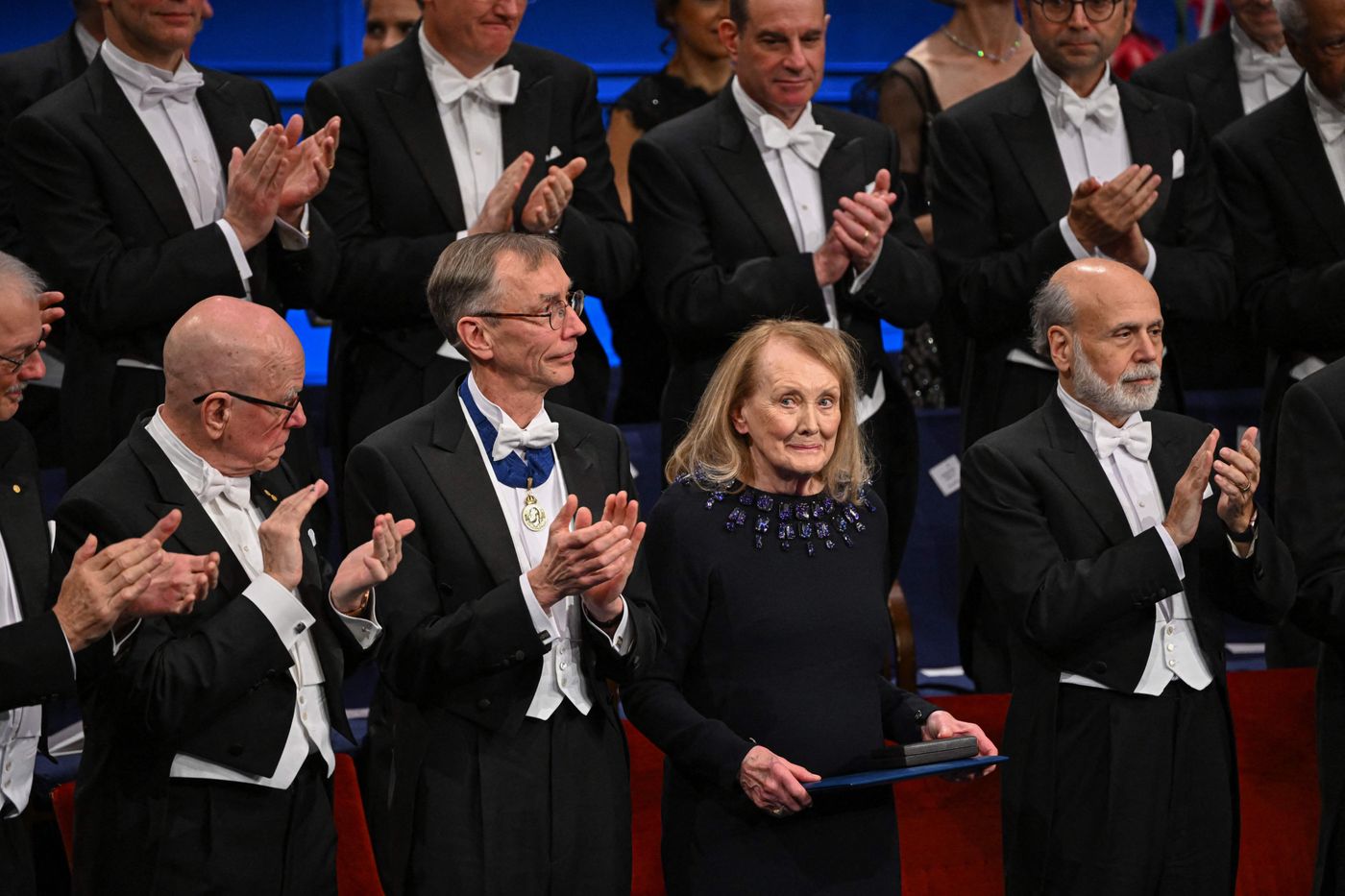
Receiving the Nobel Prize for Literature in 2022.
Photo: Jonoathan Nackstrand/
One thing I also noticed while reading your
One thing I also noticed while reading your notebooks was your seemingly immense memory, which you have called “the memory of the stigmatized.” Do you have any fears tied to forgetfulness, whether personal or social?
When you have memories of humiliation, memories of shame, all of that is very powerful. It becomes anchored in your memory. An example that springs to mind: I’m with a bookseller. I’ve just done an event at her store, and afterward, we go to a tearoom, and the table hasn’t been cleared yet. The waitress comes over quite pleasantly, but the bookseller makes a gesture and speaks to her in a curt tone: “Clear the table, please.” I find myself identifying with the waitress, not at all with the bookseller.
As for forgetting: Let’s just say I do have a poorer memory for dates than I used to and it’s something that saddens me because dates have a way of allowing you to organize many things around them. But of course what I’m afraid of is total memory loss from Alzheimer’s. Every man and woman who grows older shares that fear.
The epigraph by Jean Genet to A Man’s Place — your book about the life and death of your father — says that “Writing is the last resort when one has betrayed.” Do you view your status as a “class defector” as a betrayal?
This notion of betrayal is something I first experienced in my work as a teacher. I taught so-called difficult classes whose students came from working-class backgrounds and had the feeling of wanting to pass on knowledge and finding myself on the “other side.” I felt with great intensity that I had changed worlds. Outwardly, I might have appeared to be someone who was accomplished, but in reality, my own childhood and adolescence had been just like theirs. I remain very uncomfortable in what is known as society, that posh world I avoid as much as possible. I am part of the literary scene but not the high-society literary scene.
You’ve said that you might not have written
You’ve said that you might not have written the novels you did had you not taught French literature to young people. What did teaching mean for your writing?
Teaching forced me to confront who I had once been, my mannerisms, my way of speaking, and so on. I had an 11-year-old in my class who came from a working-class family who was outstanding in French literature but spoke poorly. I immediately saw myself in her. When I moved into higher education, I taught via correspondence through the National Centre for Distance Education. I had chosen French autobiography as my academic specialization, and the more I taught it, the more convinced I became of its importance.
You have lived in Cergy, a town in the Parisian suburbs, since ’75, when it was still very new in its planned form. You said you were drawn to it precisely because it lacked the symbols of power found in older towns. To what extent does living and remaining in Cergy constitute a way to assert your position as an outsider?
When you visit old cities, Paris first and foremost, it is obvious that there is a whole history there, and it is not the history of the poor. The homes where poor people lived have invariably vanished, whether in Paris or in the provinces, whereas bourgeois homes are still standing. Naturally, in Cergy there is a town hall and a police station and they remain places of power. The police station, where I’ve accompanied migrants seeking legal status, comes across as a place of formidable power. Power is constantly being constructed; that is the problem.
Living here has a political significance, of course, but at the same time, I live in a house with a garden in the oldest part of the village, not in the middle of housing projects. But yes, there is a bit of a manifesto aspect to it. I’m also attached to this home because it’s where my children grew up, where my mother spent a lot of time, where I experienced romantic relationships. It’s a place steeped in history for me. I arrived when I was 35, and now I’m 86. I’ve spent far more time in this “new town” that isn’t new anymore than back in Normandy, which I left at 24.
You are also interested in suburban spaces
You are also interested in suburban spaces that don’t always receive what I’ll call “the literary treatment,” such as the RER (the regional train) or supermarkets. Why do they interest you?
Because that’s where the people are. I approach them from a sociological and a historical perspective. While people certainly make history, they are unaware of the history they are making. I’m fascinated by the kind of history we create when we go to the supermarket or take the RER. That is what interests me — things that can only be truly grasped through contact with crowds of people.
You recently said on a French radio program that you weren’t taking the Nobel Prize very well.
No, I’m not. For one thing, it wasn’t a dream of mine. Whenever someone won the Nobel, I’d think, “Poor soul. They have to go to Stockholm, give a speech, all that.” I was caught off guard right up to the very last moment, despite the rumors. Winning was like being on another planet. It was a massive rupture in my life — starting with the trip to Stockholm and the whole ceremony. Originally, it wasn’t an institution built for women. You’re required to wear long gowns. It’s a ritual of power whose pageantry is completely outdated. Alfred Nobel’s intentions were noble. But everything that follows — the mountains of mail, the endless requests — is a burden.
How do you reconcile your success within the literary Establishment with your origins?
Let’s just say that in France, my Nobel Prize was highly contested. Given that the Nobel Prize in France had always been awarded to men, my status as a woman already rendered me illegitimate. France is a country where literature doesn’t adapt to the current century, as it does in the U.S., thanks to institutions like the Académie Française, which only admitted men until 1980. Before I published The Years,I was frequently attacked by critics on the basis that what I wrote was not “literature,” a construct defined by forms of exclusion and belonging. Then, I was attacked on a major radio program hosted by Alain Finkielkraut, who became particularly well known for his strong opposition to Islam, and the journalist Pierre Assouline. They picked apart my Nobel and claimed at one point that I was antisemitic based on my support for a boycott of Israeli goods once Netanyahu took office and a petition regarding Netanyahu’s invitation to Paris. What was most intense for me was to essentially ask “Where does this antisemitism of hers come from?” and then suggest, “One should look to her parents’ café. It was such a baseless, gratuitous remark implying that a working-class café is inherently antisemitic. For the past three years, this has become the easiest way to stigmatize anyone.
When I came under attack, my thought
When I came under attack, my thought was that this was, at the very least, something I’d received on behalf of the people I represent. What I found truly wonderful and deeply moving was hearing so many men and women say, “It’s as if we won the Nobel Prize.” Sometimes, when I’m feeling down, I think back to that and tell myself, well, perhaps receiving the Nobel was a form of sacrifice. [Laughs.]
You’ve said before that most of your books are written as if they were your last. What is left for you to write about?
I’m fully aware the one I’ve been working on for a while now is the last one. I think that’s the mind-set you need to have to put everything into it, all your energy.
Is there more you can share?
It’s a topic that is rather politically incorrect in the current climate. I can’t say any more than that. When you write, it’s not just for the current era. You shouldn’t let yourself be held back by the idea that it isn’t the right topic for right now.
One last little question — actually, a big one. What are you most proud of?
Having written books that may have changed the world a little bit. The world of women, the world of the oppressed.
This conversation has been condensed, edited, and translated.