We exercise because we want to change something. If we enjoy it, we want to change our mood for the better. If we do it for health reasons, we want to improve how we feel and function – namely, gaining stronger tissues, more efficient vital organs, lowering our risk of most chronic diseases and losing fat.
But why is exercise so effective at delivering these benefits? “We are talking about a basic athletic training principle,” explains leading physical activity researcher and neuroscientist Professor Emmanuel Stamatakis. “The adaptations represent the body’s preparations for the next time the same physical challenge is present.”
The word challenge is key here. For most of the benefits of exercise, we have to consistently challenge the body in some way. This persuades our nervous system that adapting is a valuable use of refits: regular runners have more efficient hearts and lungs, and strength-training aficionados have larger muscles
The most efficient way to improve fitness
Vigorous-intensity activity – any activity that leaves you out of breath to the point you can’t speak in full sentences – is the physiological language the body best understands, Professor Stamatakis says. In other words, it sends the strongest signal to upgrade our cardiorespiratory system and trigger a cascade of consequent health benefits.
In their 2025 research, Professor Stamatakis and colleagues found that, for every one minute of vigorous-intensity activity you do, you would need to do six minutes of a moderate-intensity activity (where your breathing is elevated but you can still hold a conversation) to have the same impact on heart health.
“For diabetes, it [vigorous-intensity activity] is nine times more effective, and for all-cause mortality and cancer, it’s a little bit lower,” he adds.
But vigorous-intensity activity looks different for different people. An elite athlete might need to sprint to achieve it, while someone who has not exercised in some time may get the same effect from walking up a large hill at a brisk pace. The training sessions look drastically different, but the overall message to the body is similar: it’s time to get fitter.
One problem I’ve encountered as a coach is that it can be quite hard to motivate yourself to reach this vigorous intensity while exercising. When things become hard, it’s second nature for many to slow things down. That’s why I like using the workout format below, which introduces a dose of healthy competition to a standard circuit session.
The workout
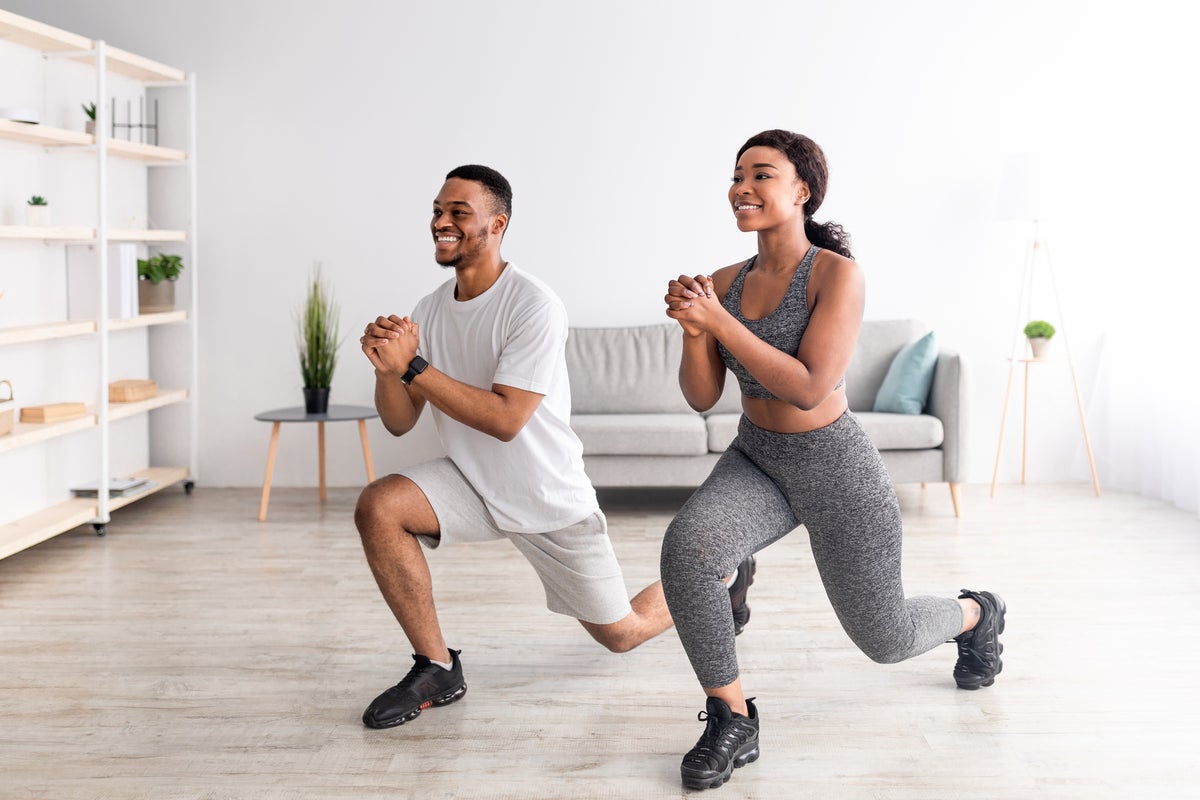
Perform the sequence below as fast as possible with good technique and record how long it takes you. Once you have completed it, rest for three minutes, then repeat it in reverse order (run, then burpee, then lunge). Try to beat your time from round one.
- Walking lunge x30
- Burpee x20
- Run x100m
Over time, as you become fitter, you might want to tweak it to make it more challenging. I would recommend adding a dumbbell or two to the lunges, upping the run to 200m, or completing anywhere from three to five total rounds.
Alternatively, some people might need a more accessible starting point: as mentioned above, exercise intensity is relative. If someone was new to exercise, they might instead perform 15 sit-to-stands, 10 wall press-ups and then walk briskly for 100m or march on the spot with high knees 30 times.
Though the exercises are easier and the target number of repetitions are lower, this version of the workout will still activate the same muscles in similar ways, raising your heart rate and leading to health benefits over time. However, this style of exercise is still not suitable for everyone.

The caveat with vigorous-intensity exercise
Vigorous-intensity exercise is the physiological language the body best understands. But Professor Stamatakis asks: “If someone cannot do vigorous activity, or they can’t integrate it into their day-to-day routine for whatever reason, what is the point of prescribing and advocating vigorous intensity?”
“It could be that a very sedentary 60- or 70-year-old gentleman may enjoy going to the park with their grandchildren or going for a slow walk with a friend and chatting – that’s absolutely fine.
“You have to be considerate and respectful towards people’s preferences; you have to acknowledge their circumstances and, considering everything, support them in the best possible way to integrate activity into their days.”
Any movement is better than no movement. All movement delivers health benefits. If you prefer lighter activities, you will have to devote a little extra time to it if you want to reap similar rewards. But when a lengthy walk in nature is on the table, that might not be such a bad thing.
Thank you for registering
Please refresh the page or navigate to another page on the site to be automatically logged inPlease refresh your browser to be logged in