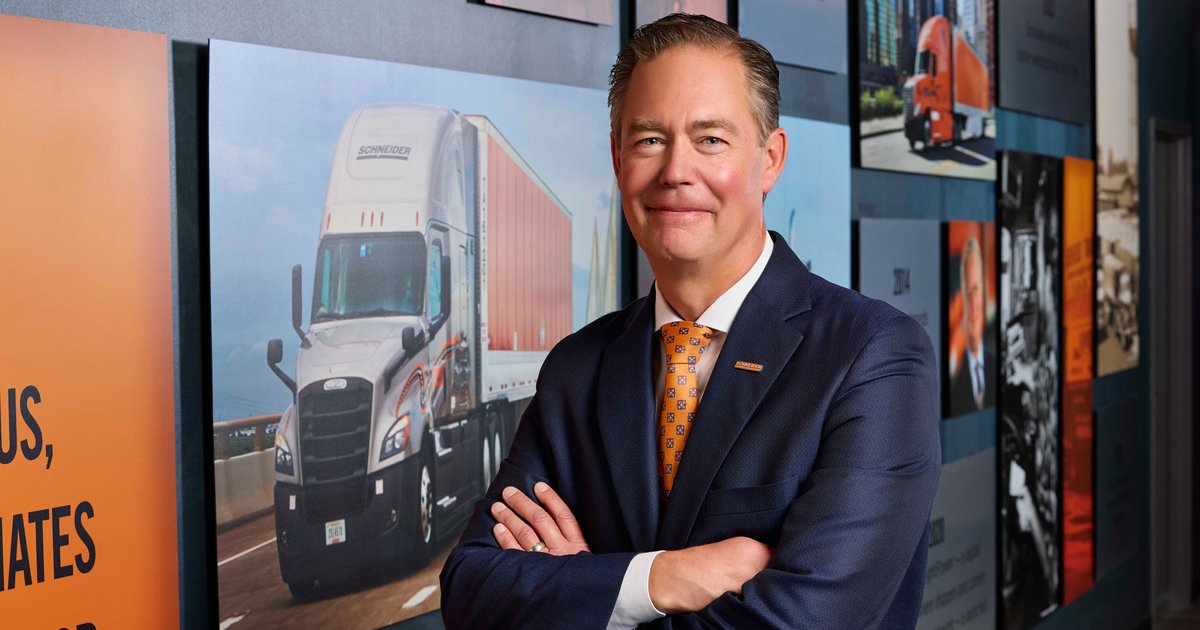
On July 1, Filter became Green Bay, Wisconsin-based Schneider’s top executive. (schneider)
key takeaways:
- Jim Filter became CEO of Schneider at the Green Bay, Wisconsin-based carrier on July 1, replacing Mark Rourke.
- Schneider’s dedicated fleet grows to about 8,600 tractors by 2025 as the acquisition reverses its truckload business mix.
- Filter said Schneider will focus on differentiated growth, low costs, strong customer loyalty and disciplined M&A.
When Jim Filter joined Schneider 28 years ago, it didn’t take long for him to realize he wanted to spend decades at carriers.
But then he never imagined becoming a CEO.
On July 1, Filter became Green Bay, Wisconsin-based Schneider’s top executive. The Wisconsin native is the fifth CEO of the company founded by Al Schneider in 1935 and the first Wisconsinite to hold the position since Don Schneider followed in his father’s footsteps.
Filter replaces Mark Rourke, who has held the CEO position since 2019, and will become executive chairman of the board. The change was announced in January.
A former Marine Corps helicopter mechanic, Filter started at Schneider as a maintenance team leader in Green Bay. He then moved to Detroit, where he met his wife Maria, who also worked for Schneider.
Over the next few decades, Filter, a University of Wisconsin-Green Bay alumnus, worked his way up the ranks, including time spent leading the company’s Mexican operations.
The Filter family moved back to Green Bay in 2012. At the time, the CEO was Chris Lofgren, the company’s first chief executive whose family name was not Schneider.
Lofgren – currently chairman of the board of directors of the US Chamber of Commerce – is the Filters’ next-door neighbor.
Schneider went public under Lofgren in 2017. At the time, Filter was the head of the company’s intermodal division.
But it’s the truckload division that has seen the biggest change since Schneider went public. In 2017, about 70% of its truckload business was networked and 30% was dedicated, shares that have since reversed.
By the end of 2025, the long-term strategic turnaround had increased the dedicated fleet to approximately 8,600 tractors.
Filter was head of the company’s intermodal division when Schneider went public in 2017. (schneider)
Acquisitions have been a driving force in the division’s transformation, with the $390 million purchase of the Baltimore-based Cowan Systems building in November 2024 followed by the acquisitions of Midwest Logistics Systems and M&M Transport Services in 2022 and 2023, respectively.
Filter recently revealed that more acquisitions are likely coming soon, but dedicated carrier acquisitions are only part of their plans for Schneider.
The executive told TT that his modest change compared to before has four elements:
- Increase in areas of differentiation
- creating a low cost organization
- Earn even more customer loyalty
- Disciplined M&A
When it comes to the last of the four, he said during an exclusive interview: “We want to focus on opportunities where we will be able to realize synergy and continue to grow the business.”
He added, “We have seen that the most opportunities exist within the dedicated ones, but we are not against the intermodal or logistics opportunity.” “But we would like to have the right cultural fit and the right opportunity to be able to grow that business.”
Carrier’s business model focuses on three segments: truckload; intermodal; and logistics, which includes only contract logistics, brokerage and electricity.
Schneider is ranked 10th on the Transportation Topics Top 100 list of the largest freight carriers in North America, 5th in the truckload/dedicated carriers and 4th in the intermodal/drayage rankings, as well as 18th on the TT Top 100 list of the largest logistics companies.
Differentiators
Filter already has time to shape the company, including the last four years as operating president, but he’s eager to sharpen those edges.
“There’s a lot of differentiation in each of our service offerings, and we want to make sure we’re focused on growing in those areas, while also making sure we’re deploying capital in places where we have differentiation,” Filter said.
Schneider’s Intermodal division is already implementing an initiative exemplifying the ethos of differentiation.
In November 2025, the company launched Fast Track, which combines Schneider’s truckload and intermodal capabilities with strategic rail partnerships to create a network of faster intermodal lanes, and the carrier says it results in transit up to two days faster than competitors on key US and Mexico lanes.
“There are customers who either have their entire supply chain or parts of their supply chain. They have very high expectations for service levels. And in the past, they often avoided intermodal on those parts of their network,” Filter told TT.
“What we were looking at was how we could really provide the same level of service for intermodal that we do on the road, because we do shipments on intermodal for automotive companies where they need to be 100% on time,” he said.
Schneider has also expanded its intermodal lanes connecting Mexico and the Midwest and Southeastern states, adding options for automotive, consumer products or paper goods customers.
At a time when federal initiatives on cabotage and visa enforcement are reducing truckload capacity on the road, services are offering discrimination.
continuous rebound
Capacity cuts boosted rates in the first six months of 2026, and Filter sees the continued boom in the freight market as sustainable.
“What we understand now is that the amount of capacity entering the market was not playing by the same rules as everyone else,” he said, adding that data shows carrier costs have increased by about 25% since 2020 due to inflation.
“Rates have not kept up with the pace of inflation. And we expect it will probably take more than an allocation session to raise rates to where we really think this industry should be,” Filter said.

Cox Fleet’s Kevin Clark discusses how fleets must rethink their maintenance strategies to remain efficient and flexible. Tune in by going above or RoadSigns.ttnews.com.
Prices continue to rise. The annual US inflation rate was 4.2% in May, the highest level in three years, according to the Bureau of Labor Statistics.
Unsurprisingly for an industry going through its longest recession in living memory, the top issue causing stress for trucking executives in 2025 was the economy for the third year in a row, according to the American Transportation Research Institute.
As the focal point of a company, stress is always present for the CEO. Filter said Rourke told him it could be a lonely job, but he continued to offer advice, as did Lofgren.
The filter has its own recipe for dealing with stress: running. “I have a training program, so it’s a different race. Every day is a little different,” he said. “I will absolutely continue to do so.”