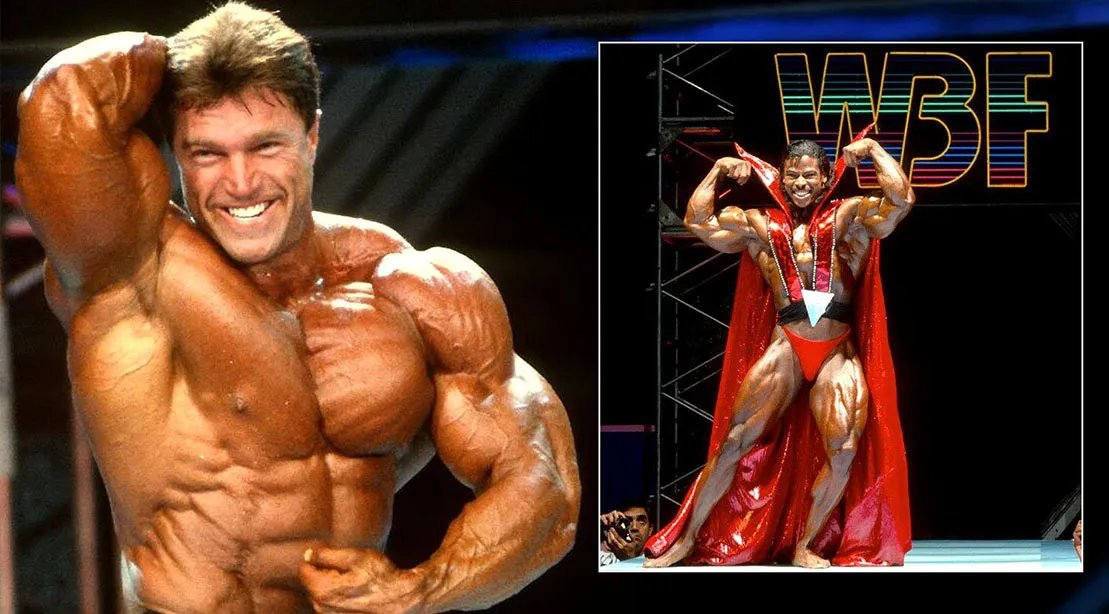
Vince McMahon is the man who took old-time regional pro wrestling and turned it into a dazzling syndicated global phenomenon, but his foray into the world of flexing was much less successful. 35 years after the inaugural World Bodybuilding Federation Championships, we take a look at five facts that range from the spectacular to the downright embarrassing.
While McMahon has become a controversial figure, currently embroiled in allegations of sexual misconduct in the workplace, the 90s were a decade when WWE leaders wanted to take the formula that had worked so well in the world of larger-than-life grappling, and take over the world of bodybuilding with the same flashy format. But while the initial buzz around McMahon’s World Bodybuilding Federation showed promise, the project failed after only two shows. Here are some of the most notable aspects of its rise and fall.
Vince McMahon used the Olympia to announce his rival project
Just as McMahon had taken rival pro wrestling promotions to task and dominated the matte market, the WWE owner looked to take over Joe and Ben Weider’s IFBB and establish his own bodybuilding federation without any worries about hurting anyone’s sentiments.
The first shot was fired in Chicago during the twenty-sixth Mr. Olympia event, when McMahon, himself a bodybuilding fan, signed a big-money contract to mentor ’80s icon Tom Platz and scout talent. The duo used the Olympia event as a way to announce their own project and get free publicity from the countless members of the media in attendance, ruffling Weider’s feathers in the process.
McMahon’s shameless takeover of bodybuilding at the Olympia became completely surreal when a group of beautiful women were brought to the event and then paraded around wearing sashes emblazoned with the WBF logo. With the formation of a supplement line and a bodybuilding lifestyle magazine to help promote the World Bodybuilding Federation as well, McMahon His desire to rule the bodybuilding world became clear.
Vince McMahon attracted bodybuilders to the WBF with big money deals
While bodybuilders are traditionally paid for winning or placing highly in competitive shows, they can also generate additional money from magazine spreads and advertising deals, but McMahon used a different method to fill his upstart federation with the best possible talent. The WBF offered guaranteed, long-term contracts to big-name bodybuilders, reported to be worth more than $400,000 per year, (Source: https://en.wikipedia.org/wiki/World_Bodybuilding_Federation) So muscle-bound athletes like Gary Strydom, who had previously won IFBB competitions and competed in the Mr. Olympia, soon joined. Other notable bodybuilders also attended, including Mike Christian, Aaron Baker, Barry Demme and Jim Quinn. Interestingly, WBF athletes were often signed to better deals than WWE Superstars, giving them better perks such as top-class travel and hotel accommodations, leading critics to wonder how such investments could be sustained. Of course, that wasn’t the case, but the first WBF Championship show took place almost 35 years ago this week on June 15, 1991, and was won by Gary Strydom.
Lou Ferrigno was the WBF’s most incredible signing
Lou Ferrigno was an obvious prize for McMahon, as he wanted to promote the second show, as the “Pumping Iron” and “Incredible Hulk” star was a big mainstream attraction, and was an original “Weider Boy” in the 1970s. Surprisingly, Ferrigno got even more greenlighting after signing a two-year deal worth a reported $900,000 with the WBF.
However, despite appearing on WBF promotional material prior to the second WBF Championship show, Ferrigno never performed on stage for the company. This is believed to stem from the fact that McMahon, who was already fighting a major steroid-related legal case against WWE, announced that drug testing would be introduced in the WBF as well. Ferrigno was soon eliminated, giving much of the momentum to McMahon’s muscle project.
WBF development was halted due to drug testing
McMahon’s decision to drug test his athletes backfired when Ferrigno jumped ship and guest posed in Weider’s place. This forced the WBF to scramble for a replacement, and it came in the form of WCW pro wrestler, Lex Luger, who had a heavy physique but lacked the mainstream media power provided by Ferrigno. To make matters worse, Luger suffered a motorcycle accident just days before the show, breaking his arm and destroying the company’s potential once again.
WBF goes from ‘flex’ to ‘flop’
Just two years after McMahon’s initial flex in Chicago at the Olympia, there was little goodwill towards the WBF. Due to the drug testing policy, critics pointed out the lack of impressive physique, and despite strenuous efforts to change the show’s routine to being partly pose-down, partly rock concert, this format never really caught on with fans.
Only 3,000 people tuned in to the pay-per-view at the 1992 WBF Championship show, and so the decision was made The group disbanded on June 15, 1992.When McMahon personally called the Weider brothers and informed them that he was getting out of the bodybuilding business.
At the 1993 IFBB Night of Champions event, Dorian Yates took the stage as a preacher surrounded by WBF branded tombstones, while former WBF bodybuilders picked themselves up off the ground and returned to the IFBB.
It is believed that McMahon lost over $15 million in his bodybuilding excursions, causing him to pursue other established sports such as football. But that’s a different story altogether.