On a recent trip to Ontario
I visited my hometown of Paris, Ontario, during the week of Remembrance Day. The news cycle that week was dominated by the potential sale of the Stellantis auto assembly plant in Brampton. The plant had stopped production in 2023 to “retool” to produce the Jeep Compass. That plan fell through; then a deal was reached to repurpose the plant to make military vehicles. Now the federal government, Unifor and the industry are attempting to stop the sale. Every news program and everyone I spoke with were seized with the issue.
There is much more to the story, of course. What struck me is how insecure Ontario has become after decades of managed auto trade with the United States, starting with the 1965 Auto Pact.
I have a personal connection to the Auto Pact and B.C.’s forest industry.
My hometown, Paris, was one of seven communities along a 58-kilometre stretch of Highway 24 in southwestern Ontario, from Kitchener-Waterloo to Brantford. The corridor had been a manufacturing juggernaut since the 1880s. In the early 1900s, Brantford trailed only Montreal and Toronto in manufacturing capacity. Paris was 10 kilometres down the road, itself an industrial powerhouse of just 5,000 people.
The list of manufactured products in the region was long: farm equipment, boilers, appliances, textiles, electronics, heavy off-road trucks, pianos, iron castings, and much more.
The decline of manufacturing in our area began before the Auto Pact and quickly accelerated once auto assembly took over. In 1981, Ottawa placed Brantford and Kitchener-Waterloo on the very first list of emergency deindustrialized communities. In 1988, unemployment in Brantford was 24 per cent. I felt this coming and left.
Go west, young man
I wasn’t wired for school and dropped out before graduation. I worked in a textile mill and a malleable iron foundry. In the textile mill, I was making the cloth backing for vinyl car seats, and in the foundry, we were pouring iron into moulds to form water pump housings for cars. Almost everyone my age and situation dreamed of working in a car assembly plant. The wages were high, and you needed neither a diploma nor a Red Seal.
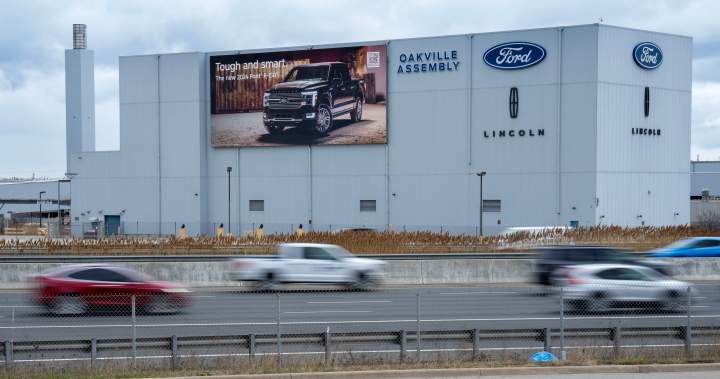
On trips into Toronto, we drove by the windowless Ford Motor Company plant in Oakville. That was all it took. I headed west in the fall of 1972 and was logging out of Campbell River by the summer of 1974.
That was 52 years ago, and Paris’s economy is now tourism and logistics. Back to my recent visit.
Returning to Vancouver
Sitting at the Hamilton airport on Nov. 16, I saw a notice on my phone about a CBC report titled “Carney says Canada could turn to Chinese automakers if Trump trade talks fail.”
That same day on CTV’s Power Play, the whole auto sector — Unifor, the Automotive Parts Manufacturers’ Association and the Canadian Vehicle Manufacturers’ Association — emphatically opposed a partnership with China.
The situation couldn’t be more different here in British Columbia.
Ontario’s auto industry is on defence and, at the moment, split with the federal government. The opposite is true in British Columbia, where the re
Despite a deep ideological break, B.C. has unknowingly reached a political consensus on re
Look at what’s happening on the ground

The list of projects is long, and so is the median time from first filing to completion: 11 years. B.C. has a lot to be proud of. It has taken immense goodwill and compromise from governments, First Nations, communities, workers and environmental groups—all have shared the benefits. The progress in economic reconciliation has been historic.
It might be hard for some to believe that all this progress and economic development has been achieved over the past 15 years, under three premiers: the BC Liberals’ Christy Clark and the NDP’s John Horgan and David Eby. Despite all the political noise, there was no break in progress on the ground.
The economy isn’t solid—not yet
There was a rural industrial construction boom, which coincided with an urban residential construction boom. Both came to an end over the past three years. Housing prices were climbing before COVID-19, and the cost of living has since exploded. Meanwhile, much of the non-professional service sector has struggled with fewer employment opportunities and low wages.
The reality is that retheir benefits widely
What are the jobs ahead?
The work ahead is to keep permitted projects on track, move new ones through the permitting process, and redirect the many thousands of young people at every education level who are working below their abilities in low-paying jobs into construction and the re
Most important in the short term is to fix forestry and find a pathway forward for coastal First Nations reliant on salmon farming and those that decide to participate in the future.
Governments can stabilize the forestry sector by expediting permitting and reducing costs. They can change course on salmon farming with the stroke of a pen. The actions needed are in the wheelhouse of the provincial and federal governments. This is about workers and communities.
LNG and mining projects are concentrated in a few regions; forestry and salmon farming support communities across British Columbia. The land mass of southern Ontario is much smaller, but the economic layout is very similar.
Giant automobile assembly plants are strategically spaced along Highway 401 (Macdonald-Cartier Freeway) from Windsor to Oshawa. In between, there are hundreds of parts manufacturers and highly productive farmland. Tens of thousands of workers, many from small towns and villages, work in the auto assembly plants—at industrial wages. There are also thousands of company and independent truckers hauling parts and assembled cars. These are car manufacturing communities.
I am cheering on the auto workers in southern Ontario, but many countries can and do assemble cars and manufacture parts of the same quality.
Forestry in British Columbia, which I write in support of, has a better chance of survival and stability than the auto industry. British Columbia’s comparative advantage lies in the quality of its forests and the dimensional lumber and fibre that few, if any, countries can match.
What should we be campaigning for? That the BC Conservatives stay focused, organized and pragmatic; that the provincial NDP, as it decides what’s next, remain committed to reironmental movement settle on pragmatism over extremism
We have done a lot to be proud of, and we have the opportunity to accomplish much more.
B.C. sells the gas. Alberta and Texas host the thinking
From Telus to Telesat: How the Liberals are intervening in the market to make life more expensive
More from this authorCensorship Industrial Complex/ 3 mins ago
Where Would We Be Without Experts?
Business/ 46 mins ago
Automotive/ 1 hour ago
While Ontario’s auto industry fights to hold on, B.C.’s re
Automotive
Mark Carney’s Made-in-China Mistake

 Melissa Lantsman –A Conservative MP translating politician into plain English.
Why the Liberal EV gamble is a bad deal for Canadian workers and a great one for Beijing.
Mark Carney was in Shenzhen this week. Call it “Nixon goes to China,” except Nixon came home with a diplomatic breakthrough, and Carney might come home with a dealership (sort of).
And while he was there, Carney hinted he’d like to get even cozier with Beijing, especially on electric vehicles. That should set off alarm bells for every Canadian.
First, some background. Because it relies so much on cross-border production and sales, Canada’s auto industry has been decimated by American tariffs. In response, Mark Carney has tried pivoting to be closer to Beijing – deepening relations with an authoritarian dictatorship at the expense of one of our closest democratic partners. This all kicked off in January, when Canada signed an agreement with them to reduce its 100% tariff on electric vehicles to 6.1%, while allowing the import of up to 49,000 vehicles annually – a number that’ll increase over time.
These EVs come with a few features. They’re incredibly cheap, they’re low-quality, and, more likely than not, they’re full of security flags that could allow them to be co-opted into spyware.
So…yeah. That’s where we’re at. Lots of people have lots of concerns.
 |
Unifor, representing 320,000 Canadian labourers, has condemned the removal of tariffs on Chinese EVs. Doug Ford said these moves would jeopardize up to 75,000 jobs while harming Canada’s status as a manufacturing powerhouse. That’s because the federal government’s own reports say that Chinese auto producers benefit from “unfair, non-market policies and practices”.
Jody Thomas, former national security advisor to Justin Trudeau, said she wouldn’t drive a Chinese EV, saying that “anybody who does buy a Chinese EV needs to understand it is a computer on wheels, and all of their information about what they do and where they’re going is going back to [their] government.”
The Americans certainly aren’t taking these risks lightly. The U.S. Department of Commerce has already introduced restrictions on connected-vehicle hardware and software linked to China and Russia, citing national security concerns. Washington has recognized that the next generation of vehicles presents a security challenge that goes well beyond traditional questions of manufacturing and trade. Here at home, we’re only just getting started on tackling those questions.
This issue seems uniting people from all corners of the political universe.
That message was reinforced earlier this week, when I participated in a roundtable hosted by Hong Kong Watch alongside members of the Tibetan and Taiwanese communities. They have been harassed for decades, even in Canada, by the Communist government in Beijing. The regime’s tactics are as simple as a phone call, or as overt as a police station opened on our own soil. Now, diaspora groups fear these EVs will be another tool for Beijing to accomplish that goal.
Now, that’s the same regime we’re going into business with. And maybe deeperbusiness after this week’s meetings with a floated deal to have even more EVs.
Before he signs on the dotted line, Mark Carney should learn from the experience of his favourite exemplar: Europe.
According to Brian Kingston, President of the Canadian Vehicle Manufacturers Association, Europe’s EV importation strategy destroyed 104,000 auto jobs in just 2024 and 2025. That’s 142 per day.
Germany’s auto industry alone lost 42,300 jobs in the first six months of 2026. And there’s no guarantee that wouldn’t happen here either, thanks to China’s anti-competitive practices. They have slave labour; we have unions and minimum wages. It’s not a fair fight. That’s why we tariffed their EVs in the first place and didn’t let them into our country.
We’re already bleeding auto jobs left, right and centre. Stellantis has idled its Brampton plant, with about 3,000 workers on layoff and no product coming. GM cut the third shift in Oshawa this winter, taking roughly 700 direct jobs with it and hundreds more at suppliers. And GM’s CAMI plant in Ingersoll has gone quiet since the BrightDrop van was cancelled, costing about 1,200 workers their jobs.
So why would anyone pour gasoline on that fire?
The root of the problem is that we still don’t have a trade deal with the Americans. Tariffs and uncertainty make it harder to move parts across the border and harder to sell what we build to American buyers. Our auto industry lives on U.S. demand because our home market is too small to carry it. Nobody’s lining up to buy Ontario-built pickups in Rome, Rio or New Delhi.
But pivoting to China won’t help us get a deal with the U.S. – in fact, it’ll only push them further away. Peter Navarro, one of Donald Trump’s senior trade advisers, publicly questioned whether Canada was trying to play China against the United States. Whether or not you agree with the Americans’ approach to trade, antagonizing the very people we’re trying to negotiate seems short sighted with a President whose days are numbered.
Think of it as a piece of circular logic: Chinese cars mean American tariffs, which means we import more Chinese cars, which results in more tariffs and trade disruptions. We stop the cycle by stopping the coziness with Beijing.
We should be fighting for Canadian jobs, not making it easier to offshore them. We should be strengthening our relationships with democratic allies, not making ourselves more dependent on authoritarian regimes. And we should be building a Canadian auto industry that can compete with the world, not opening the door to a flood of subsidized imports that it cannot compete against.
Mark Carney calls this a strategic partnership. Canadians might reasonably ask: strategic for whom?
Automotive
Former U.S. Envoy Warns Canada Not to Count on Democrats to Roll Back Trump Tariffs
David B. MacNaughton testifies before the House of Commons Standing Committee on Foreign Affairs and International Development.

David L. Cohen said a presidential veto still stands in the way of rolling back the tariffs, as Derek Burney said Canada may be wasting too much time on Europe.
The former U.S. ambassador to Canada told the House of Commons foreign affairs committee in Ottawa on Monday not to take a lot of comfort from the fact that Democrats want to roll back Donald Trump’s tariffs, saying a presidential veto still stands in the way.
“I don’t think Canadians should take a lot of comfort from the fact that the Democrats want to roll back tariffs because it’s very hard,” David L. Cohen, who served from 2021 to 2025 under President Joe Biden, told the committee by video.
He said there is “a real will by Democrats to remove tariffs on Canada, at least many tariffs on Canada.” Still, he said, “They can only do it through legislation. It’s very hard to get the legislation through. It’s subject to veto, and there aren’t enough votes to override the veto.”
“I still think that negotiating a deal is the right way to go.”
‘Footsie with China’
Conservative MP Shuvaloy Majumdar said Prime Minister Mark Carney “is openly suggesting that Canada should turn to Chinese automakers if negotiations with Washington fail.” He said Carney is scheduled to meet President Xi Jinping in Shenzhen on Tuesday.
Cohen did not close the door. “The United States may also be playing footsie with China,” he said. He pointed to Carney’s “very limited deal for the importation of a very small number of Chinese EVs” and to an “adverse reaction from China hawks in the United States.”
That deal is already on the books. In January, on the first official visit to China by a Canadian prime minister since 2017, Ottawa agreed to let in up to 49,000 Chinese electric vehicles a year at a 6.1 per cent tariff, starting March 1, and repealed a 100 per cent surtax, according to the Prime Minister’s Office and Global Affairs Canada. Global Affairs said that as of March 1, China had cut tariffs on Canadian canola seed to 14.9 per cent, down from almost 85 per cent. The Prime Minister’s Office says Carney will meet Xi on Tuesday at the APEC leaders’ meeting in Shenzhen.
Don’t write China off
About half an hour later, asked to elaborate on Canada’s engagement with China, Cohen put it as a hypothetical. If he “were Canada,” he “can’t afford to just write off the world’s second largest economy.” He added, “I don’t think you can exclude China from the all of the above.”
‘Wasting too much time on Europe’
Derek Burney, a former Canadian ambassador to Washington from 1989 to 1993 and former chief of staff to Brian Mulroney, appeared by video from Colorado. After what the Prime Minister’s Office calls a year and a half in which Canada has forged a much deeper alliance with Europe, including the 2025 Security and Defence Partnership, the EU’s SAFE program, and a stop in Dublin last week, Burney treated that outreach as a waste of time and pointed instead to Asia.
“I’m not too concerned about Europe,” he said. He added, “I don’t know how long it would take for us to diversify effectively in Europe.” Then: “I think we may be wasting too much time on that region, frankly.”
He named Japan, India, South Korea, Indonesia, and the countries of ASEAN. In his opening statement, he told the committee, “Canada must intensify its diversification efforts, notably in Asia.”
“We need more Canadian companies to take the lead in diversifying and not relying on the government to do all the work,” Burney said. “The government can provide a framework for them to expand.” But, he said, “Our private sector is too complacent in the cocoon of North America.”
“That’s not the world we’re in today,” he said. “So they’ve got to wake up and see the opportunities that exist around the world, as I said, notably in Asia.”
d International Development, meeting 50, November 16, 2026 (ParlVU); quotes are our own reading of the English audio, as the official Evidence is not yet posted. Prime Minister’s Office, January 16, 2026, June 23, 2025, November 12, 2026, and November 16, 2026; Global Affairs Canada, January 16, 2026, March 4, 2026, and Import Notice 1162
For the full experience, upgrade your subscription.

Business2 days agoCOP31 and the Widening Gap Between Climate Pledges and Energy Reality
-
Crime2 days ago
Stolen 120-year-old bell recovered after vandalism at another church in Canada

Business2 days ago“All they’re doing is increasing the profits for certain developers”: Analyst Who Read the Budget Tears Into the Spending Spree
- Automotive2 days ago

Alberta1 day agoMayor Farkas, Please Meet Candidate Farkas

Bjorn Lomborg2 days agoNearly 90% of CO2 emissions will come from developing world by 2100, negating any benefit of costly net-zero policies

Economy2 days agoNew Research Quantifies the Economic Impact of the Trans Mountain Expansion Project

COVID-1919 hours agoIdaho delivers ‘massive’ victory in COVID jab injury case