You don’t think of Vespas competing on race tracks like their Italian counterparts, Ducati and Ferrari, but the little Italian scooter had a knack for tearing up rubber, setting records and claiming victories, thanks to the Piaggio Group’s need to advertise its brand-spanking new scooter. The results were somewhat fast, yet still looked extremely strange racing machines Which left a mark on the two-wheeler world.
Immediately after World War II, the Piaggio Group, which was making wartime aircraft, faced a new uphill battle; Finding your peacetime identity. With a destroyed factory and no real need for aircraft after the war, they opted to find a smaller production solution. Enrico Piaggio’s directive was to create a simple two-wheeled machine. The goal was a simple vehicle that anyone could drive without getting dirty. Designer Corradino D’Ascanio, a renowned non-fan of motorcycles, was tasked with designing something that fit that description and thus the MP6 prototype was born. Its wasp-like looks (and eventually wasp-like sound with the 98 cc two-stroke engine) would give the scooter its enduring name: Vespa, Italian for wasp.
Vespa released its first production 98 model in 1946.And it wasn’t long before he took the little scooter to the track. Motorcycle companies were doing the same thing to advertise their machines, so why not this cute little scooter? And this happened. Piaggio debuted the 98 Corsa (the first racing version of the Vespa) at the Viareggio circuit in 1947. It later won the scooter category at the Naples Grand Prix, as well as the hill climb at the Rocca di Papa in Rome.
When Vespa design and track days will become more interesting
The 98 model – already subtly modified with a smaller shield fairing, shorter handlebars and a more ventilated engine casing for cooling – was further modified to cope with circuit racing resulting in the 98 Corsa “Circuit”. But competition from Morini and MV Agusta in the 100 cc class created a need for a larger engine to allow for a wider competitive field in the 125 cc class. So Piaggio developed the 98 into a Super Sport with a larger 125 cc two-stroke engine, which in its steel-bodied version would score some wins for the Italian manufacturer. Another aluminum version was built, but had difficulty because the metal was not rigid, making it an unstable machine at high speeds.
The 1950s marked the beginning of a new design era for Vespa’s racing bikes, which emerged as an aeronautical homage to the company’s roots. Piaggio introduced a new Super Sport which again included a 125 cc two-stroke engine for power. But the design of this scooter looked more like a bike. This machine was constructed, like an aircraft, from aluminum alloy and alloy rivets. It also has a tank bubble between the seat and handlebar which is actually part of the larger fuel tank included to cover longer distances. The handlebars were now lower than on the original Vespas, with a fairing now above and in front of the handlebar like race bikes of the time. This more endurance-built craft was capable of a top speed of 80 mph and claimed several victories, including a 1–2 finish at the Bologna Grand Prix with riders Giuseppe Cau and Dino Mazzoncini.
Vespas are winners, but what else?
Piaggio seemed to be having success with its Vespas racing, but there were still more wins to be won and records to be set. The brand also had to deal with Innocenti, another Italian scooter company, which had defeated Piaggio in the first national motor scooter race at the Circuito di Genova in 1948. Piaggio’s Vespas earned their heroics back the following year with a win at the Naples track, but it was not enough. This led to the creation of Super Sport Montlhéry.
Piaggio took Montlhéry with three of his riders to the Montlhéry Circuit in France where they broke 17 world records including fastest average speed of one hour, 100 miles, 500 miles, 1000 km and over 10 hours. The record-setting bike did not look like a bike at all, but more like a car, as the high front and rear ends used carved fairings that helped direct air to maintain top speed.
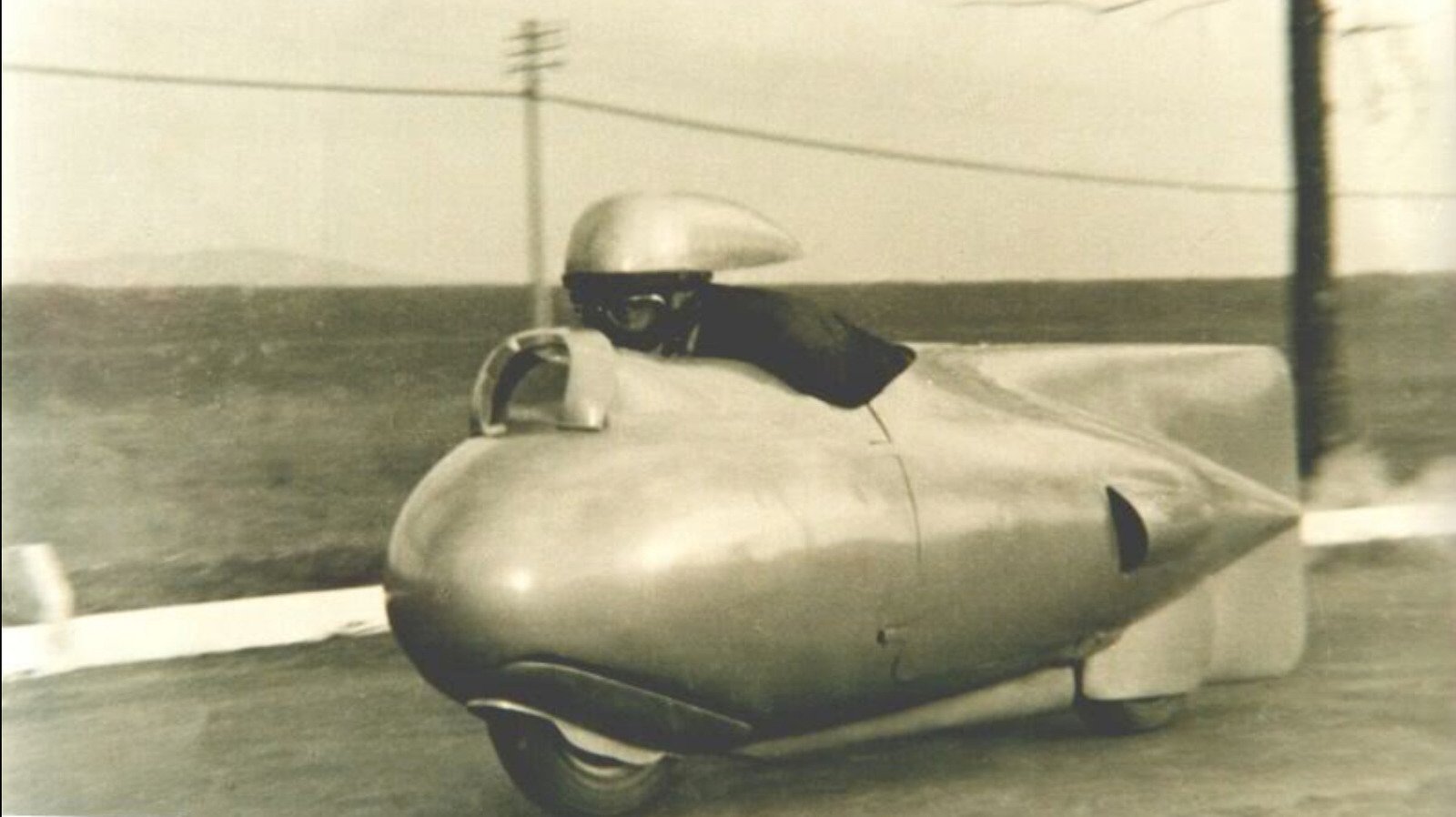
If the Montlhéry wasn’t weird enough, its successor, the Siluro, took a big left turn from the original scooter design. When translated Siluro, or “torpedo”, resembled a rocket or jet car. There were two versions that were tested side by side to see which version would reach stable higher speeds, one of which had the driver looking forward, while the other would have the “driver” on his knees.
Powering the torpedo-like scooter was a two-stroke single cylinder engine with opposed horizontal pistons producing 18 hp, which also ran on alcohol. How it worked was that a single shaft had two pistons pushing toward the center, each powered by its own carburetor. This unique machine was built with the aim of breaking the “Standing Kilometer” record of going 100 meters from a stop. The Siluro broke the record in 1951, reaching an average speed of 171 km/h (106 mph) in 20.24 seconds.
last checkered flag
Eventually, Piaggio’s speed-chasing days were over and the Vespa was returned to a more scooter-like form. The newly designed 125 6 Giorni was a durable and fast machine that could withstand the elements, and was immediately entered into endurance races to prove Vespa’s dominance. This special version had a more durable frame and included space for a spare tyre. It won the national trophy, and earned nine gold medals among its entries at the 26th International Six-Day Trial (now International Six-Day Enduro) event. Apparently this was enough wins and record-setting for Piaggio to withdraw its Vespas from racing shortly afterwards.
Nearly thirty years later, Piaggio contemplated a return to racing and began creating potential entries for the Paris–Dakar race. The project was cancelled, along with three of the four Rally Vespa prototypes built specifically for this event.
Considering the efforts put in by Piaggio to create so many wins and records, it would be interesting to see how the company would have incorporated its experimental engineering into its scooters over the decades. But maybe it was for the best. Vespa is world-famous, as evidenced by the huge turnout on the scooter’s 80th birthday. And although Piaggio can no longer enter its Vespas today nor showcase its innovative prowess in racing as a manufacturer, fortunately we don’t have to leave its fate to the imagination. As YouTube will show, people always have and always will have a way. To race on something with wheels.