Urology Supplements Market Trends, Leading Companies, Company Revenue / Sales Performance, Procedure Volume, Healthcare Spending, Technology Adoption, Reimbursement Analysis, Competitive Landscape, and Growth Outlook
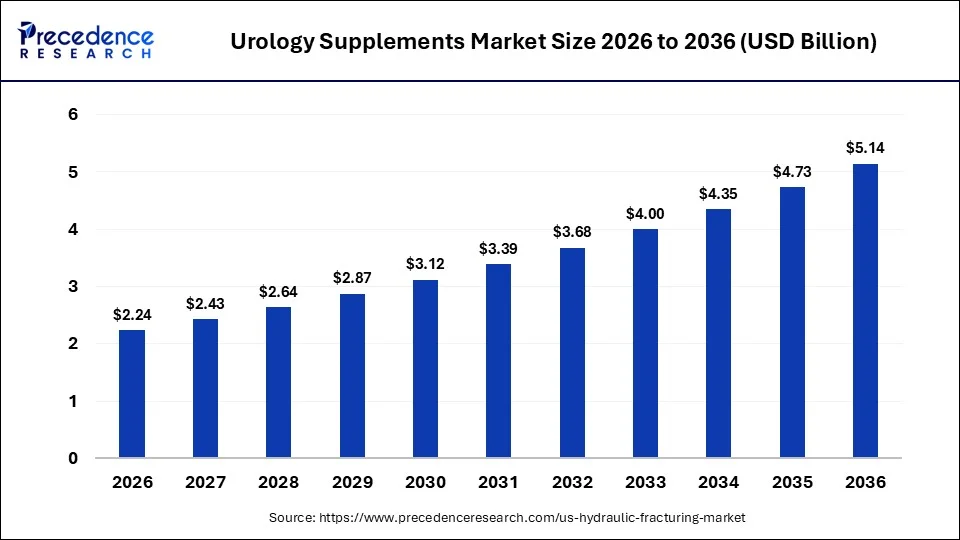
The urology supplements market reached USD 2.43 billion in 2027. Market growth is driven by rising demand for wellness supplements and government initiatives promoting preventive healthcare. Senior Researcher Deepa Pandey analyzed these trends to develop this report, which provides valuable insights for multiple stakeholders, including nutraceutical manufacturers, pharmaceutical companies, private equity firms, raw material suppliers, and contract manufacturers.


Table Of ContentReport Description

Revenue,
2027
USD 2.43 Bn

Forecast Year,
2036
USD 5.14 Bn

CAGR,
2026 – 2035
8.65%

The global urology supplements market size is forecasted to expand from USD 2.43 billion in 2027to USD 5.14 billion by 2036, growing at a CAGR of 8.65% from 2027 to 2036. The urology supplements market sits at the intersection of preventive healthcare, men’s health, women’s urinary wellness, healthy aging, and the broader dietary supplements industry. As opposed to prescription urology medications, such products have a general market application for the health of the urinary system, prostate, and bladder, among others. The commercial success of such products will depend on factors such as ingredient believability, formulation effectiveness, consumer trust, frequency of repurchase, distribution, and communication of benefits without disease treatment claims.
Key Takeaways
- By product composition, the multi-ingredient segment held the largest market share of 71.8% in 2026.
- The cost of urological supplement products is based on the complexity of the formulation, dosages, packaging, and branding.
- The value chain includes raw material extraction and processing, formulation, manufacturing, and distribution.
- Amway, Better Being, Biotexlife, DSM-Firmenich, and Gaia Herbs are prominent players that develop urology supplements.
- Evidence-based formulations, digital distribution, and premiumization are potential white spaces in the market.
What is the Significance of Urology Supplements?
The urology supplements market’s four main demand pools include urinary tract health, prostate health, bladder health, and kidney health. Its commercial approach differs from that of prescription urological medicines in that purchases are determined by factors such as practitioner suggestion, ingredient familiarity, online discovery, preventive wellness behavior, and frequency of use. Dosage, ingredient concentration, extraction standardization, certification, and pack length all affect supplement costs. They come in liquid, powder, tablet, softgel, capsule, and combination forms.
The crucial strategic realization is that accessibility and therapeutic models must develop together. Distribution and brand awareness are advantages enjoyed by mainstream brands, but formulations, targeted components, practitioner relations, and product testing allow specialty supplement firms to compete. Distribution coverage or a lengthy ingredient list does not make a product clinically effective.
Coverage Highlights
- Revenue streams are available from UTis, prostatitis, cystitis, and nephritis.
- Consumer demand by age, gender, health objective, and purchasing behavior.
- Formulation mix, ingredient positioning, average selling prices, and premiumization.
- Regional demand, e-commerce saturation, and developing market prospects.
- Competitive concentration, brand positioning, product portfolios, and strategic white spaces.
How is the Urology Supplements Market Evolving Through 2036?
Growth requires the translation of awareness of health benefits into repeat purchases, the proof of the quality of the ingredients used, and the diversification of speciality products into new channels. The negative scenario will take into account lower consumer confidence, marketing claims, poor quality of the product, and insufficient proof for certain ingredients. The positive scenario will be based on more repeat-purchasing behavior, practitioner recognition, differentiation, and growth in other geographical regions.
The complete analysis takes into consideration the differences between the market growth generated by increasing unit sales and the growth created by the premium pricing, new product mix and online channels.
Coverage Highlights
- CAGR and incremental revenue opportunity.
- Regional and product-level growth contribution.
- Base, upside, and downside scenarios.
- Sensitivity to pricing, repeat purchases, and distribution expansion.
Urology Supplements Market Segment Analysis
Urology Supplements Market by Product Composition 2026 Share & Size
| Segments | 2026 Share | 2026 Market Value (USD Billion) |
| Single-ingredient | 28.60% | 0.64 |
| Multi-ingredient | 71.40% | 1.596 |
Multi-ingredient supplements remain the leading category, supported by formulations combining ingredients for broader urinary and prostate wellness needs. The shares are adjusted estimates; the previously supplied 71.8% figure is retained only as a reference, not as the revised share.
Urology Supplements Market by Application 2026 Share & Size
| Segments | 2026 Share | 2026 Market Value (USD Billion) |
| Urinary Tract Health | 33.40% | 0.747 |
| Prostate Health | 30.70% | 0.687 |
| Bladder Health | 20.80% | 0.465 |
| Kidney Health | 15.10% | 0.338 |
Urinary tract health is estimated to remain the largest application, followed by prostate health. Bladder and kidney health supplements account for the remaining market.
Urology Supplements Market by Key Ingredients 2026 Share & Size
| Segments | 2026 Share | 2026 Market Value (USD Billion) |
| Cranberry | 21.60% | 0.483 |
| D-mannose | 16.40% | 0.367 |
| Saw Palmetto | 14.70% | 0.329 |
| Beta-Sitosterol | 8.30% | 0.186 |
| Pumpkin Seed | 9.30% | 0.208 |
| Pygeum | 5.80% | 0.13 |
| Vitamins and Minerals | 10.40% | 0.233 |
| Botanical Blends | 13.50% | 0.302 |
Cranberry and D-mannose are estimated to account for the largest ingredient shares, particularly in urinary tract health products. Saw palmetto, beta-sitosterol, pumpkin seed and pygeum contribute to prostate-focused formulations.
Urology Supplements Market by Dosage Form 2026 Share & Size
| Segments | 2026 Share | 2026 Market Value (USD Billion) |
| Capsules | 37.40% | 0.836 |
| Softgels | 18.50% | 0.414 |
| Tablets | 16.30% | 0.365 |
| Powders and Sachets | 10.20% | 0.228 |
| Liquids | 7.20% | 0.161 |
| Gummies | 5.90% | 0.132 |
| Other Forms | 4.50% | 0.101 |
Capsules are estimated to lead because they accommodate diverse ingredient combinations and offer convenient dosing. Softgels and tablets remain established alternatives across supplement formulations.
Urology Supplements Market by Distribution 2026 Share & Size
| Segments | 2026 Share | 2026 Market Value (USD Billion) |
| Pharmacies | 26.40% | 0.59 |
| Health and Nutrition Stores | 21.70% | 0.485 |
| Supermarkets | 11.60% | 0.259 |
| E-Commerce | 24.80% | 0.555 |
| Direct Selling | 9.60% | 0.215 |
| Practitioner Channels | 5.90% | 0.132 |
Pharmacies and e-commerce are estimated to represent the largest distribution channels. Health and nutrition stores also contribute significantly through specialized product selection and consumer guidance.
Urology Supplements Market by Consumer Group 2026 Share & Size
| Segments | 2026 Share | 2026 Market Value (USD Billion) |
| Men | 34.70% | 0.776 |
| Women | 32.40% | 0.725 |
| Older Adults | 21.50% | 0.481 |
| General Wellness Consumers | 11.40% | 0.255 |
Men are estimated to represent the largest consumer group, reflecting demand for prostate and urinary wellness products. Women represent another substantial segment, particularly for products focused on urinary tract health.
Urology Supplements Market by Price Positioning 2026 Share & Size
| Segments | 2026 Share | 2026 Market Value (USD Billion) |
| Value | 16.80% | 0.376 |
| Mainstream | 42.10% | 0.942 |
| Premium | 30.60% | 0.684 |
| Practitioner-Oriented | 10.50% | 0.235 |
Mainstream products are estimated to lead because of their broad consumer reach and accessible pricing. Premium products form a substantial secondary category, supported by differentiated formulations and branded ingredients.
Urology Supplements Market by Region 2026 Share & Size
| Segments | 2026 Share | 2026 Market Value (USD Billion) |
| North America | 30.80% | 0.689 |
| Europe | 21.80% | 0.488 |
| Asia Pacific | 35.60% | 0.796 |
| Latin America | 6.90% | 0.154 |
| Middle East and Africa | 4.90% | 0.11 |
Asia Pacific is estimated to hold the largest regional share, supported by expanding supplement availability and growing consumer interest in preventive wellness. North America and Europe remain important markets with established supplement distribution networks.
The market can be segmented across product composition, application, ingredient, dosage form, distribution channel, consumer group, and geography. Multi-ingredient products accounted for approximately 71.8% of market revenue in 2025. It implies that there is a definite bias in favor of multi-ingredient drug formulations in one regimen, but this percentage should not be seen as a universal constant.
Urinary tract health is a major commercial category, particularly for cranberry- and D-mannose-based formulations. Products for the prostate target a specific market segment, positioning through ingredients such as saw palmetto, beta-sitosterol, pumpkin seeds, and others. Kidney and bladder products require particularly careful differentiation because supplements intended for general nutritional support are not substitutes for medical management of kidney disease, urinary obstruction, or infection.
Although multi-ingredient goods may be able to charge higher absolute prices and streamline the purchasing process, their economicients, accurate labeling, and promises supported by research. One-ingredient products could be attractive to seasoned customers
Coverage Highlights
- Revenue and growth by composition and application.
- Ingredient-level positioning and product differentiation.
- Dosage-form preferences and price tiers.
- Consumer-group and geographic segmentation.
- Largest and fastest-growing segments, subject to harmonized market estimates.
What are the Main Drivers and Challenges of the Urology Supplements Market?
Growing awareness of preventive healthcare, healthy aging, natural ingredients, and personalization is among some of the factors favoring the development of the industry. Urological health has a huge pool of consumers, whereas prostate health supplements will benefit from the fact that urinary problems are highly relevant for older men. More access and the chance to compare different components, costs, and serving sizes are offered by online shopping.
Demand, however, does not always indicate a clinically established effect. Evidence differs according to target populations, extracts, components, and dosages. Cranberry products, for example, have a specific qualified health claim pathway in the United States for certain products and a limited evidence statement concerning recurrent urinary tract infections in healthy women. That does not establish equivalent effectiveness for all cranberry supplements or other urinary health ingredients.
Key obstacles include misleading marketing campaigns, inferior products, lack of ingredient consistency, consumer confusion between dietary supplements and medicines, and adverse drug reactions. One more commercial barrier is customer retention, where the customer may choose to stop using a product because the product’s effects may be unknown or take too long.
Competitive advantage could also be more credible due to high-quality research, proper labeling of ingredients, and realistic representation of product advantages.
Coverage Highlights
- Demand drivers, restraints, opportunities, and threats.
- Evidence-backed versus emerging ingredient categories.
- Consumer acquisition, repeat purchasing, and retention.
- Premiumization and trust-related purchase behavior.
- Commercial exposure to misleading claims and quality concerns.
What Ways are Product Profitability Affected by Ingredient Quality, Economies of Serving Size and Brand Positioning?
The sophistication of the formulation, constituent dosage, pack size, certifications, brand positioning, and sales channels utilized all contribute to significant price differences. The former involves a simple botanical in one ingredient in competition based on economies of serving sizes, while the latter involves combination products for practitioners.
As an illustrative premium market benchmark, publicly listed products from a specialist urinary-health supplement portfolio include individual products priced at approximately USD 65-105, with multi-product bundles priced higher. This is based on actual product listings and is not the market wide average sales price; pack size, number of servings, discount offers, and currency may affect comparisons.
It is therefore advisable for commercial benchmarking purposes to consider price per daily serving along with the retail price per pack. A 60-capsule product taken twice daily may offer a different cost of use from a 60-capsule product taken once daily.
Sourcing ingredients, standardizing extracts, contract manufacturing, testing, packing, shipping, marketing costs, market fees, and distributor discounts all affect profit margins. Only when consumers can see the benefit and when repeat business pays for customer acquisition expenses can price premiums be justified.
Coverage Highlights
- Average selling price by ingredient, dosage form, and price tier.
- Retail price per pack and per daily serving.
- Ingredient sourcing, manufacturing, packaging, and testing costs.
- Channel margins, promotional discounts, and e-commerce fees.
- Premiumization, price elasticity, and profitability scenarios.
Where are the Main Constraints on Quality, Availability, and Value Capture?
The supply chain begins with botanical, fruit-derived, vitamin, mineral, and specialty-ingredient suppliers. Ingredients are extracted, processed, standardized where applicable, tested, and incorporated into finished formulations by in-house or contract manufacturers. The products pass through brand owners, importers, distributors, pharmacies, specialist stores, and Internet channels.
Though the capital-intensive process of pharmaceutical manufacturing involves certain competencies, supplement manufacturing generally relies upon existing formulation and packaging competencies. However, standardized botanical extracts, reliableures may become considerable challenges
The levels of active ingredient concentration, use of special suppliers, foreign exchange risk, and disruptions in international transportation. The testing and certification process results in higher costs; however, it reduces the risks of mistakes in labeling and batch variability
The analysis of trade flows is important since supplements could be imported/exported. At the same time, customs categorization could unite supplements with a wide range of food products or botanicals, so the accurate estimates of imports/exports would require product classification.
Coverage Highlights
- Ingredient sourcing, contract manufacturing, and finished-product distribution.
- Supplier concentration and botanical sourcing exposure.
- Manufacturing, testing, quality control, and packaging economics.
- Dependence on imports, export possibilities, and regional production.
- Risks of supply, inventory management, and localization possibilities.
Why Are Standardization and Responsible Claims Central to Market Access?
Innovation is around standardized botanical extracts, combination formulations, convenient dosage forms, improved ingredient delivery, transparent labeling, and product-specific quality testing. Microbiome studies and other processes may be useful in developing future products, but biological plausibility alone would not be sufficient to demonstrate that a product is clinically effective.
Dietary supplements in the U.S. follow a separate regulatory system compared to drugs. The structure/function claims need to satisfy all appropriate requirements like substantiation, notification, and labeling requirements. Disease claims may lead to classification of dietary supplement as a drug, and claims made in the advertisements have to be truthful and adequately supported. Other markets follow different regulations regarding acceptable ingredients, health claims, product registration, labeling, and quality of manufacture.
Customers of urology supplements are individuals, pharmacies, nutrition shops, e-commerce companies, practitioners, and distributors. Individuals will take into consideration various parameters such as cost, content, user-friendliness, safety, consumer reviews, and efficiency. There could be more aspects for practitioners as their consumers.
Coverage Highlights
- Ingredient standardization, delivery formats, and quality testing.
- Regulatory demands in key markets.
- Claim substantiation, labeling, and advertising compliance.
- Consumer purchasing criteria and practitioner influence.
- Product differentiation and unmet customer needs.
How Do Specialty Brands and Well-Established Manufacturers Compete?
The urology supplements market is characterized by a fragmented competitive environment, comprising diversified nutrition companies, niche brands for urinary health care, botanical products manufacturers, formulator brands that serve practitioners, and digital-native consumer brands. Since competition is across categories including urinary tract health, prostate health, bladder health, and other urology needs, corporate revenues do not tell anything about the competitiveness of a business in the market.
Whereas companies focused on size benefit from brands and extensive product lines in addition to the strength of the retailing side, the specialists can offer themselves an edge in the way they develop their products and ingredients. Nevertheless, there is no available market data that would allow constructing a comparable market share hierarchy for all competitive players mentioned above.
A competitive advantage does not solely rely upon product portfolio but depends more on an organization’s capability to provide the right combination of quality products, effective communications, and market access. The incumbents can take advantage of their large distribution network and consumer awareness, while the niche firms have more options for meeting the specific urinary needs of consumers.
With regard to ingredient specificity, internet discoverability, subscription business models, and pricing, both botanical firms and digitally-led businesses have greater opportunities to set themselves apart. These benefits allow brands to make money, but they don’t always indicate that they have a definite advantage in terms of sales or market share.
Rather than releasing another undifferentiated prostate or urinary-health formula, the biggest competitive potential is to develop a defensible position around a clearly defined customer demand. Brands can differentiate themselves from the competition and win consumers’ trust by using clear ingredient standards, suitable product testing, sound production practices, and health-related marketing.
However, goods that use easily replicable component blends or generic well-being claims may encounter pricing issues and low customer loyalty. This brings to mind that the recommendation for market leaders is to reinforce category differentiation, whereas for the new entrant the priority should be evidence-based positioning and potential for repeat purchases.
The whole research further analyzes competitive positioning by product category, formulation method, brand proposition, distribution channel, geographic presence, pricing strategy, and evidence creation capabilities. In addition to product range comparisons, manufacturing and quality concerns, strategic partnerships, and consolidation opportunities, it takes into account the relative advantages and disadvantages of scale-based, specialist, practitioner-oriented, botanical, and digital-first approaches. When comparison data is available, the research compares the total corporate revenue to the specific performance of urology enterprises without assuming an unwarranted degree of accuracy regarding market concentration.
The competitive intelligence can also be structured into a company- and product-level dataset, tracking company, brand, product category, formulation and key ingredients, dosage format, price, geography, sales channel, product claims, testing disclosures, and relevant regulatory status. Records can be filtered and benchmarked by categories such as those dealing with the urinary tract, prostate, bladder, and other urology supplements, thus giving a detailed overview of the analysis done in the report.
Tentative Leading Company Universe
| Company | Headquarters | Market Position and Core Strength |
| Amway | Ada, Michigan, U.S. | Direct selling and nutrition supplements through Nutrilite |
| Better Being | Salt Lake City, Utah, U.S. | Multi-brand natural wellness and supplements |
| Biotexlife | Verify entity-specific location | Specialist supplement participation |
| dsm-firmenich | Kaiseraugst, Switzerland/Maastricht, Netherlands | Nutrition ingredients, science, and formulation capabilities |
| Gaia Herbs | Brevard, North Carolina, U.S. | Botanical supplements and herbal positioning |
| GNC | Pittsburgh, Pennsylvania, U.S. | Specialty nutrition retail and supplement brands |
| Himalaya Wellness | Bengaluru, India | Herbal formulations and international wellness distribution |
| Himalayan Organics | India | Plant-based and botanical supplement positioning |
| Integrative Therapeutics | U.S. | Practitioner-oriented nutritional supplements |
| Jarrow Formulas | Los Angeles, California, U.S. | Specialty nutritional supplements |
| La Renon Healthcare | Ahmedabad, India | Pharmaceutical and urology-adjacent product participation |
| Life Extension | Fort Lauderdale, Florida, U.S. | Science-oriented supplements and healthy-aging products |
| MegaFood | Manchester, New Hampshire, U.S. | Food-based nutritional supplements |
| Natrol | U.S. | Consumer supplements and established retail distribution |
| Nature’s Bounty | U.S. | Mainstream vitamins, botanicals, and specialty supplements |
| Nestlé Health Science | Vevey, Switzerland | Nutrition science and consumer health products |
| NOW Foods | Bloomingdale, Illinois, U.S. | Broad natural-product and botanical supplement portfolio |
| Ortho Molecular Products | Barrington, Illinois, U.S. | Practitioner-oriented nutritional formulations |
| PharmaLinea | Ljubljana, Slovenia | Nutraceutical formulation and private-label development |
| Pharma Nord | Vejle, Denmark | Quality-focused nutritional supplements |
| Pure Encapsulations | U.S. | Practitioner-oriented and hypoallergenic supplement formulations |
| Puritan’s Pride | U.S. | Value-oriented vitamins, minerals, and botanicals |
| Solaray | U.S. | Botanical and specialty ingredient formulations |
| Swanson Health Products | Fargo, North Dakota, U.S. | Value-led supplements and online distribution |
| Theralogix | Rockville, Maryland, U.S. | Specialist urinary-health and practitioner-oriented formulations |
Why is Brand Visibility Not the Same as Urology-Specific Revenue?
A consistent denominator based only on sales of urological supplements is required for a market share analysis. It is impossible to determine a market share for urology supplements directly because corporate profits disclosed by public firms comprise vitamins, sports nutrition, herbs, medicine, medical nutrition, and other endeavors.
The full competitive analysis distinguishes the top five and top ten participants, the remaining market, specialist brand exposure, and regional share shifts. In cases where the sale of products or services is not disclosed, it is better to represent their market position through qualitative measures or ranges.
Which Capabilities Translate Into Durable Advantage?
| Competitive Dimension | Scale-Oriented Brands | Specialist Brands | Emerging Digital Brands |
| Distribution | Strong retail reach | Practitioner and specialist channels | Online-first |
| Product breadth | Broad | Focused | Narrow to moderate |
| Formulation differentiation | Variable | Often a central proposition | Rapidly testable |
| Consumer acquisition | Brand and retail visibility | Practitioner trust and education | Digital marketing and reviews |
| Quality communication | Brand-dependent | Often a key selling point | Must establish credibility |
| Geographic expansion | Existing infrastructure | Selective market entry | Platform-led expansion |
| Main vulnerability | Portfolio dilution | Limited scale | Acquisition costs and trust |
The strategic implication is that no single business model guarantees leadership. Scaling reduces distribution friction, while specialization helps in making products more relevant. The new brands can easily test out their consumer hypotheses, but high costs of acquiring customers and low repeat purchases pose challenges for their model.
Where can Specialized Formulations Outperform Generalized Supplement Product Lines?
Portfolio benchmarking separates prostate formulas, urinary tract products, kidney and bladder support, single-ingredient botanicals, and multi-ingredient combinations. Theralogix has a visible specialist urinary health portfolio, including cranberry, D-mannose, and kidney-health products. NOW Foods’ portfolio spans both botanical and specialty supplements, whereas Nature’s Bounty and Himalaya Wellness have a more extensive range of supplement and herbal products.
The business issue is one of determining whether there is aformer strategy will enable cross-selling; the latter strategy will allow for building expertise in the area of dosing and formulation
Differentiation Moving Beyond Ingredient Count?
Benchmarking innovations involves assessing standardized extracts, tracing of ingredients, dosing standards, formulation processes, third-party testing, and scientific validity of claims made. It is essential that benchmarking be done on the basis of what is actually achieved by the products rather than on claims of better technologies.
This will involve product launches, certification processes, formulation partnerships, ingredient blends, and claims development programs. The number of patents is less relevant compared to that of the pharmaceutical industry, as many dietary supplement products use already existing ingredients and formulations.
Which Regions Offer the Best Route to Expansion of Urology Supplements?
Application benchmarking maps competitors across urinary tract health, prostate health, bladder support, and kidney health supplements. Geographic benchmarking measures retail accessibility, regulatory requirements, buying capacity of the consumer, influence of the practitioners, and formulation availability.
North America is identified as a leading region in several published market estimates, while other estimates differ on whether Asia Pacific leads. This disparity should be sorted out through geographic consistency and similar product coverage and not be repeated as an authoritative list.
For India and other developing economies, possibilities lie in accessibility, consumer awareness, manufacturing quality, and availability from pharmacies and online platforms. Local-language education and carefully controlled claims may be particularly important where consumers confuse supplements with prescription urology medicines.
Does Outsourcing Create an Advantage for Smaller Brands?
Contract manufacturing allows supplement brands to enter the market without constructing production facilities. Even when the initial cost is reduced, the brand becomes more reliant on manufacturing partners for quality assurance in terms of batch homogeneity, record keeping, testing, and production run scheduling.
Manufacturing facilities, quality processes, minimum order quantities when stated, testing facilities, and supply consistency must all be included in the benchmarking process. Public capacity figures are unlikely to be comparable across many private label businesses; undisclosed capacity should remain unquantified.
Can Specialist Advice Improve Retention and Customer Economics?
The retail channel offers access to consumers as well as an easy environment for purchase, whereas the specialist channel helps in product comparison and education. Online channels help boost the visibility of the selection and make it easier for buyers to subscribe, but they also expose businesses to platform fees, discounts, erratic reviews, and client acquisition costs.
Increased trust in complex formulations may be facilitatedt recommendations are reliable and their claims are compliant. The extensive study compares direct-to-consumer models, marketplace distribution, pharmacy reach, repeat purchase metrics, and channel dependability
Where is Competitive Investment Most Likely to Create Value?
The introduction of products related to urinary health, formulation deals, certifications, entry into new retail outlets, and geographic distribution deals are some of the strategic moves that need to be considered. The analysis is based on strategic moves that have happened from 2024 to 2026, and wherever possible, the values of transactions are incorporated.
Possible M&A opportunities include acquisition of a specialist urinary health brand, acquisition of botanical expertise, development of practitioner channels, and expansion into new regions. The desirability of M&As can be assessed not only on synergy estimates but also on portfolio fit, customer retention, quality systems, and channel access due to the confidential nature of product category revenues.
Coverage Highlights
- Competitive company universe and category-specific participation.
- Estimated market share, rankings, and concentration where supportable.
- Portfolio, formulation, distribution, and geographic benchmarking.
- Manufacturing and quality-system comparisons.
- Product launches, partnerships, purchases, and tactical placement.
What are the White Spaces of the Urology Supplements Market?
The most attractive opportunities are likely to emerge where a clearly defined consumer need intersects with credible formulation design, underserved distribution, and sustainable customer economics.
- Evidence-led Urinary Tract Formulations: Cranberry- and D-mannose-based products offer an established category for differentiation through transparent doses, product testing, and responsible communication of evidence limitations.
- Specialist Prostate Health Products: Specialist product formulations for consumers who value ingredient explanations and easy dosages can be developed if claims stay science-driven.
- Quality-led Premiumization: Differentiation over low-cost tactics can be made possible by ingredients with standards, batch tests, track records, and comprehensive labels.
- Emerging Market and Digital Sales Channel: Accessibility and recurring purchases can be facilitated by partnerships with pharmacies, translations, subscription models, and affordable packs.
Where there is sufficient data, the full analysis will quantify opportunity pools by geography, use, pricing level, and sales channel. It will also separate real growth from internal brand switching.
How Do Customer Choice, Supplier Dependency, and Regulatory Requirements Affect Competition?
| Competitive Force | Indicative Assessment | Strategic rationale |
| Supplier power | Medium | Specialized extracts and quality requirements can limit qualified sourcing options. |
| Buyer power | Medium to high | Consumers can compare brands, ingredients, reviews, and prices with relative ease. |
| Threat of new entrants | Medium | Contract manufacturing lowers entry barriers, but trust and distribution take time to establish. |
| Threat of substitutes | High | Consumers can choose alternative supplements, conventional foods, lifestyle changes, or medical consultation. |
| Competitive rivalry | High | Broad supplement portfolios, overlapping formulations, and online price comparison intensify competition. |
Which Outside Variables Will Distinguish Between Short-Term Demand and Sustainable Growth?
Political and legal: new regulations on supplements, allowable health claims, product registrations, and product imports.
- Economic: discretionary income levels, ingredient pricing, foreign currency, marketing activity level, and willingness to pay for premium products.
- Social: healthy aging, preventive wellness, knowledge of urinary health, and attitudes towards botanicals.
- Technological: online shopping, data-driven consumer retention, product testing, standardized extracts, and formulation enhancements.
- Environmental: supplier tracking, packaging choices, botanical sourcing, and agricultural variance.
With a perceived consumer need, the capacity to differentiate items, and favorable economics for recurrent purchases, the market offers a strong growth opportunity. When a brand has continuously high customer acquisition costs, lacks formulation differentiation, and depends on unsubstantiated efficacy claims, it is less appealing.
Which Factors Will Define the Next Phase of Growth in the Urology Supplements Market?
In the base scenario, brand and formulators growt the quality of the products. In the positive scenario, growth is driven by higher rates of repeat purchases, differentiation in formulations, and increasing consumer trust. Growth is constrained in the negative scenario by a lack of distinction, fraudulent claims, poor quality, and higher acquisition costs
Instead of the sheer quantity of supplements and marketing reach, the competitive advantage will come from the combination of positioning, formulation, reasonable prices, and customer loyalty.
Coverage Highlights
- Emerging ingredient and formulation opportunities.
- Geographic expansion and channel evolution.
- Pricing, customer retention, and profitability outlook.
- Future leaders, specialist challengers, and potential acquisition themes.
Key Strategic Questions Addressed
- Which product categories generate the largest revenue pools, and which offer the strongest growth potential?
- How do urinary tract, prostate, bladder, and kidney-health products differ commercially?
- What part do multi-ingredient formulae play in product differentiation and market expansion?
- What effects do brand positioning, daily serving costs, and ingredient quality have on pricing?
- Which distribution channels and consumer segments are the most effective to target?
- What effects might quality and regulatory issues have on market expansion and entry?
- What firms have the best portfolio of products and distribution capabilities in place?
- What proportion of the market is captured by leading brands, and how reliable are current share estimates?
- How can companies that sell a variety of supplements compete with specialty brands?
- What particular sourcing, testing, and manufacturing skills provide businesses a competitive advantage?
- What recent new product launches, partnerships, and acquisitions have been made by firms?
- What are the most attractive regional markets for both existing and new brands?
- Where are the gaps in products, pricing, and distribution creating white-space opportunities?
- Which strategy priorities will propel expansion and financial success through 2035?
Urology Supplements Market Segments
- Single-ingredient
- Multi-ingredient
- Urinary Tract Health
- Prostate Health
- Bladder Health
- Kidney Health
- Cranberry
- D-mannose
- Saw Palmetto
- Beta-Sitosterol
- Pumpkin Seed
- Pygeum
- Vitamins and Minerals
- Botanical Blends
- Capsules
- Softgels
- Tablets
- Powders and Sachets
- Liquids
- Gummies
- Other Forms
- Pharmacies
- Health and Nutrition Stores
- Supermarkets
- E-Commerce
- Direct Selling
- Practitioner Channels
- Men
- Women
- Older Adults
- General Wellness Consumers
- Value
- Mainstream
- Premium
- Practitioner-Oriented
- North America
- Europe
- Asia Pacific
- Latin America
- Middle East and Africa
For inquiries regarding discounts, bulk purchases, or customization requests, please contact us at sales@precedenceresearch.com
Frequently Asked Questions
Answer : Some popular supplements used for urinary system support are cranberry extract, D-mannose, magnesium, vitamin D, pumpkin seed extract, and saw palmetto.
Answer : Supplements usually are not controlled by any regulatory agencies and are over-the-counter (OTC).
Answer : The best time to take a prostate supplement will depend on the individual components of the supplement.
Ask For Sample
No cookie-cutter, only authentic analysis – take the 1st step to become a Precedence Research client