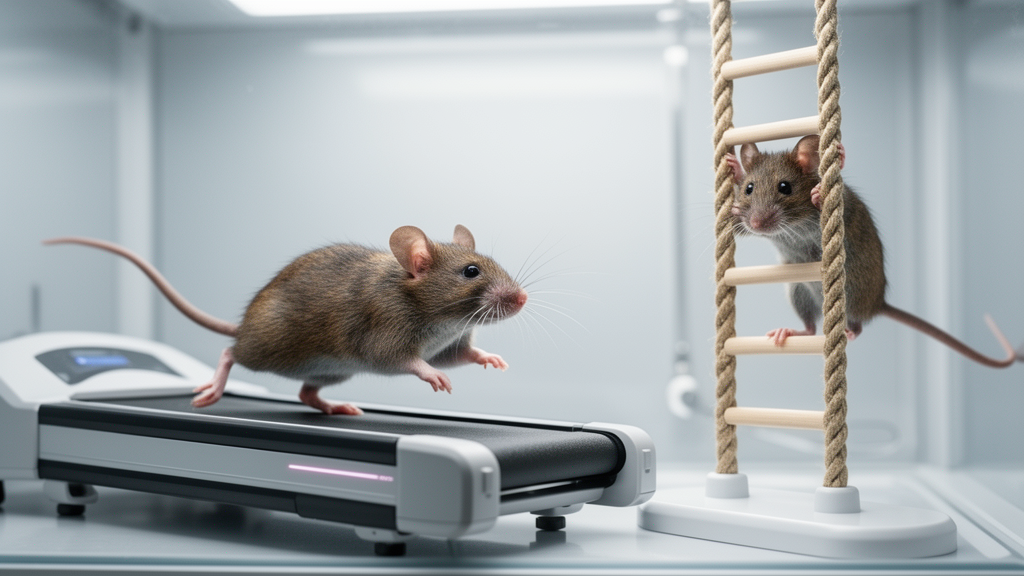
A six-week physical activity regimen combining forced treadmill running and weighted ladder climbing significantly attenuated age-related cognitive decline, reduced cortical protein aggregates, and alleviated neuropathology within vulnerable somatostatin interneurons in an aged mouse model of Alzheimer’s disease, according to findings published in Molecular Brain. Researchers led by Mingming Yang, Xiaosen Ouyang, and Yun Li evaluated whether combining aerobic endurance with resistance climbing could counteract neurodegenerative pathology in thirteen- to fourteen-month-old 3xTg-AD mice. The cohort completed progressive treadmill running alongside weighted ladder climbing before undergoing behavioral evaluations and immunohistochemical examinations of cortical and hippocampal tissues. The results demonstrated that the exercise intervention restored novel object recognition memory, enhanced spatial working memory, and preserved sociability compared to sedentary controls. Furthermore, physical activity reduced regional glial activation and selectively decreased Thioflavin S-labeled misfolded protein aggregates inside somatostatin-positive inhibitory interneurons across the cortex and hippocampus, demonstrating cell-specific neuroprotection in aged transgenic mice.
Alzheimer’s disease is pathologically characterized by progressive cognitive deterioration accompanied by amyloid-beta plaques, neurofibrillary tangles containing hyperphosphorylated tau, neuroinflammation, and widespread neurodegeneration. Although monoclonal antibody therapies targeting amyloid-beta have received Food and Drug Administration approval, their clinical benefits remain limited and are frequently accompanied by significant adverse effects. Consequently, non-pharmacological interventions such as physical activity have emerged as promising strategies in preclinical models. Aerobic exercise, including treadmill running and wheel running, promotes adult neurogenesis, enhances amyloid clearance, and protects against cognitive decline in rodents. However, biological aging is commonly accompanied by sarcopenia, a progressive decline in muscle mass and strength that limits endurance capacity. Resistance exercise addresses sarcopenia by requiring muscle contraction against external loads, and preclinical studies indicate that resistance training improves executive function, elevates brain-derived neurotrophic factor levels, and dampens neuroinflammatory signaling. Despite known benefits of individual exercise modalities, the specific effects of combining endurance running and resistance climbing on established neuropathology in aged subjects remained insufficiently understood.
To investigate these combined effects, the researchers utilized homozygous 3xTg-AD mice harboring three human mutations: APPSwedish, PSEN1M146V, and MAPTP301L. This triple-transgenic model exhibits progressive pathological hallmarks that mirror critical aspects of human Alzheimer’s disease. In 3xTg-AD mice, learning and memory deficits emerge around four months of age, followed by amyloid plaques and reactive gliosis between six and seven months, and neurofibrillary tau tangles at approximately twelve months. Because mortality in male and female 3xTg-AD mice has been reported to initiate around fifteen months of age, the team scheduled the intervention to commence no later than thirteen to fourteen months of age. This timing ensured that the experimental protocol was initiated in aged animals displaying mature amyloid and tau pathologies, allowing the investigators to assess whether structured exercise could modify advanced neurodegenerative declines rather than merely preventing initial onset.
Prior to initiating the intervention, twenty male
Prior to initiating the intervention, twenty male and female 3xTg-AD mice completed longitudinal behavioral testing across three baseline pre-test periods: Pre-Test 1 at nine to eleven months, Pre-Test 2 at eleven to twelve months, and Pre-Test 3 at thirteen to fourteen months of age. This baseline schedule enabled the researchers to document cognitive decline trajectories before administering training. The behavioral battery comprised three distinct paradigms: the novel object recognition test, the Y-maze spontaneous alternation test, and the three-stage social behavior test. The novel object recognition test evaluated recognition memory by assessing the rodent’s innate preference to explore novel objects over familiar ones, an ability dependent on cortical and hippocampal integrity. The Y-maze test evaluated spatial working memory by recording the natural tendency of mice to alternate entries between unfamiliar maze arms. The social behavior test quantified sociability and social novelty preference across sequential habituation, sociability, and social novelty stages, providing insights into social cognitive dimensions frequently degraded in Alzheimer’s disease.
Following baseline assessments, mice were assigned into an exercise group (PA-group, five males and five females) and a sedentary control group (CT-group, six males and four females). The PA-group underwent a six-week dual-modality training program conducted at room temperature during daytime hours. Forced treadmill running took place three times weekly on a motorized treadmill. Following a one-week habituation at 0.1 meters per second, mice completed forty-minute sessions flanked by five-minute warm-up and cool-down periods at 0.1 meters per second. Belt speed increased from 0.2 meters per second in weeks one and two, to 0.25 meters per second in weeks three and four, and 0.3 meters per second in weeks five and six. Ladder climbing was performed twice weekly on a one-meter ladder inclined at eighty-five degrees with two-centimeter steps. Tail-attached load rings provided resistance starting at fifty percent of body weight, increasing to fifty-five and sixty percent across two-week intervals until fatigue.
Post-intervention testing at sixteen to seventeen months of age revealed marked cognitive improvements in active mice compared to sedentary controls. In the novel object recognition test, sedentary controls exhibited abnormal performance from eleven months onward, whereas active mice restored preference for novel objects. The discrimination index was significantly higher in the PA-group than in controls at post-testing (p < 0.01) and significantly improved relative to its eleven-month baseline (p < 0.001). In the Y-maze, both groups exhibited baseline alternation rates near fifty percent, indicating impaired working memory. Following training, the PA-group displayed significantly higher spontaneous alternation than controls (p < 0.05) and improved over its ten- to eleven-month pre-test (p < 0.01). In the social behavior test, sedentary controls lost normal sociability at post-test, showing a significant drop in discrimination index compared to active mice (p < 0.05) and baseline (p < 0.01), whereas active mice preserved sociability. Neither group demonstrated improved preference during the social novelty stage.
Physiological monitoring showed that the six-week exercise protocol
Physiological monitoring showed that the six-week exercise protocol produced a statistically significant reduction in body weight in the PA-group (p < 0.05), while sedentary controls experienced no significant weight change. This weight loss was predominantly driven by male mice, which decreased from 37.4 grams to 32.1 grams (p = 0.06), whereas female mice maintained stable body weight, averaging 26.4 grams before training and 26.3 grams afterward (p = 0.81). To determine whether cognitive gains corresponded with neuropathological changes, the researchers performed Thioflavin S staining to quantify misfolded protein aggregates with beta-sheet structure. Quantitative fluorescence analysis revealed a statistically significant reduction in Thioflavin S intensity in the cerebral cortex of trained mice compared to controls (p < 0.01), whereas whole hippocampal Thioflavin S intensity showed no significant difference between groups. Global immunostaining with specific antibodies against amyloid-beta and hyperphosphorylated tau revealed no significant differences, suggesting that exercise primarily modified heterogeneous intracellular aggregates rather than uniform single-species deposits.
To assess whether the exercise protocol influenced neuroinflammation, the authors measured reactive gliosis in cortical and hippocampal tissues using immunofluorescent staining for Glial Fibrillary Acidic Protein (GFAP) for astrocytes and Ionized Calcium-Binding Adapter Molecule 1 (IBA1) for microglia. Quantitative analysis showed that hippocampal GFAP intensity was significantly reduced in the physical activity group compared to sedentary controls (p < 0.05), indicating decreased reactive astrogliosis, accompanied by a downward trend in cortical GFAP (p = 0.0607). In parallel, cortical IBA1 intensity was significantly decreased in the exercise cohort compared to controls (p < 0.05), indicating attenuated microglial activation, while hippocampal IBA1 expression showed a downward trend that narrowly missed statistical significance (p = 0.0706). These findings indicate that combining treadmill running with ladder climbing mitigated chronic glial activation in a region-specific pattern, suppressing microglial reactivity within the cortex and reducing astrocytic reactivity within the hippocampus of aged transgenic mice.
The researchers next investigated inhibitory interneurons, which constitute approximately twenty percent of cortical neurons and maintain the excitation-inhibition balance critical for memory circuits. Immunostaining for parvalbumin (PV) and somatostatin (SST) interneuron markers was analyzed via automated QuPath particle quantification. The analysis revealed a statistically significant increase in parvalbumin-positive particle density within the hippocampus of trained mice compared to controls (p < 0.05), an effect not observed in manual cell body counts, suggesting preservation of parvalbumin in neuronal processes. Crucially, co-staining of interneuron markers with Thioflavin S showed that misfolded protein aggregate intensity inside somatostatin-positive interneurons was significantly reduced in both the cortex and hippocampus of trained mice compared to sedentary controls (p < 0.01). Conversely, Thioflavin S signals within parvalbumin-positive interneurons were weak and showed no difference between groups. This observation demonstrated that the exercise intervention exerted a cell-specific neuroprotective effect, selectively alleviating misfolded protein accumulation within vulnerable somatostatin interneurons.
The study authors noted several important limitations
The study authors noted several important limitations that contextualize these preclinical findings. First, the investigation lacked age-matched wild-type control mice, preventing direct comparisons to differentiate exercise effects on normal aging from transgenic Alzheimer’s pathology. Second, the protocol did not include treadmill-only or ladder-climbing-only groups, leaving unresolved whether endurance and resistance exercises acted additively or synergistically. Third, the study lacked direct physiological markers of fitness adaptation, such as maximal oxygen consumption (VO2 max) or muscle grip strength measurements. Fourth, the absence of a body-weight-matched control cohort made it difficult to isolate the cellular consequences of physical training from those of metabolic weight reduction. Finally, the modest sample size of ten mice per group provided insufficient power to evaluate sex-specific differences in neuroprotective outcomes. Despite these limitations, the authors concluded that a six-week combined aerobic and resistance exercise regimen significantly attenuates cognitive decline, reduces gliosis, and alleviates intraneuronal protein aggregates within vulnerable somatostatin interneurons in aged 3xTg-AD mice.
Subject of Research: Effects of combined aerobic and resistance exercise on cognition, gliosis, and protein aggregates in aged Alzheimer mice
Article Title: Forced treadmill running and ladder climbing physical activity attenuates cognitive decline and protein aggregates in aged 3xTg-AD mice
Article References: Yang, M., Ouyang, X., Gautam, S.,
Article References: Yang, M., Ouyang, X., Gautam, S., Singleton, M., Davydzenka, V., Zhang, J., & Li, Y. (2026). Forced treadmill running and ladder climbing physical activity attenuates cognitive decline and protein aggregates in aged 3xTg-AD mice. Molecular Brain, 19(1), Article 69. https://doi.org/10.1186/s13041-026-01332-z
DOI:10.1186/s13041-026-01332-z
Keywords: Alzheimer’s disease, 3xTg-AD mice, treadmill running, ladder climbing, aerobic exercise, resistance training, somatostatin interneurons, parvalbumin interneurons, novel object recognition, Y-maze test, spatial working memory, social behavior test, Thioflavin S, reactive gliosis, GFAP, IBA1, misfolded protein aggregates, preclinical exercise therapy
News. Treadmill Running and Ladder Climbing Slow Cognitive Decline in Aged Alzheimer Mice. Scienmag