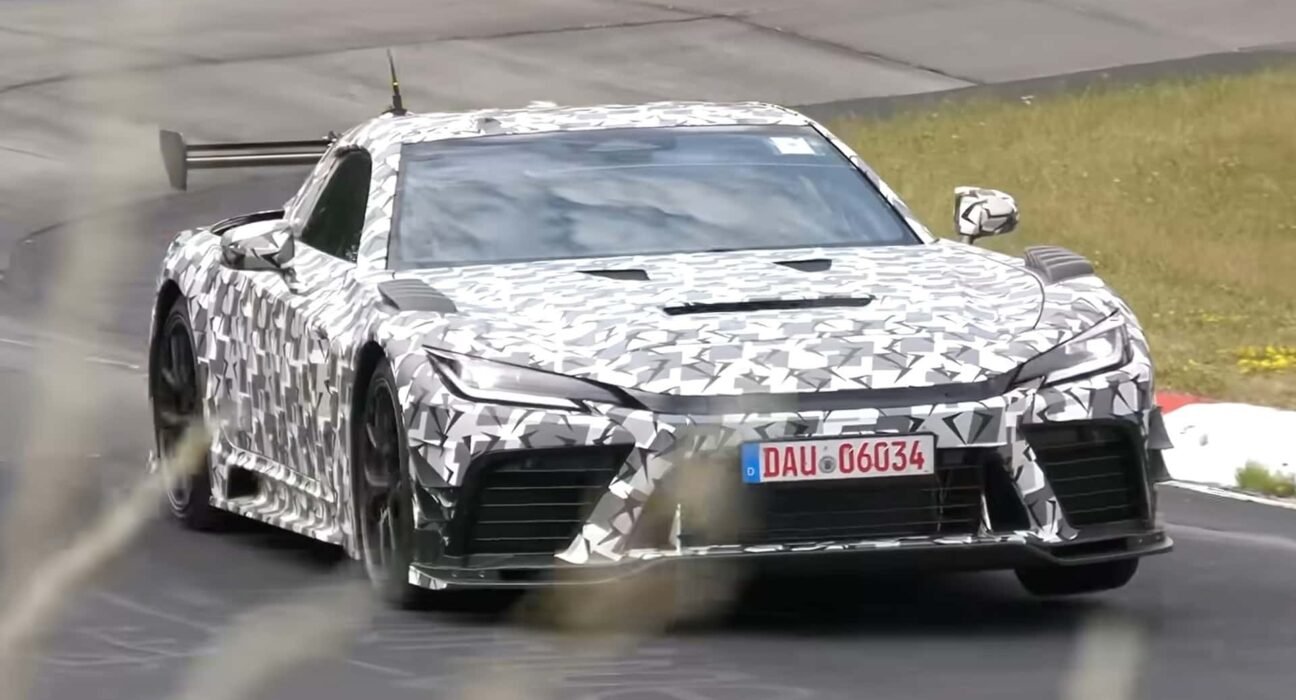
- Toyota is testing a track-focused, road-legal GR GT in Germany.
- The wild prototype has a swan-neck rear wing and fender louvers.
- Other changes include the front splitter and bumper canards.
Toyota’s long-awaited supercar finally broke ground last December, but the mid-engine V8 machine won’t launch until next year. Meanwhile, a new spy video shows that the prototypes have returned to the Nürburgring for further testing to iron out any last-minute glitches. This is not the regular GR GT clocking miles in Green Hell, as the car in the paparazzi Nurburg Automotive Also seen a poor looking version.
At first glance, it might seem like Toyota has just brought out the track GR GT3, but that’s clearly not the case. The camouflaged prototype has a license plate, which is evidence that it is a road-legal version. That said, it appears to borrow bits from the race car. A new aerodynamic package includes a front splitter that extends farther than the regular model. At the rear, the swan-neck wing shows that this is not the standard version.
Although Toyota did its due diligence to hide most of the car, it deliberately left some details exposed. The front fenders now feature Porsche 911 GT3 RS-style carbon-fibre louvers, and we can also see front canards on the outer edges of the bumper. It’s fair to expect that all of these new components will be offered as part of optional packages, unless Toyota decides to launch a separate GR GT variant altogether. That said, we wouldn’t expect something like GRMN to arrive so early in the model’s life cycle.

The spy footage from the Nordschleife shows both versions of the GR GT running side-by-side, making it easy to spot the differences between them. Don’t expect the hotter model to ditch the hybrid powertrain, as the prototype still has the yellow sticker that all electrified vehicles must display during testing at the famous German circuit. This is a safety requirement that helps track marshals and first responders quickly identify vehicles equipped with high-voltage systems in the event of an accident.
Track-focused packages rarely bring more power, as automakers usually focus on improving aerodynamics. As a result, this hardcore GR GT can retain the same combined outputs of 641 horsepower and 627 pound-feet (850 Newton-meters) from its twin-turbocharged 4.0-liter V8 engine and electric motor. However, these figures are not final, as they apply to development cars, and Toyota has not ruled out getting even more performance from the production version.
Whether engineers will reduce additional weight through more extensive use of carbon fiber is unclear. Even if they do, significant weight loss is unlikely to occur. As a reminder, Toyota estimates that the regular GR GT will weigh 3,853 pounds (1,750 kg) or less, which is a respectable figure for a hybrid V8 supercar.
The GR GT uses Toyota’s first all-aluminum body frame, and the company plans to share it with another model. Lexus is bringing the LFA back in 2027 as an all-electric supercar based on the same lightweight platform as the V8-powered flagship. Whether its body panels will also use aluminum and carbon-fibre-reinforced plastic like the GR GT remains to be seen. Either way, the EV will inevitably be heavy. Even if it adopts the solid-state batteries mentioned in recent reports, the electric LFA is highly unlikely to match the weight of the GR GT, let alone undercut it.


32
Source: Toyota
Motor1’s Opinion: Toyota is determined to take on the Germans on their home turf with the GR GT. But competition is still not stable. Mercedes-AMG is developing a new Black Series model with equally extreme aerodynamic upgrades and a menacing race-car-for-the-road vibe.
With emissions regulations tightening around the world, we may be seeing the final chapter for V8-powered supercars.
Source:
Nürburg Automotive / YouTube