The Autumn Stafford Sale is coming to Bonhams; To be precise, in October 2026. If you’re a motorcycle history buff like me, it makes for an excellent viewing experience even from a distance; You never know what is going to come up, nor what kind of rabbit holes it will take you down when you start researching. And while I’ve talked about the Yamaha Townmate before, something we haven’t discussed before is Yamaha’s first attempt at a Super Cub of its own.
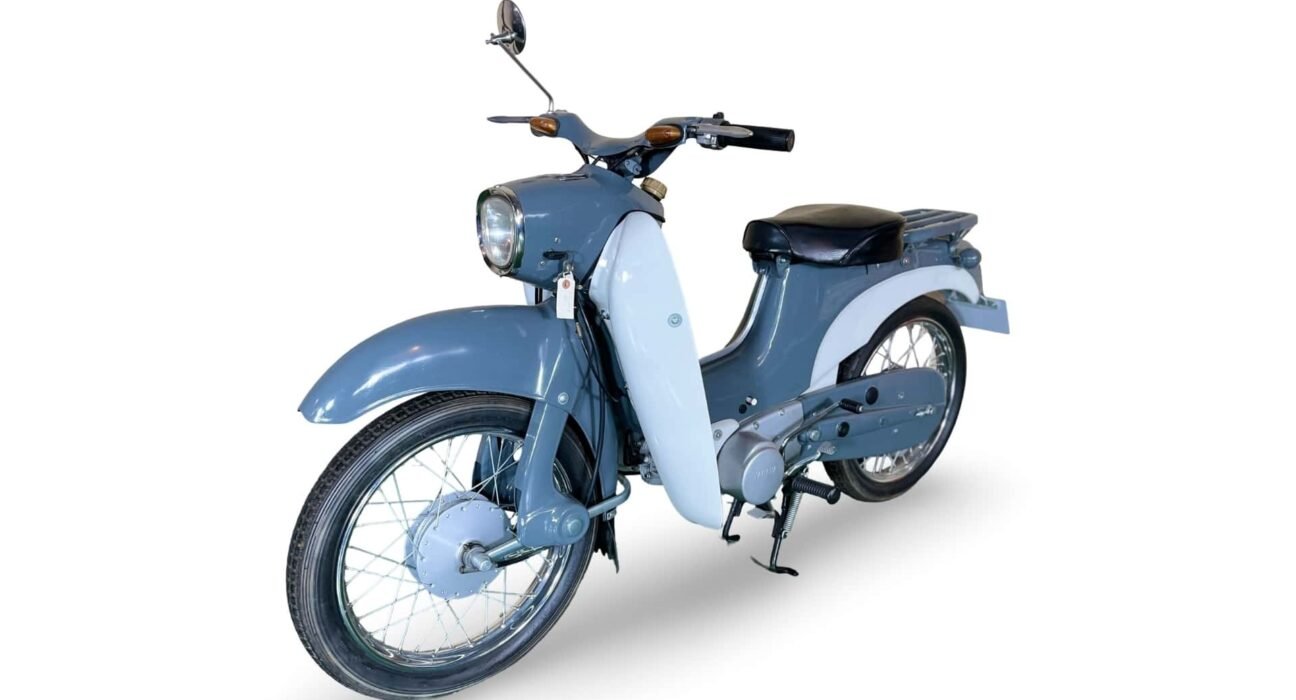
This is the Yamaha MF-1, on which Team Tuning Fork says it ultimately based its Mate (and later iterations) moped line. Styling-wise, you can definitely see the similarity between the MF-1 and the original Super Cub.
When Honda introduced the Super Cub in 1959 (after it was first announced in 1958), reportedly 24,000 of the cute little guys were sold within the first five months of its release. The following year, Honda’s official history of the Super Cub states that it sold “approximately 167,000 units”. The same history states that at that time, Japan’s total motorcycle sales (across all manufacturers) were approximately 300,000 per year.


Left: Original Honda C100 Super Cub. Right: Yamaha MF-1
You can see why competitors like Yamaha would want a piece of that particular pie, right? In developing the Super Cub, Honda invented the automatic centrifugal clutch system that it still uses on the model today; In fact, that was the reason they invented it. Takeo Fujisawa and Soichiro Honda wanted to make operating the Super Cub as easy as possible, so they developed this unique clutch solution for use on this small four-stroke machine.
It was a bike for everyone; Young, old, men, women; Absolutely Everyone. It required at least 4 horsepower (at the time of production it was finished at 4.5), the better to deal with the fact that less than 10% of Japan’s roads were paved at the time of its release. In the development of the Super Cub Honda had to persuade a spark plug manufacturer to make special spark plugs for it, as well as a tire manufacturer to make special tires to fit the 17-inch wheels (much smaller than the standard 24 to 26-inch diameter in use on many other Euro mopeds).
5
Source: Bonhams
Of course, a year or two later, competitor Yamaha came out with the MF-1. While the visual similarities are undeniable, the mechanical differences were significant. The MF-1 only produced a claimed 3.4 horsepower (about 25% less over the Super Cub), and the engine was two-stroke, not four-stroke like the Super Cub. (As you may or may not know, Soichiro Honda famously hated two-strokes and didn’t want to build them.)
The MF-1 had a point in terms of technological advancement: in addition to a standard kickstart, it also had an electric starter added in 1960. In Yamaha’s archives, it also talks about the use of a Neidhart-type front suspension paired with an Aligo rear suspension for added rider comfort.
At Bonham’s upcoming Autumn Stafford sale in 2026, you can score a great deal Buy this example of the MF-1 and make it yours. It’s up for auction on October 11, 2026, has been restored, and even comes with a key. According to Bonhams, the engine is turned over and has 2,224 kilometers on the clock.