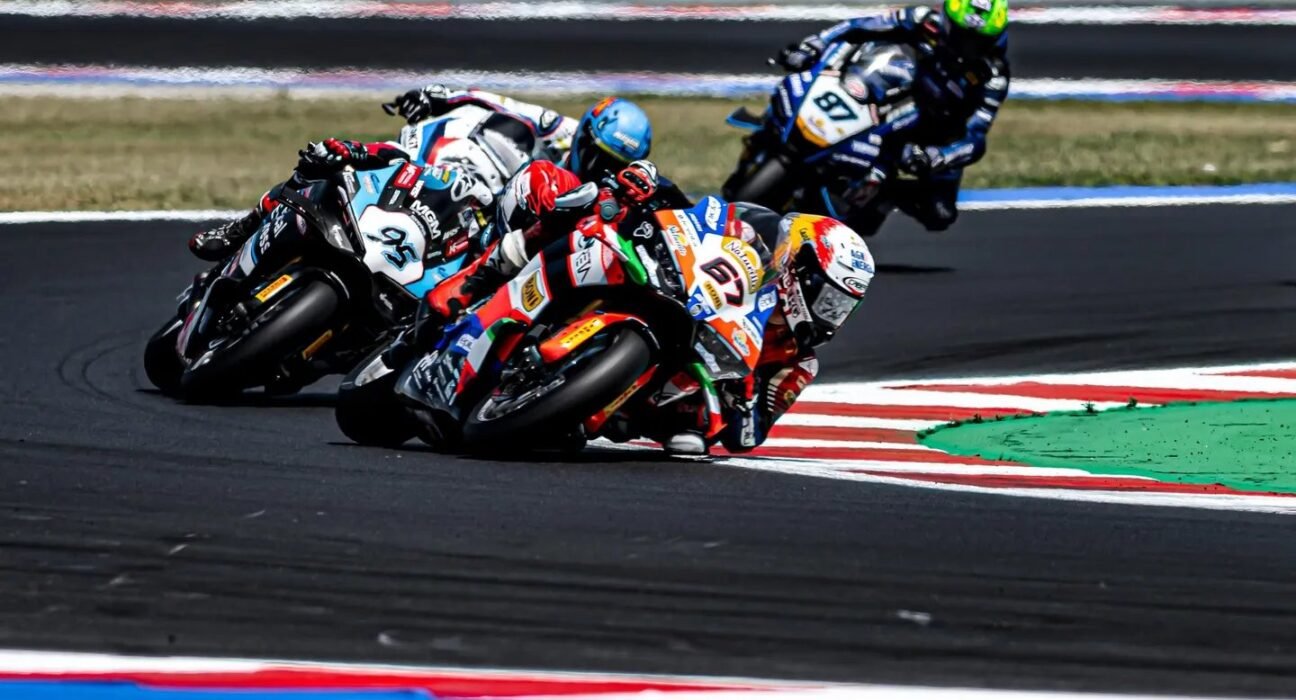
At first glance, the Ducati Panigale V4 R, BMW M1000 RR, Honda CBR1000RR-R Fireblade SP, Yamaha YZF-R1 or Kawasaki Ninja ZX-10RR competing in the Superbike World Championship look almost identical to the machines sitting in the dealership. This is not a coincidence. WorldSBK rules require manufacturers to race production-based motorcycles. However, while the foundation is the same, the finished race bike is dramatically different, benefiting from countless engineering improvements that turn it into one of the fastest production-derived motorcycles in the world.
Unlike MotoGP, which is built around pure prototypes, WorldSBK starts from a homologated production motorcycle. The chassis, engine architecture and many structural components must remain faithful to the road-going model. This requirement creates a direct link between racing and showroom motorcycles, but it also leaves room for extensive customization within the technical regulations.
Homologation is only the beginning
Manufacturers must first produce a road-legal homologation model before entering WorldSBK. That’s why motorcycles like the Ducati Panigale V4 R, BMW M 1000 RR, Honda CBR1000RR-R Fireblade SP, Kawasaki Ninja ZX-10RR and the Bimota KB998 Rimini exist in the first place. They provide the best possible starting point for racing development while remaining available to customers.
However, once those bikes reach the race workshops, they undergo an extraordinary transformation.
The engine is the same—but only on paper
The engine case remains the same as that of the production motorcycle, but internally the powerplant receives careful preparation.
Every rotating component is balanced, internal friction is reduced, tolerances are optimized and the race-spec exhaust system, cooling system, clutch and engine management dramatically improves overall performance.
While a modern litre-class superbike typically produces around 210 to 220 hp in road trim, WorldSBK machinery often exceeds 230 hp, making power delivery significantly sharper and more aggressive.
Electronics differentiates road bikes from race bikes
Perhaps no field highlights the difference more clearly than electronics.
Road motorcycles prioritize safety, emissions and everyday utility. WorldSBK bikes use sophisticated Magneti Marelli Racing ECUs capable of controlling traction, wheelies, engine braking, launch control, power delivery, fuel strategies and corner-specific calibration via GPS mapping.
Electronics have become as important as mechanical performance.
Suspension, brakes and chassis setup
Although the basic chassis remains identical, almost every surrounding component is changed.
Factory teams fit full racing Öhlins or Showa suspension systems, Brembo racing brakes and countless adjustable chassis components. Geometry, weight distribution, swingarm pivot position and suspension settings are continuously refined every race weekend to suit every rider and every circuit.
Aerodynamics and Tires
Winglets are now a familiar part of modern WorldSBK machinery, but these components must also originate from homologated production models.
Tires are another big difference. Although supplied by Pirelli, WorldSBK slicks are purpose-built racing tires with compounds and structure that bear little resemblance to road-going sports tyres.
How light are they?
Every gram counts.
Titanium fasteners, carbon fiber bodywork, magnesium components, lightweight wiring and a specially designed fuel system allow the race bike to reach the championship’s minimum weight limits while improving mass centralization.
So, are they really the same motorcycle?
Yes and no.
Yes, because every WorldSBK machine starts its life as a motorcycle that customers can buy.
No, because thousands of development hours, race electronics, bespoke suspension, professional engine preparation and constant engineering refinements enable that production motorcycle to compete at the highest level of production-based motorcycle racing.
The unique relationship between road bike and race bike is what makes the Superbike World Championship so special. Fans can recognize the machines they see on the track, knowing that their DNA is identical to the motorcycles available in dealerships – even if the finished racing package is on a completely different level.
Don’t miss a second with the new app where you can watch live timing of MotoGP, Formula 1, NASCAR, IndyCar and much more: just press – Here (Free for all users)