For decades, “premium” and “economical to run” have felt like opposite ends of the same spectrum: choose your leather-clad comfort, then be prepared for the service invoice that comes with it. But that agreement is now beginning to seem old. A new generation of buyers is discovering that some luxury nameplates now offer quiet cabins and long feature lists without the parts and labor worries that traditionally ride shotgun with German badges. This SUV is arguably the clearest example of that change yet, and it’s worth understanding why.
Updated: 2026/07/17
This article has been updated to include details and comments from our test drive of the model.
Premium ownership doesn’t mean premium costs
For years, the unwritten rule of luxury SUV ownership was simple: You paid upfront for badge prestige, and then you paid again and again, every time the vehicle needed a service, a sensor replaced, or an air suspension component repaired. European three-row SUVs in particular built a reputation for beautiful interiors with maintenance bills that can rival the value of a used car.

He is changing the calculations. Buyers are increasingly cross-shopping luxury SUVs, based not just on cabin ambience and infotainment technology, but also total cost of ownership, insurance, fuel, depreciation and, critically, how often the vehicle actually needs to go to a workshop. Lexus, long established as a brand that quietly outperforms its German rivals in terms of dependability, is at the center of this change. The brand has been ranked as the top nameplate in terms of long-term vehicle dependability for four consecutive years, a measurement focused on real-world ownership rather than first impressions. That reputation is now spreading to the area where it matters most to families: three-row luxury SUVs.
The Lexus TX blends Lexus comfort with Toyota mechanical confidence

enter the 2026 lexus txLexus’s newest and largest crossover, introduced for the 2024 model year as the brand’s dedicated three-row SUV. On the surface, it looks like every other modern Lexus, with quilted leather, ambient lighting, a 14-inch touchscreen, and a quiet, isolated cabin that prioritizes comfort over outright athleticism. The entry-level TX 350 uses a 2.4-liter turbocharged four-cylinder engine that produces 275 horsepower and 317 pound-feet of torque, paired with an eight-speed automatic transmission. Hybrid TX 500h and Plug-in Hybrid TX 550h+ variants output up to 404 horsepower For buyers who want higher sales without compromising efficiency.
Solid build quality that rewards long-term ownership

However, what separates the TX from a typical European luxury SUV lies beneath its comfort-focused body. The TX is built on the same platform as its Toyota Grand Highlander sibling and the mid-size Highlander. This is engineering with a long, proven service history, rather than a brand-new architecture that came to market. The TX is assembled in the same Indiana plant that builds the Toyota Highlander and Grand Highlander, with an additional layer of Lexus-specific quality checks on top of standard Toyota production standards. The result is a vehicle that feels like a Lexus from the driver’s seat but is based on the mechanical components Toyota has spent years refining over millions of Highlander and Grand Highlander units.
Strong resale value and low ownership costs make the TX a smart long-term buy

Depreciation is consistently the biggest cost of vehicle ownership, and this is where the Lexus TX quietly differentiates itself from almost every rival in its class. Independent resale analysis positions the TX 350 as the strongest performer for value retention among luxury six-seat SUVs, After five years it remains at about 64 percent of its original valueWell above the segment average of about 50 percent. Put another way, a TX 350 owner retains significantly more equity in his vehicle at the five-year mark than the typical buyer of a rival three-row luxury SUV. Other depreciation estimates tell a similar, if slightly more conservative, story: A TX is expected to lose about a third of its value after five years, leaving a resale figure in the mid-$40,000s from an original price closer to $67,000.

That value retention adds to the running-cost benefits discussed earlier. Low depreciation means fewer losses at trade-in or resale, predictable Toyota-adjacent maintenance keeps annual running costs under control, and Lexus’ extended warranty absorbs the early-ownership risk that lures buyers away from the new nameplate. Add strong dealer network coverage and Lexus’ generally painless ownership experience, and the TX becomes a rare thing in the luxury SUV world: a vehicle that rewards patience as much as it rewards the early purchase decision.
Shared Toyota engineering helps keep reliability high and maintenance costs predictable

This is where the “cost of running” half of the equation comes into focus. Because the TX borrowed so much from Toyota’s mainstream engineering – turbo four-cylinder, hybrid system, eight-speed transmission – it inherited some parts commonality and a mechanical track record that a scratch-off luxury platform couldn’t match in its first few years on sale.
The numbers support this, even though TX is still so young that some data sets remain thin. Recent reliability scoring has put the TX around an 80 out of 100, which is a solid figure, if not quite class-leading within Lexus’s own SUV lineup. More insightful is what happens when you zoom out to the brand level. Lexus’ average annual maintenance costs are slightly higher than the equivalent Toyota average and significantly lower than premium rivals such as BMW, Audi or Mercedes-Benz. That’s a meaningful difference in a segment where German three-row SUVs regularly rack up four-figure annual service bills after they’re a few years old.
Warranty coverage confirms the picture

Lexus backs the TX with longer bumper-to-bumper protection than its Toyota sibling, giving buyers extra peace of mind during those years when unexpected repair costs usually hit hardest: The TX has a four-year/50,000-mile extended warranty, compared to the standard coverage on the Grand Highlander. This doesn’t mean that the TX is immune from problems; It has had its share of recalls, mostly focused on the rearview camera software rather than anything structural or powertrain related. But the underlying story is one of a luxury SUV whose mechanical DNA comes from a brand that makes some of the most reliable vehicles on sale, Rather than pursue excessive complexity for one’s own self-interest.
Three rows of space, modern technology and family-friendly practicality
Running costs only matter if the vehicle actually serves the life a family needs, and here the Lexus TX earns its keep. It’s worth being precise about configuration: unlike some Lexus SUVs that offer both two- and three-row layouts, the TX is exclusively a three-row model, available in six-passenger form with second-row captain’s chairs or seven-passenger form with a traditional bench. This is a deliberate contrast with the Grand Highlander, which offers a more utilitarian seven- or eight-passenger layout aimed at maximizing occupancy over comfort.
The space for this section is really generous. Lexus engineered the third row to be a viable seating position for adults rather than just children, with 33.5 inches of legroom in the third row and a slide-assist mechanism that tilts the second-row seats forward for easy access. Cargo capacity is also increased: The TX offers 20.2 cubic feet behind the third row, 57.4 cubic feet with third row foldedAnd a maximum of 97 cubic feet with both rear rows folded, dimensions that comfortably outpace most midsize crossovers, if not full-size body-on-frame rivals like the Escalade.
Technology is where the Lexus badge most clearly earns its premium

A 14-inch touchscreen infotainment system with wireless Apple CarPlay and Android Auto, a 12.3-inch digital gauge cluster, and an optional 21-speaker Mark Levinson sound system is standard. Every TX comes with Lexus’ latest suite of driver-assistance features as standard, giving families the same active-safety net whether they choose the entry-level TX 350 or the fully loaded F Sport Hybrid. This is a cabin specifically designed for long trips with people who actually need to be comfortable for that duration, not just decently equipped to hang out in the showroom.
We tested the 2026 Lexus TX 350 F Sport AWD, and the quality was felt in every aspect


Our first impression of the TX was that the design seemed a little busy, although it undoubtedly has road presence. Extraneous side-eye glances aside, stepping into the larger TX gives occupants a familiar atmosphere, assuming they’re familiar with Lexus’s delicious brand of mature, quality-over-theater luxury.
The build quality is excellent, the materials used are premium, and the architecture is spectacular. The design angles the controls toward the steering wheel, giving Lexus an aura of driver orientation.
On the road, the TX displayed respectable athleticism, although the handling felt a little off at times – this is to be expected from a large SUV whose focus is away from corner-hugging. And despite not being as fast as Euro rivals, it’s supple and responsive enough to feel confident in emergency maneuvering situations. Ride comfort and cabin quietness are themes that are ever-present here, with road obstructions becoming a non-factor in all but the most shabby of roadways. Overall, this is a well-appointed luxury family hauler that puts passenger comfort and overall quality first.
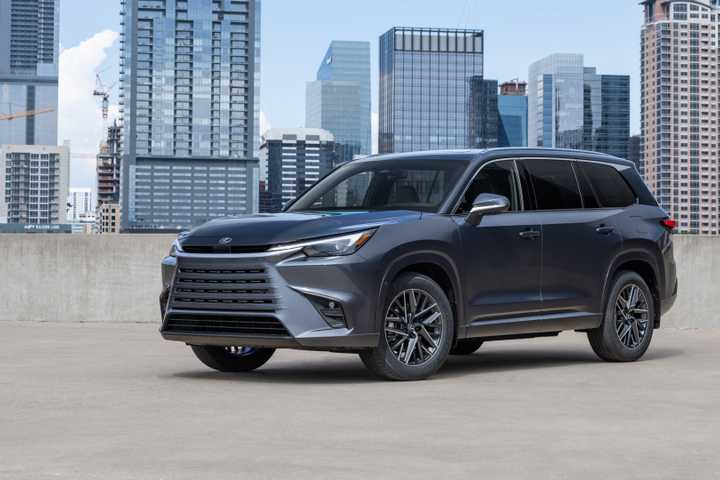

- base trim engine
-
2.5L I4 ICE
- base trim transmission
-
8-speed automatic
- base trim drivetrain
-
Front-wheel Drive
- Base Trim Horsepower
-
275 hp
- base trim torque
-
317 pound-feet
- Make
-
lexus
- Sample
-
texas
- Section
-
midsize luxury suv
Source: Lexus, CarEdge, iCars