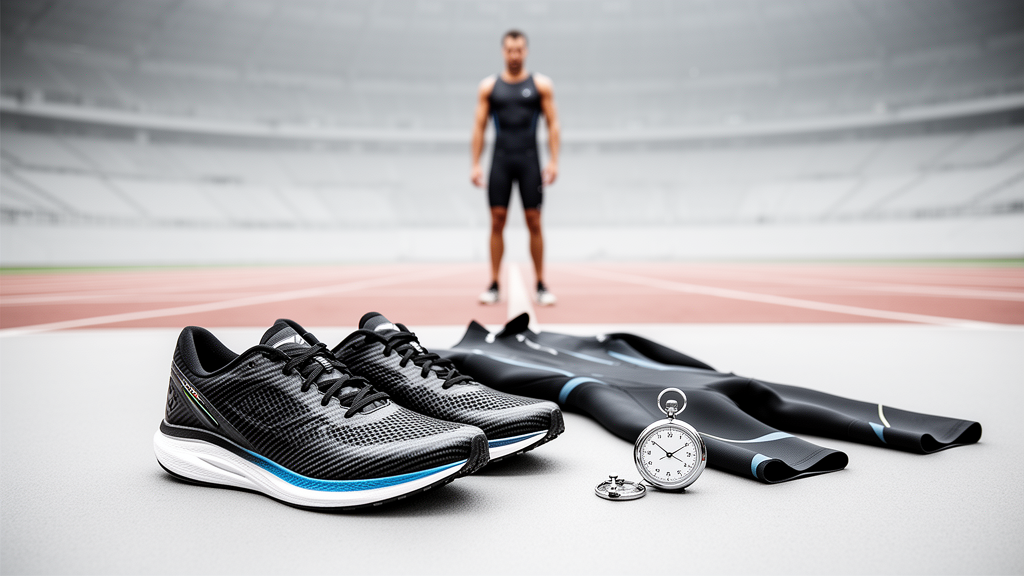
Sports researchers analyzing the ethical and mechanical implications of modern athletic equipment argue that sports fundamentally capable of being conducted without apparatus, such as swimming and distance running, require restrictive oversight to protect intrinsic human performance. In a perspective published in Frontiers in Sports and Active Living, Anton Arndt, Sigmund Loland, and Frida Williamsson examine how rapid technological advancements challenge traditional sporting principles. Swimming and running do not inherently require equipment at the boundary between the body and the surrounding environment, as human anatomy provides the natural buoyancy, propulsion, and physiological systems necessary to compete. While social norms and injury prevention necessitate garments and footwear, the authors contend that athletic outcomes in these non-technological disciplines should reflect personal prerequisites rather than engineered materials. By applying normative criteria spanning harm, fairness, the nature of sport, and ecological sustainability, the analysis outlines why sports governing bodies must establish firmer boundaries against intrusive technological innovations.
The debate surrounding technological equipment in non-technological athletics first escalated significantly through elite swimming competitions over two decades ago. Speedo introduced the full-body FASTSKIN suit ahead of the Sydney Olympic Games in 2000, where competitors wearing the equipment captured eighty-three percent of all swimming medals and broke thirteen of fifteen world records. The design was approved despite existing international regulations stating that athletes could not use devices aiding speed, buoyancy, or endurance. FASTSKIN featured textured fabric inspired by shark skin, utilizing tiny riblets to channel water flow, suppress turbulence, and diminish skin friction drag. Furthermore, the suit provided full-body compression that stabilized muscles and reduced vibration, helping swimmers maintain optimal hydrodynamics. Subsequent investigations confirmed that these early garments reduced drag while enhancing distance per stroke and decreasing oxygen consumption. This shift generated substantial controversy within the sporting community, prompting criticisms that swimming was transitioning from an assessment of bodily capacity into a demonstration of technical manufacturing.
Technological refinement accelerated in 2008 with the release of the Speedo LZR Racer, a suit engineered alongside researchers from the National Aeronautics and Space Administration. Constructed with high-density LZR Pulse fabric composed of fine nylon and elastane microfibers, the suit reportedly reduced skin friction drag by an additional twenty-four percent compared to contemporary racing materials. The garment incorporated an internal compression system that acted like a corset, while polyurethane panels flattened the torso and boosted buoyancy. During the 2008 Beijing Olympics, athletes wearing the LZR Racer claimed ninety-two percent of all medals and established multiple records. Tensions intensified further in 2009 when rival manufacturers released one hundred percent polyurethane suits, culminating in forty-three world records across forty events at the 2009 World Aquatics Championships.
A directly comparable dynamic currently defines long-distance road
A directly comparable dynamic currently defines long-distance road running following the widespread adoption of advanced footwear technology featuring embedded rigid structures and specialized foam compounds. Although carbon plates appeared in experimental running shoes in the early 2000s, modern configurations achieved unprecedented performance breakthroughs. In 2019, Eliud Kipchoge completed an unsanctioned marathon distance in one hour, fifty-nine minutes, and forty-one seconds wearing Nike Vaporfly shoes containing an embedded carbon-fiber plate and responsive midsole material suggested to improve running economy by roughly four percent. In October 2024, Ruth Chepngetich lowered the women’s marathon world record to two hours, nine minutes, and fifty-six seconds in Chicago, trimming almost two minutes off the prior mark. In 2026, Sebastian Sawe registered the first sub-two-hour performance in a sanctioned marathon race, finishing London in one hour, fifty-nine minutes, and thirty seconds wearing Adidas Adios Pro Evo 3 footwear. Every long-distance road world record between five thousand meters and the marathon has fallen since advanced footwear became prominent in 2016.
Biomechanical evaluations demonstrate that advanced footwear technology directly optimizes running economy, which represents one of the primary physiological determinants of distance running alongside maximal oxygen uptake and lactate threshold. The embedded curved carbon-fiber plate increases the longitudinal bending stiffness of the sole, functioning as a lever that reduces the work rate required at the ankle joint. This stiffened structure limits dorsiflexion at the metatarsophalangeal joint, thereby minimizing negative joint power generation and curtailing energy dissipation during toe-off. Working in synergy with the rigid plate, modern low-density midsole foams, such as polyether block amide, offer superior compliance and resilient mechanical energy return without imposing excess mass on the foot. The considerable stack height permitted in modern designs also extends the runner’s effective leg length, which contributes to lower metabolic costs during locomotion. Because conventional coaching methods find running economy challenging to alter compared to cardiovascular conditioning, mechanical interventions have become the chief conduit for dramatic performance increases.
Available statistical evidence indicates that the performance advantages conferred by advanced footwear technology are not uniformly distributed across athletic demographics. Observational analyses of competitive distance running reveal disproportionate benefits for female athletes relative to their male counterparts across events spanning five thousand meters to the marathon. Specifically, elite marathon data showed average finishing time improvements of zero point eight percent, or one point two minutes, for male runners, compared to one point six percent, or three point seven minutes, for female runners. This doubled relative response rate has caused the historical performance gap between sexes to narrow noticeably. The underlying cause does not appear to stem from sex-specific physiology or simple anthropometric measurements, but remains tied to complex inter-individual interactions among running mechanics, baseline physiological parameters, and shoe structural design. Consequently, standardizing equipment access across a field does not guarantee equal competitive opportunity, because identical mechanical interventions yield divergent physiological adaptations among individual athletes.
Evaluating innovative sports equipment under health and injury
Evaluating innovative sports equipment under health and injury considerations yields largely inconclusive evidence across both sports. Medical reviews from the polyurethane swimsuit era recorded superficial traumas, including finger ulcerations, blisters, and extensive limb bruising caused by donning exceptionally tight garments, alongside unverified concerns regarding circulatory restrictions from rigid compression. In distance running, the biomechanical alterations induced by advanced footwear technology present conflicting health outcomes across clinical studies. Some investigations link rigid carbon plates and high stack heights to altered lower-extremity loading, potentially elevating risks for bone stress injuries and complaints involving the Achilles tendon, foot, ankle, and knee. Given the lack of definitive proof that performance-enhancing equipment directly harms athletes, the authors conclude that injury considerations cannot serve as the decisive criterion for regulatory prohibition.
Environmental evaluations demonstrate that innovative equipment in non-technological sports imposes substantial ecological burdens without delivering compensatory sporting value. High-performance swimsuits and advanced running shoes rely heavily on non-biodegradable synthetic polymers and carbon fibers whose manufacturing processes require aggressive chemical treatments and present intractable recycling difficulties. Furthermore, these products exhibit remarkably brief functional lifespans. Midsole foams made from polyether block amide lose mechanical properties rapidly compared to conventional ethylene-vinyl acetate; experimental testing shows that after four hundred and fifty kilometers of running, polyether block amide midsoles suffered a two point twenty-eight percent decrease in running economy advantage. Single-race models like the Adidas Adizero Adios Pro Evo 1 illustrate an extreme consumer pattern prioritizing fleeting performance over durability.
Faced with corporate commercial interests and accelerating engineering cycles, sports governing bodies encounter significant operational friction when regulating technological performance enhancements. Sport governing bodies frequently struggle because commercial manufacturers make substantial financial investments, coordinate multidisciplinary engineering teams, and execute high-stakes marketing campaigns around competitive breakthroughs. When governing bodies delay regulatory interventions, as occurred during the decade preceding the 2010 ban on polyurethane swimsuits, retroactive restrictions disrupt commercial investments and disparage athletic accomplishments. World Athletics attempted a proactive approach by enforcing rules in 2020 and revising them in 2026, including mandates requiring competitive shoes to be commercially available to all competitors. However, ensuring retail availability does not resolve ethical challenges regarding technological dependence or unequal individual responsiveness. Unrestrained innovation risks turning elite contests into equipment demonstrations, placing governing bodies under intense commercial pressure while eroding the clear distinction between athletic talent and mechanical assistance.
To establish durable regulations, the authors suggest shifting
To establish durable regulations, the authors suggest shifting oversight toward measuring direct mechanical properties rather than attempting to quantify complex individual biological responses. Adopting theoretical frameworks that separate direct footwear effects, like isolated midsole energy return, from mediated physiological responses allows governing bodies to enforce objective mechanical thresholds for competition eligibility. Such standards align with the philosophical foundation of sporting games, which Bernard Suits defined as voluntary attempts to overcome unnecessary obstacles. Unlike technological sports where machines constitute the activity, swimming and running achieve meaning through human bodily exertion alone. Arndt, Loland, and Williamsson conclude that competitive integrity requires athletic challenges that optimize skill over mechanical efficiency. In pursuit of true fairness and equal opportunity, governing bodies should restrict extraneous equipment, preserving the principle that victories belong exclusively to intrinsic athletic performance—ideally manifested through athletes running barefoot and swimming unassisted.
Subject of Research: Ethical and technical evaluation of performance-enhancing technologies in non-technological sports
Article Title: You can swim naked, you can run barefoot. Performance-enhancing technologies in non-technological sports: a restrictive view
Article References: Arndt, A., Loland, S., & Williamsson, F. (2026). You can swim naked, you can run barefoot. Performance-enhancing technologies in non-technological sports: a restrictive view. Frontiers in Sports and Active Living, 8, Article 1984980. https://doi.org/10.3389/fspor.2026.1984980
DOI:10.3389/fspor.2026.1984980
Keywords: sports technology, advanced footwear technology, performance enhancement, technological doping, sports ethics, swimsuit regulations, running economy, Speedo Fastskin, LZR Racer, carbon-fiber plate, PEBA foam, marathon world records, World Athletics, FINA regulations, sports fairness, equal opportunity, running biomechanics, environmental impact, non-technological sports
News. Sports Ethicists Urge Strict Limits on Performance Enhancing Swimming and Running Technologies. Scienmag