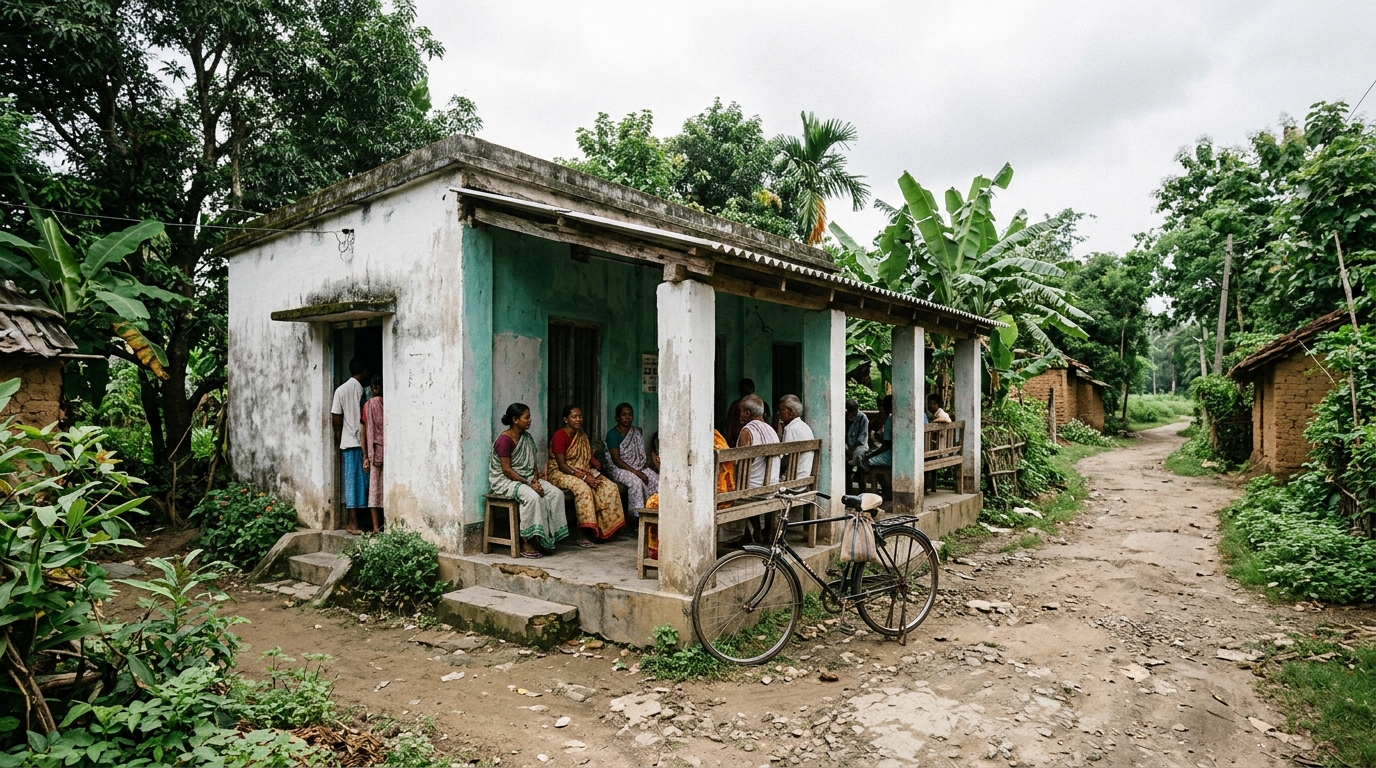
A qualitative study published in Discover Health Systems examines the lived experiences of community members interacting with rural Sub-Centres in West Bengal, India. The research, led by Mir Azad Kalam and Saptamita Pal, investigates how trust, accessibility, and community participation shape the functioning of these primary healthcare facilities. The study focuses on two specific Sub-Centres located in the Sovanagar Gram Panchayat area of Malda District, providing a detailed look at the intersection of healthcare delivery and social dynamics in a rural setting.
The investigation adopted an exploratory qualitative design to capture the nuanced perceptions of local residents and frontline health workers. The research team purposively selected twenty-four participants from the two Sub-Centres, ensuring a balanced representation of six male and six female individuals from each site. Additionally, four Accredited Social Health Activists, known locally as ASHA didis, and two Auxiliary Nurse Midwives were included to provide perspectives from the healthcare workforce. All participants had utilized services at the health centre at least four times within the preceding six months, ensuring they had sufficient engagement to reflect meaningfully on their experiences.
Data collection involved semi-structured interviews and two focus group discussions, conducted face-to-face within the premises of the health centres to ensure privacy and cultural appropriateness. The interviews, which lasted between 30 and 45 minutes, explored three thematic areas: the services provided, barriers to use, and recommendations for improvement. The focus group discussions, ranging from 60 to 70 minutes, allowed for broader community-level perspectives on the health centre’s inclusivity and functionality. The data were analyzed thematically using Braun and Clarke’s six-phase framework, facilitating an in-depth understanding of how community members perceive and engage with the health centre as a functional and social space.
Five major thematic domains emerged from the analysis:
Five major thematic domains emerged from the analysis: knowledge and experiences about the health centre, practice and accessibility, challenges in service delivery, gender and power dynamics, and the role in community health. Participants generally valued the Sub-Centres for their affordability and accessibility, particularly for vaccinations, routine check-ups, and maternal services. However, the depth of knowledge about available services was uneven, with some participants unaware of supplementary provisions such as nutrition advice or mental health support. This uneven awareness contributed to missed opportunities for care, highlighting a gap between the services offered and the community’s understanding of them.
Physical accessibility was a significant concern, with participants noting that while the centres were conveniently located for nearby residents, structural barriers persisted. During the rainy season, roads often became flooded, making it difficult to reach the facilities. Service timing and availability were also unpredictable, with some patients reporting that doctors were not present when they arrived, forcing them to return the next day. These disruptions added to the inconvenience for villagers who had to plan their visits carefully, often balancing healthcare needs with agricultural and daily wage labour responsibilities.
Challenges in service delivery were prominent, with participants frequently citing inadequate infrastructure and irregular staff availability. Long queues and a lack of seating arrangements were common, particularly during peak hours or special camp days. Patients often had to wait outside in the sun, which was especially burdensome for older adults, pregnant women, and caregivers attending with children. The absence of sufficient facilities created an atmosphere of neglect and inconvenience, undermining the quality of the patient experience. Participants also reported issues with cleanliness and sanitation, including dirty toilets and unclean waiting areas, which raised concerns about safety and hygiene.
Gender and power dynamics played a crucial role
Gender and power dynamics played a crucial role in shaping healthcare access and participation. Women emerged as the primary users of the facility, particularly for maternal care, child health, and vaccinations. However, this regular usage did not always translate into comfort or empowerment within the health system. Some participants reported rushed or insensitive interactions, particularly during procedures, which reinforced feelings of disempowerment despite routine contact with the health centre. Men, on the other hand, tended to use services only when experiencing acute symptoms, a pattern tied to cultural expectations around masculinity and reluctance to seek preventive care.
Women’s autonomy in healthcare decision-making was often constrained by household hierarchies, with male members frequently controlling when and whether health services were accessed. This dynamic could delay or restrict timely utilization of services, highlighting the intersection of gender and social power in rural healthcare. Community health workers, particularly ASHA workers, played a crucial role in encouraging women to access preventive and routine health services. Their proactive engagement in disseminating information and facilitating service uptake helped bridge the gap between institutional healthcare and rural households, fostering trust and improving health-seeking behavior.
Despite these challenges, the Sub-Centres functioned as vital public spaces where healthcare, social interaction, and community participation intersected. Participants described the centres as trusted and indispensable sources of affordable primary care, instrumental in raising health awareness and promoting hygiene and vaccination. The centres served as hubs where villagers not only sought treatment but also gathered to exchange information and engage in shared practices of health responsibility. This dual role as both a healthcare provider and a communal space contributed to building social capital and strengthening resilience at the village level.
The study highlights the need for strengthening Sub-Centres
The study highlights the need for strengthening Sub-Centres through consistent policy implementation, equitable resource allocation, and participatory governance. Addressing infrastructural deficits, ensuring consistent medical staffing, and empowering ASHA workers are critical steps toward enhancing the inclusivity and responsiveness of primary healthcare institutions. The findings suggest that conceptualizing primary healthcare as both a clinical and civic space can offer a pathway toward more equitable and responsive public health in rural India, aligning with global calls for participatory health governance and the achievement of Sustainable Development Goals.
Limitations of the study include its context-specific nature, conducted within a limited number of health centres in a particular rural setting. The findings may not be fully transferable to other rural contexts, where socio-cultural dynamics, health system organization, and resource availability may differ. The cross-sectional design captures perceptions at a single point in time and does not account for changes in experiences or service delivery over time. Future research should aim to address these limitations by expanding the scope to multiple health centres across different districts or states and incorporating the perspectives of administrators and local policymakers.
This research contributes to the understanding of how rural health centres function as socially embedded institutions that extend beyond biomedical functions to serve as public spaces promoting collective well-being. By examining the interplay of trust, accessibility, and community participation, the study provides valuable insights for policymakers and healthcare providers seeking to improve the effectiveness and equity of primary healthcare services in rural India. The emphasis on the role of ASHA workers and the importance of gender-sensitive approaches underscores the need for a multidimensional strategy to address the persistent challenges facing rural healthcare systems.
The study was situated within the broader context
The study was situated within the broader context of India’s three-tier rural public healthcare system, where Sub-Centres serve as the most peripheral level of care. These facilities typically cover a population of approximately three to five thousand residents and are staffed by a Community Health Officer, an Auxiliary Nurse Midwife, and a network of Accredited Social Health Activists. In the specific study area of Sovanagar Gram Panchayat, the two selected Sub-Centres served a catchment population of roughly 3,000 to 4,000 residents. The local economy is predominantly rural, with livelihoods based on small-scale agriculture, daily wage labour, and informal occupations. This economic context is significant because, despite the centres offering free services, participants reported hidden costs associated with healthcare. For instance, some residents had to purchase medicines not available at the centre from outside pharmacies, a burden that was particularly acute for economically disadvantaged households who could not afford private doctors.
Service delivery at these sites included a range of essential primary healthcare activities, such as blood pressure and blood sugar monitoring, haemoglobin testing, antenatal and postnatal care, immunization, and family planning counselling. Basic diagnostic services, including fetal monitoring via Doppler assessment, were provided without cost, making the centres accessible to vulnerable populations. However, the availability of medical supplies was a recurring concern. Participants noted that while basic medicines like paracetamol and folic acid tablets were present, essential drugs for chronic conditions such as diabetes and blood pressure were frequently missing. This inconsistency in supply chains undermined trust in the public health system and led some regular visitors to consider stopping their visits or seeking alternative care, highlighting the tension between policy intent and ground-level resource constraints.
The role of ASHA workers in this system was described as pivotal, extending beyond their official duties to ensure essential health services reached underserved populations. These community-based health workers, often referred to locally as ASHA didis, engaged in house-to-house visits to inform residents about available facilities, vaccination schedules, and health programmes. Their efforts were crucial in addressing stigma around healthcare and family planning, gradually gaining community acceptance. Despite their dedication, ASHA workers faced significant challenges, including low salaries and the need to perform duties typically reserved for senior staff when doctors were unavailable. They reported that handling low-risk procedures without adequate supervision was risky for both themselves and the patients, underscoring the systemic weaknesses in the delivery chain and the reliance on low-level staff for basic medical tasks.
Infrastructure and environmental conditions also played a significant
Infrastructure and environmental conditions also played a significant role in shaping the patient experience. The physical state of the buildings was a source of frustration, with participants and health workers alike noting damaged structures and inadequate seating. During the rainy season, the limited space for providing services became even more constrained, and one centre was located near the River Kalindri, an area affected by regular riverbank erosion. Sanitation issues, such as dirty toilets and unclean waiting areas, were frequently mentioned, with some participants feeling that the environment was unsafe for children. These physical barriers, combined with the lack of shaded waiting areas, contributed to a sense of institutional neglect and diminished the dignity of the healthcare experience for vulnerable groups, including the elderly and pregnant women.
The study’s findings align with broader global evidence on rural health systems, where infrastructural limitations and workforce shortages continue to hinder equitable access to primary healthcare. The researchers noted that the centres often functioned as sites of selective primary healthcare, focusing on targeted interventions like maternal and child health rather than providing a fully integrated approach. This pattern reflects a persistent disconnect between policy frameworks, such as the National Rural Health Mission and Ayushman Bharat, and the realities of rural service delivery. By framing the Sub-Centres as public spaces rather than just clinical facilities, the study highlights the importance of social context in shaping health outcomes. The findings suggest that strengthening these institutions requires not only biomedical improvements but also a recognition of the social and power dynamics that influence community engagement and trust in public health services.
Subject of Research: Experiences of trust, accessibility and community participation in rural sub health centres in West Bengal
Article Title: Experiences of trust, accessibility and community
Article Title: Experiences of trust, accessibility and community participation in rural sub health centres in West Bengal
Article References: Kalam, M. A., & Pal, S. (2026). Experiences of trust, accessibility and community participation in rural sub health centres in West Bengal. Discover Health Systems, 5(1), Article 54. https://doi.org/10.1007/s44250-026-00394-z
DOI:10.1007/s44250-026-00394-z
Keywords: Experiences, trust, accessibility, community, participation, rural, health, centres, West, Bengal, scientific research
News. Rural Health Centres in West Bengal Face Trust and Access Gaps. Scienmag