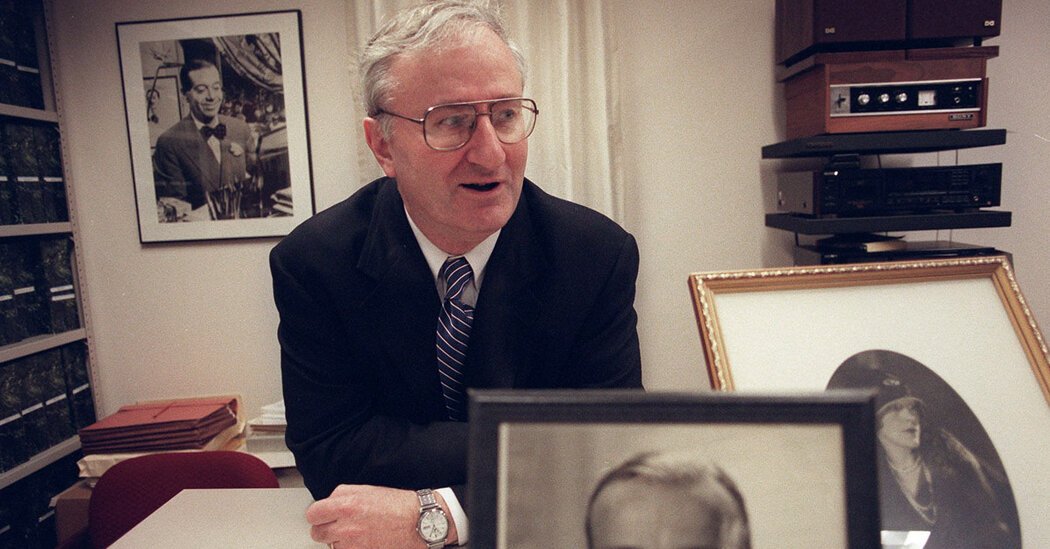
Robert Kimball, a musical theater historian and champion of the American popular song who unearthed hundreds of pieces long considered lost and helped rediscover the work of the seminal black Broadway songwriting team of Noble Sisley and Eubie Blake, died Wednesday in Manhattan. He was 86 years old.
His death in a hospital was confirmed by his wife Abigail Kimball and his son Philip.
Mr. Kimball often acted like the song’s Indiana Jones, such as when he helped excavate a treasure trove of manuscripts by George Gershwin, Cole Porter, Richard Rodgers and many others, which was found in a warehouse in Secaucus, N.J., in 1982.
The collection dates back to the advent of sound pictures, when Warner Bros., the film studio responsible for the landmark 1927 talkie “The Jazz Singer,” purchased several music publishing houses to meet its new soundtrack needs.
After half a century, largely untouched and forgotten in about 80 boxes, the holdings included approximately 70 previously unknown songs by Gershwin, including the missing scores of some of his brief musicals; Over 175 unreleased songs by Jerome Kern, including a half-hour musical cut from “Show Boat” from shortly after its 1927 premiere; Manuscripts by Vincent Youmans, Victor Herbert, Sigmund Romberg, Rudolf Friml and other masters; and original orchestrations by leading Broadway orchestrators such as Frank Sadler, Hans Spialek and Robert Russell Bennett.
“The first envelope I opened, it said ‘Cole Porter’ on it, it had songs I’d never heard – and I’m a Cole Porter scholar and biographer,” Mr. Kimball. told The Los Angeles Times in 1987, when he and a team of experts had finally finished cataloging the material. “I sat there stunned.”
Mr. Kimball fell in love with the Broadway musical after seeing “Annie Get Your Gun” as a child. After majoring in American studies at Yale, from which he graduated in 1961, he wrote his graduate thesis on the music of the late 1920s.
After a brief period in politics, he returned to Yale for law school, graduating in 1967, and in his final year was asked to help organize the papers left to the university by Cole Porter. Mr. Kimball served as curator of Yale’s American Musical Theater Collection from 1967 to 1971.
He later told The Boston Globe, “Instead of working for the Justice Department or a big law firm, this is what I did.” “A lot of people thought I was a bit of a fool.”
He was also the music and dance critic for The New York Post; an artistic advisor to Cole Porter and the Ira Gershwin estate; The author, with collaborators, lavishly illustrated biographies of Porter and the Gershwins; and editor of editions of the complete songs of Porter, Lorenz Hart, Ira Gershwin, Irving Berlin, Frank Loesser, and Johnny Mercer.
In 1973, Mr. Kimball teamed up with composer William Bolcom to write the book “Reminiscing with Sissel & Blake,” which documented the songwriting team’s career and included interviews with both men. It helped put his immense contributions — particularly the 1921 hit musical “Shuffle Along,” a black theater landmark, which was adapted and revised on Broadway in 2016 — back into the spotlight.
When Mr. Kimball contacted Mr. Sisley in the late 1960s, the black musician and songwriter was about to throw out his old files and memorabilia; She didn’t think anyone was interested in them.
“And by this miracle we were able to get there on time,” Mr. Kimball recalled in a 2016 interview on the NPR show “Fresh Air.”
“We had no idea how close we were to losing this extraordinary legacy,” he said. ‘Well, if you’re interested in it,’ Sisley said, ‘I’ll call my old friend and we can go out and meet him in Brooklyn.’ Sisley took us to 284A Stuyvesant Avenue, where Eubie and Marion Blake lived. And UB welcomed us there, and the afternoon I spent was one of the most memorable afternoons of my life.
Robert Eric Kimball was born on August 23, 1939 in New York City to Morris Kimball, who had his own plastics firm, and Eve (Shulman) Kimball.
In 1962, after graduating from Yale, he worked for liberal Republican Representative John V. Lindsay, who would later serve as Mayor of New York. In the fall of 1963, Mr. Kimball became director of the Republican Legislative Research Association, which was formed to help draft and advance civil rights legislation. In 2021, he published a memoir about this period, “Crisis and Compromise: Defending the 1964 Civil Rights Act.”
In 1972, he married Abigail Kuflick, a longtime writer and editor at Newsweek. In addition to him and his son, he is survived by his daughter, Miranda Swaffield, and three grandchildren.
In 1971, following the publication of “Cole,” the biography Porter wrote with New Yorker journalist Brendan Gill, Mr. Kimball received a call from Irving Berlin.
“I was a little shocked, I have to say,” Mr. Kimball told The Boston Globe. “He wanted to talk with me about Cole Porter. He probably talked for a couple of hours. It was the first of many phone conversations we had over the years.”
Of all the songwriters Mr. Kimball discovered, “Mr. Berlin,” as he always insisted on calling him, was probably his favorite. Every Christmas until the composer’s death in 1989, at age 101, Mr. Kimball would take a group of carolers to Berlin’s home in Manhattan to sing “White Christmas” and other songs under his window.
Yet Mr. Kimball never completely abandoned his critical approach. “Irving Berlin,” he said, “also wrote some of the worst songs ever published – as he said himself.”
Mr. Kimball recalled giving the great musician this solace: “Well, Babe Ruth did a lot, too.”
ash woo Contributed to the reporting.